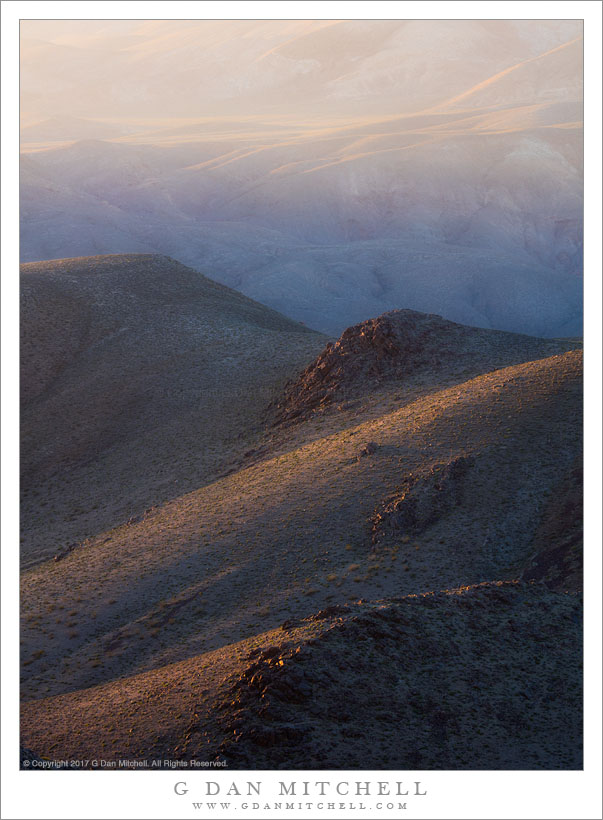
Soft light and haze in the evening high in the Panamint Mountain Range, Death Valley National Park
From a high point along the ridge of the Panamint Mountains, there are stupendous views in all directions — north and south along the spine of the range, east into Death Valley and on to Black Mountains and beyond, west across the lower Panamint hills as they drop toward the Panamint Valley only to rise again and eventually culminate in the Sierra Nevada crest. Early and late in the day the low angle light sweeps across the terrain and reveals large and small features of the landscape.
On this evening it was quite hazy, probably because high winds had whipped up sandstorms in lower elevation areas. This dust filled atmosphere can seem to glow from within when back-lit, and as I pointed my camera down toward these western slopes I began to see that luminescence. In a way there is nothing special in this photograph — a nearby ridge, and intervening valley, and more ridges in the distance. But the further ridge is still in the warm-colored, evening light, whose color contrasts with the cooler blue tones of the shadowed ridges.
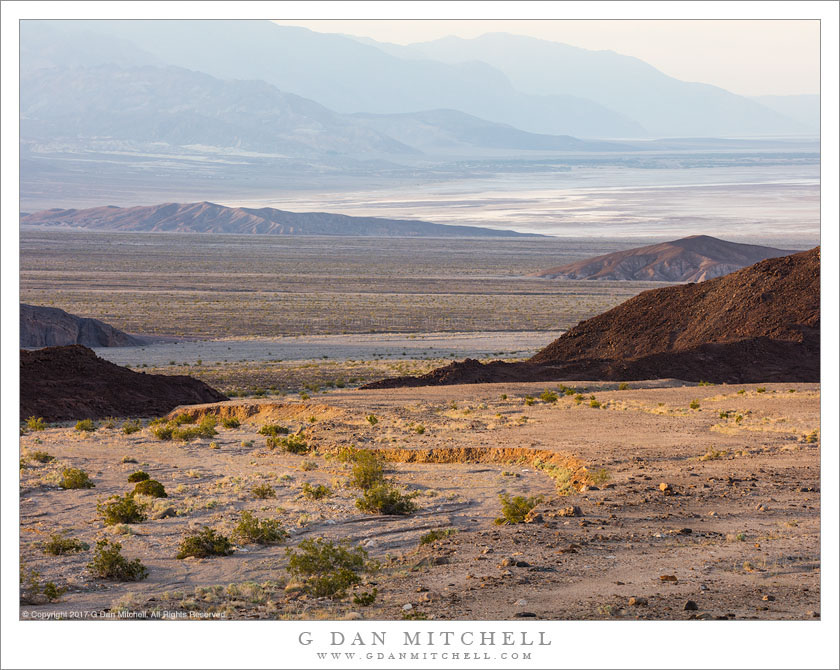
Morning light on a desert wash, hills on an alluvial fan, salt flats, and distant mountains of Death Valley National park
As I wrote in a previous message describing this Death Valley trip, one of the areas I decided to focus on this time was this one — a location along a fairly well-known Death Valley route that includes a vast alluvial fan, cut by washes, interrupted by hills of darker rocks, and always with extensive long views of surrounding mountains and off int the distant reaches of the valley itself.
This time I went in the early morning. I arrived before sunrise, set up, and watched as the morning began to unfold. From this location I could see a huge range of terrain. The highest point in the park at more than 11,000′, Telescope Peak, poked up above the bulk of the Panamint Range and caught the first dawn sunlight. Far to the west I could see the upper slopes of the Cottonwood mountains, and soon the sun lit them, too. The light slowly worked its way down from the mountains and before long fingers of morning sunlight reached the valley floor. I made this photograph while some distant parts of the valley were under cloud shadows, but when the light was beginning to shine on the desert wash at the base of the small hill from which I photographed.
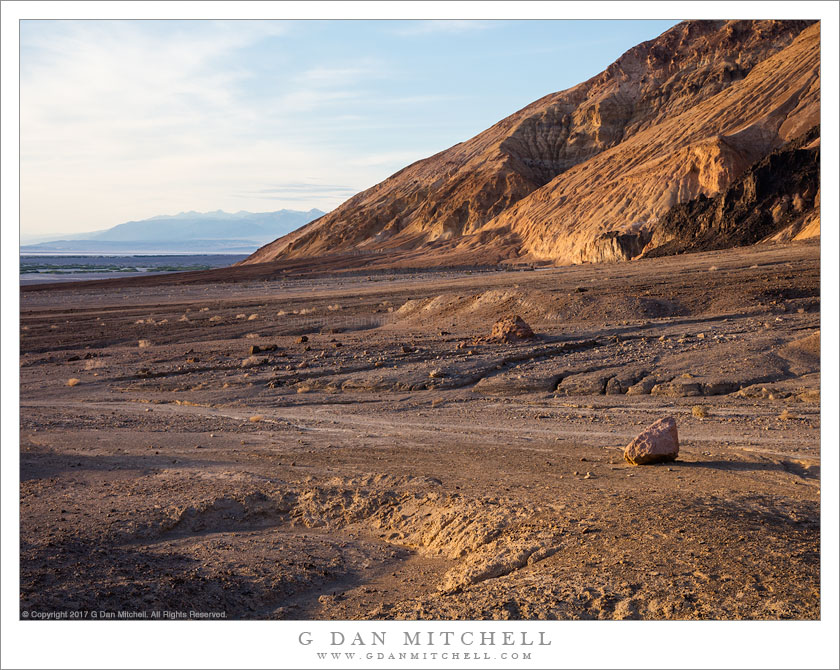
Evening light on golden hills and a wash at the base of the Black Mountains
I often use a sort of scheduling strategy when photographing in Death Valley. I get up before dawn and start with some subject that works will in the first light, and then I work a second subject that is promising in somewhat later light. Following a midday break (spent in camp or perhaps traveling to a more distant location) I reverse course later in the day, starting with a subject that works in non-golden hour light and then moving to one that works well around sunset and beyond. If conditions are right, I may even add a night subject! The second morning subject and the first afternoon subject are often canyons of one sort or another, where the edge-of-the-day light can be too dim, but where later light from a higher sun can be wonderful.
I had begun this afternoon’s photography with such a subject, one of the canyons along the eastern side of the valley. In the 90 degree plus afternoon heat I loaded up my pack with camera gear and water and slowly wandered into a narrow canyon where there was beautiful shade and somewhat moderated temperatures. Eventually it was time to return from the canyon and I reversed course and emerged from the mouth of the canyon during golden hour. This time I didn’t even have to travel to the final location since I was already there! At the time I made this photograph the long shadow of the Panamint range had stretched almost all the way across the valley and would soon steal the light from these hills, but for a few moments the golden light produced lengthy shadows and a colorful glow on the hills and along the wash emerging from the canyon.
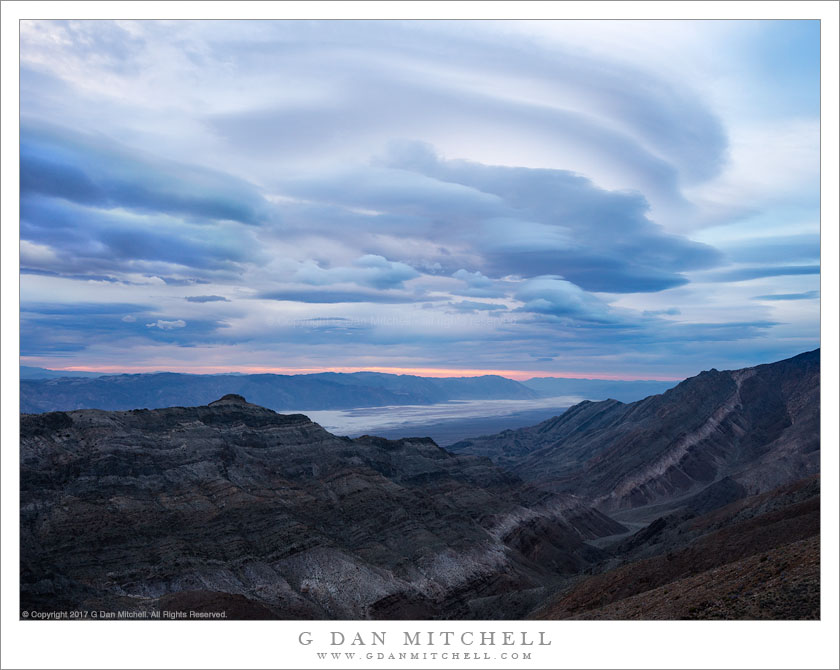
Lenticular clouds build over the Black Mountains before dawn, Death Valley National Park
Death Valley can be a tough place in general and a tough place for photography in particular. My recent trip in April of this year might be a case in point. The photography was not easy, and I faced different sorts of challenges almost every day. During the morning and evening hours when I typically look for “golden light” subjects, I had rather thick clouds on almost each day. Wind is often a challenge in the park, and this trip was no exception. And with the wind comes dust — yes, I dealt with dust storms on multiple days. On one morning I arrived at what I thought was my location in pre-dawn murky light, loaded up a pack, and wandered out into the landscape… only to realize once the light came that I was in the wrong place! While this sort of thing can make the photography edge a bit more difficult, I know that it comes with the territory, so I’m philosophical about it. If you are out there enough to encounter astonishing conditions, it is not a surprise when you find yourself at the opposite end of the bell curve on occasion. And when this does happen, if I just open myself to the terrain and look more carefully I can almost always find something.
On my second-to-last day of photography in the park I packed up my camp and left one of the popular campgrounds, with a plan of putting myself in a more isolated location, one of several that I had in mind. However, as I drove up the Valley a storm wind began to rise from the south, and soon clouds of dust and sand were filling the air and blowing north towards the places I thought I would visit. I wasn’t in the mood for camping in a dust storm so I switched gears and decided to head up into the Panamint Range where I thought the terrain might give me some protection. I arrived and set up my “camp” (which, in this case, was mostly my vehicle, in which I would roll out a sleeping bag), and almost immediately clouds filled the sky and a strong wind raced through the campsite. I hunkered down, at some dinner, and realized that this was not going to be a photography evening. The next morning, my final in the park on this trip, I was up and out of the campground at around 5:00, heading out on a gravel road to a high place with a grand panorama. As the first light appeared it became clear that the clouds had not gone away, and my hopes of a colorful sunrise were not going to be rewarded. I arrived at the destination to find that gale-force winds were raking the summit ridge. But I was there, I had my camera, I figured something might happen, so I got out and watched the sky lighten. Soon I saw this remarkable lenticular cloud formation to the southwest above the Black Mountains.
Photographer and visual opportunist. Daily photos since 2005, plus articles, reviews, news, and ideas.
Manage Consent
To provide the best experiences, we use technologies like cookies to store and/or access device information. Consenting to these technologies will allow us to process data such as browsing behavior or unique IDs on this site. Not consenting or withdrawing consent, may adversely affect certain features and functions.
Functional
Always active
The technical storage or access is strictly necessary for the legitimate purpose of enabling the use of a specific service explicitly requested by the subscriber or user, or for the sole purpose of carrying out the transmission of a communication over an electronic communications network.
Preferences
The technical storage or access is necessary for the legitimate purpose of storing preferences that are not requested by the subscriber or user.
Statistics
The technical storage or access that is used exclusively for statistical purposes.The technical storage or access that is used exclusively for anonymous statistical purposes. Without a subpoena, voluntary compliance on the part of your Internet Service Provider, or additional records from a third party, information stored or retrieved for this purpose alone cannot usually be used to identify you.
Marketing
The technical storage or access is required to create user profiles to send advertising, or to track the user on a website or across several websites for similar marketing purposes.

 G Dan Mitchell is a California photographer and visual opportunist. His book, “California’s Fall Color: A Photographer’s Guide to Autumn in the Sierra” is available from Heyday Books and Amazon.