
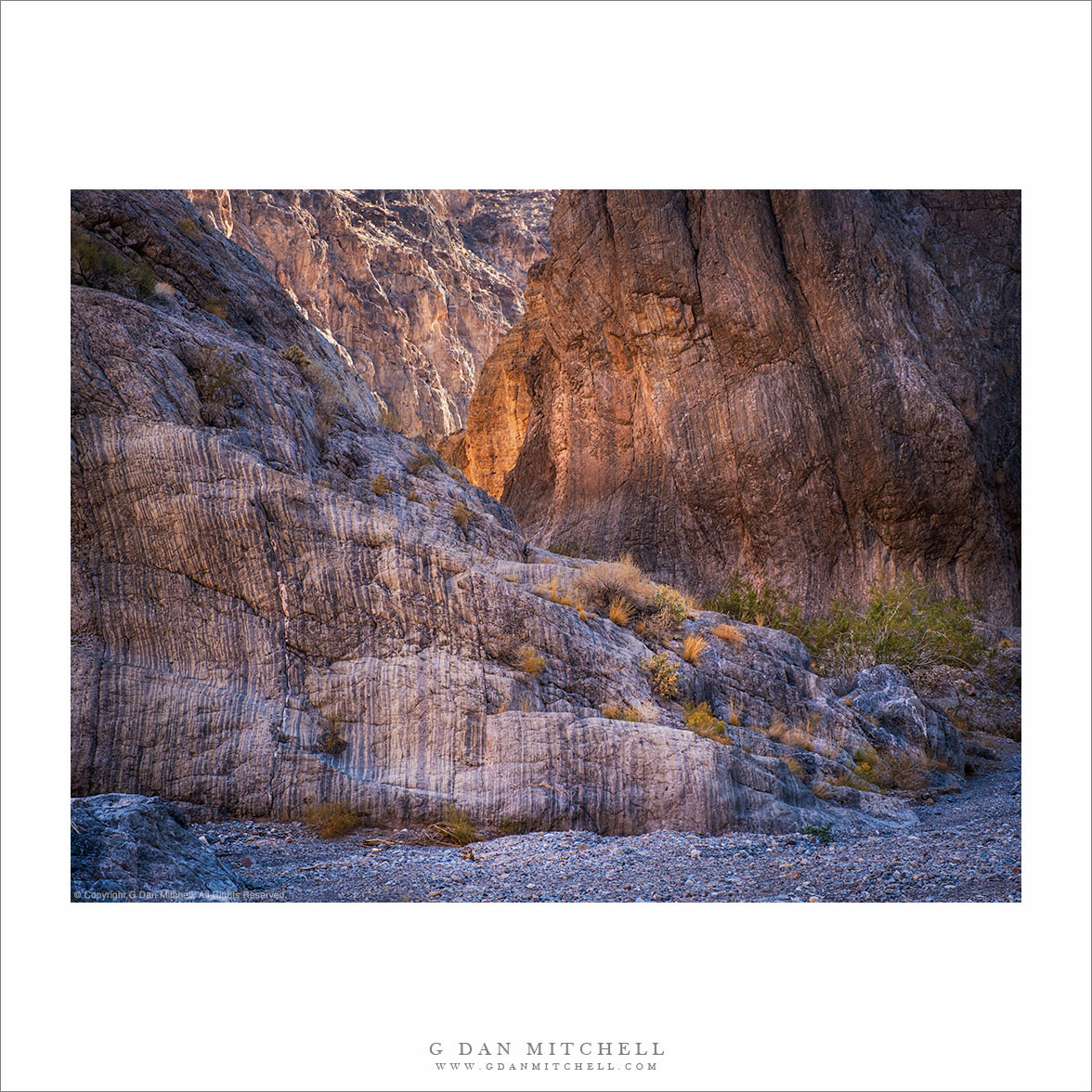
We love fantastically narrow and twisty slot canyons, but those are more of the exception to the rule. You can find those in Death Valley, but more likely you’ll find a scene like this one, at least in canyons that run through steep, rocky mountain ranges, like this one on the east side of the valley. Through much of its length it is more than wide enough that a vehicle could pass, if they were allowed here. Note also the very rugged and broken rock formations — this is not your smooth-walled Utah red rock canyon!
At this spot the canyon takes a couple of very sharp bends around the tall face to the right. When the trend of the canyon lines up the right way, very little direct sunlight penetrates all the way down. Instead the canyon bottom is often in shade, but that shade is filled with soft, reflected light that has bounced between the canyon walls. When I hike these canyons I always look forward to passing through these spots.
G Dan Mitchell is a California photographer and visual opportunist. His book, “California’s Fall Color: A Photographer’s Guide to Autumn in the Sierra” (Heyday Books) is available directly from him. Blog | Bluesky | Mastodon | Substack Notes | Flickr | Email
4 responses to “Canyon Light”
-
Love this shot! The longer I look at it the more I like it. Forgive me for being such a pendant, but I am so moved by the intricacies of the light in this photo.
Nice, tight composition of three separate layers: the far layer in direct sunlight; the middle, golden layer and the “giant’s foot” in the foreground. At first glance my eye was drawn to the well defined textural striations of the foreground in a seemingly softer, bluer, open shade type light. But no! It’s actually strongly directional (from the left, reflected by ?) which makes the vertical striations really pop. The far layer is being illuminated by the sun’s direct rays coming from the right, which is how we know the foreground light from the left is reflected (assuming no auxiliary lighting). The middle golden layer is the real mystery. The bright gold color and intensity of the light is greater at the left edge and gradually falls off into open shade light at the far right. The reflected light source must be something close by and behind the “giant’s foot” that is strongly reflecting the sun’s rays. It’s almost like the photographer laid out a large gold colored tarp to act as a reflector. But I doubt that. More likely it’s a warm colored rock formation that is serving as the reflector. Beautiful.
Whatever the case…this is an amazing photo! I love it when a photo strikes you at first and then even more so as your eye roams around and you try to figure out why you like it so much. In the final analysis, it’s no surprise how often it comes down to the “Light” and we are then reminded that the Greek root of “photography” is “light drawing”.
Nice work Dan!
Charlie Colladay
-
Thanks Charlie,
YOu certainly have an eye for light!
The combination of layers and light is pretty much what this photograph is “about.” As you surmised, there are three kinds of ight (at least) at work in the photograph. OK, maybe four.
There is the direct sunlight on the far canyon wall. Then there is the light reflected from a(n out of sight) reddish section of cliff that illuminates the middle face. The foreground light is coming from behind and above my camera position — a combination of more reflected light and light from the open sky. The forth kind of light? The deeper shadows with the more blue tones.
One of the things I love about these canyons is precisely that variety of lighting, and especially the way that the light picks up colors from the sky and from whatever surface reflects it.
Dan
-
-
Dan:
It reminds me of Dedeckera Canyon over at the Eureka Dunes.
-
Thanks for sharing that. I’ve been to Eureka several times, but I have never investigated that canyon.
Dan
-


(All media © Copyright G Dan Mitchell and others.)
Join the discussion — you are welcome to leave a comment or question. (Comments are moderated and may not appear immediately.)