
Tag Archives: early

Morning Light, Haze, El Capitan

Morning Light, Haze, El Capitan
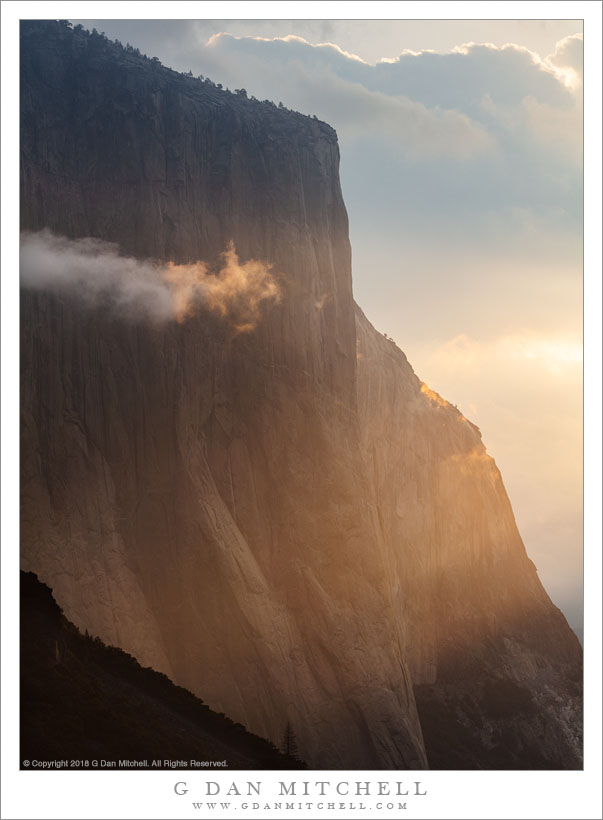
Beams of early morning sunlight pass through haze to illuminate El Capitan

Morning Light, Haze, El Capitan. © Copyright 2018 G Dan Mitchell – all rights reserved.

Beams of early morning sunlight pass through haze to illuminate El Capitan

I’m coming to think of the start of this particular day in lower Yosemite Valley as being “Bierstadt Day.” Albert Bierstadt was a landscape painter who made several notable renderings of Yosemite subjects in the 1800s, paintings that perhaps formed the image for the park for many who saw them. They are not “realistic” in a photographic sense, but tend toward exaggerating features and using dramatic effects of perspective, atmosphere, and light. When I see Bierstadt paintings I often think both of how they evoked the wonder of seeing remarkable places like Yosemite Valley and of how flexibly and subjectively he treated these subjects. I also think about how little they look like the literal place, as least in objective sense.

However, at certain moments, the quality of light and atmosphere came close on this morning. The morning began inauspiciously, and in the pre-dawn light I could tell that it was cloudy and gray. However, as I approached the Valley from Wawona there were breaks in the clouds. Arriving at my first clear viewpoint, the iconic tunnel view (where I usually wouldn’t stop on my way into the Valley), the view included the usual Valley features, layers of drifting clouds and mist, and beams of colorful light playing across this landscape. I put a long lens on my camera and began to follow the changing conditions, picking out small sections of the grand view that seemed most interesting. At the moment of this photograph (and, indeed, the light lasted only a moment) sun beams broke through the clouds and moved in front of the face of El Capitan.


G Dan Mitchell is a California photographer and visual opportunist. His book, “California’s Fall Color: A Photographer’s Guide to Autumn in the Sierra” is available from Heyday Books and Amazon.
Blog | About | Flickr | Twitter | FacebookGoogle+ | LinkedIn | Email


All media © Copyright G Dan Mitchell and others as indicated. Any use requires advance permission from G Dan Mitchell.
Egret, Blue Hour Fog

Egret, Blue Hour Fog
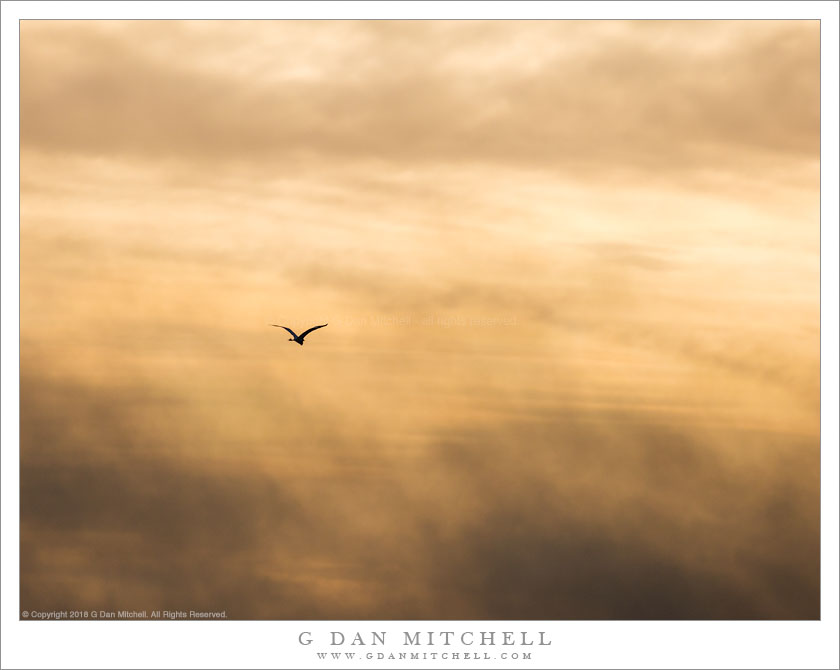
An egret hunting in blue hour fog

Egret, Blue Hour Fog. © Copyright 2018 G Dan Mitchell – all rights reserved.

An egret hunting in blue hour fog

For those who don’t know the term, “blue hour” is that twilight period when the light tends to become soft and blue, most likely because the primary illumination is from the blue sky itself, with no assistance from direct sunlight. You might not notice the depth of the blue color of the light if you don’t think about it carefully or look at a photograph. Our eyes adjust to the color and see things as being “normal,” but the camera records (more or less) “what is.” Most often when people refer to blue hour they are referencing that period of early twilight — just after the red sunset tones have faded, but before it becomes extremely dark. Of course, there are two “blue hours” every day – one before sunrise and one after sunset.

I usually start my bird photography before it becomes light, and I frequently have to wait a bit before starting to photograph. On this morning it was exceptionally murky — not only was it still dark, but the tule fog was very thick. Eventually I looked for subjects that I could photograph in this challenging light. You are never far away from an egret in places like this, and it wasn’t long before I came upon one that was hunting in the nearby vegetation. In many cases I might try to compensate for the blue tones and the darkness, but here I instead decided to “go with the blue” and produce a photograph that feels more like such mornings actually feel.


G Dan Mitchell is a California photographer and visual opportunist. His book, “California’s Fall Color: A Photographer’s Guide to Autumn in the Sierra” is available from Heyday Books and Amazon.
Blog | About | Flickr | Twitter | FacebookGoogle+ | LinkedIn | Email


All media © Copyright G Dan Mitchell and others as indicated. Any use requires advance permission from G Dan Mitchell.
Departure

Departure
waves of Ross’s geese lift off into foggy early morning winter sky

Departure. © Copyright 2018 G Dan Mitchell – all rights reserved.

Waves of geese lift off into foggy early morning winter sky

There are many ways in which geese may depart, and almost any time I watch them I think about when and how they will leave. They might leave one or two at a time, perhaps circling around and returning, or possibly simply flying a short distance to a more interesting spot nearby. They might begin a mass departure by leaving in small groups of perhaps a half-dozen or a few more. The geese in this photograph were leaving in what might be described as waves — groups of perhaps a dozen or two lifting off at once and forming into lines as they headed to the north. There is also that most spectacular event, when many thousands of them erupt into the air simultaneously, with a shocking sound of thousands of wings along with their cries.

On this winter morning we arrived before dawn, as always, and watched as ground fog formed over the wetlands. We did not find the spectacularly large flocks that we sometimes see but there were groups still settled into ponds. As the first light arrived they began to fly away, first a few, then larger groups, until very soon all of them had left.


G Dan Mitchell is a California photographer and visual opportunist. His book, “California’s Fall Color: A Photographer’s Guide to Autumn in the Sierra” is available from Heyday Books and Amazon.
Blog | About | Flickr | Twitter | FacebookGoogle+ | LinkedIn | Email


All media © Copyright G Dan Mitchell and others as indicated. Any use requires advance permission from G Dan Mitchell.
Sandhill Cranes, Morning Light

Sandhill Cranes, Morning Light
A group of sandhill cranes flies in early morning light

Sandhill Cranes, Morning Light. San Joaquin Valley, California. January 1, 2017. © Copyright 2017 G Dan Mitchell – all rights reserved.

A group of sandhill cranes flies in early morning light

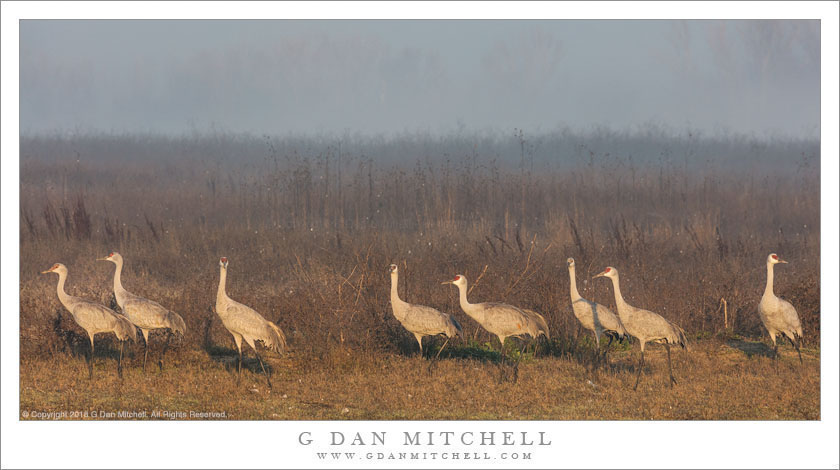
It wasn’t that long ago when I first began to photograph the birds in the San Joaquin Valley. I was oblivious to their presence for many, many years — which is strange, since I have traveled across that valley for decades on my way to and from the Sierra and other locations. Perhaps a bit more than a decade ago I got my first hint on a long drive to Seattle, when I passed through the Sacramento Valley and was shocked to see huge flocks of geese in the evening sky. Later, almost as an accident, a friend mentioned a location where there are sandhill cranes and, looking for something to photography, I went off to find the spot and, again, thousands of birds. From that time forward, photographing the birds in fall and winter has become a passion.

At first it was the geese that got my attention. Anyone who has seen flocks of thousands of snow geese or Ross’s geese suddenly fill the sky, or who has heard the sound they make will understand why them made such an impression. But somehow the cranes have become more and more the birds that define these places for me. Their call is like that of no other bird that I know, and they are often heard before they are seen. Their manner of flight is often more sedate than that of geese, and they often tend to fly at low elevations and in straight lines. This group flew overhead in the early morning light.


G Dan Mitchell is a California photographer and visual opportunist. His book, “California’s Fall Color: A Photographer’s Guide to Autumn in the Sierra” is available from Heyday Books and Amazon.
Blog | About | Flickr | Twitter | FacebookGoogle+ | LinkedIn | Email


All media © Copyright G Dan Mitchell and others as indicated. Any use requires advance permission from G Dan Mitchell.