Tag Archives: geology

Detail, Red Cathedral

Detail, Red Cathedral
“Detail, Red Cathedral” — The eroded and fluted face of the Red Cathedral, Zabriski Point, Death Valley National Park.

I have recently posted other photographs made in the area of Zabriskie Point in Death Valley, including one other of this feature sometimes known as the Red Cathedral. It stands to the right of the more famous and recognizable parts of the Zabriskie Point Landscape where, for example, Manley Beacon is one of the most well-known visual icons in the park.

This detail photograph was made using a long lens very shortly after the first morning light had arrived on this feature. In my experience, getting good light on Red Cathedral can be a tricky thing. Parts of it face away from the sun and towards Death Valley and because its face is deeply fluted it can be tricky avoiding blocked shadows. But increasing exposure too much creates problems with saturated colors on the brightest strata that cut through its face. If you shoot it in the morning, light somewhat softened by some high clouds can be helpful, and that is what I had on this morning – the sun light is direct, but it is also filtered a bit by passing through broken clouds to the east.


Leave a comment or question using the form. (If you are reading this on the home page, click the article title to see the full article and the comment form.

G Dan Mitchell is a California photographer and visual opportunist. His book, “California’s Fall Color: A Photographer’s Guide to Autumn in the Sierra” (Heyday Books) is available directly from him. Blog | Bluesky | Mastodon | Substack Notes | Flickr | Email

All media © Copyright G Dan Mitchell and others.
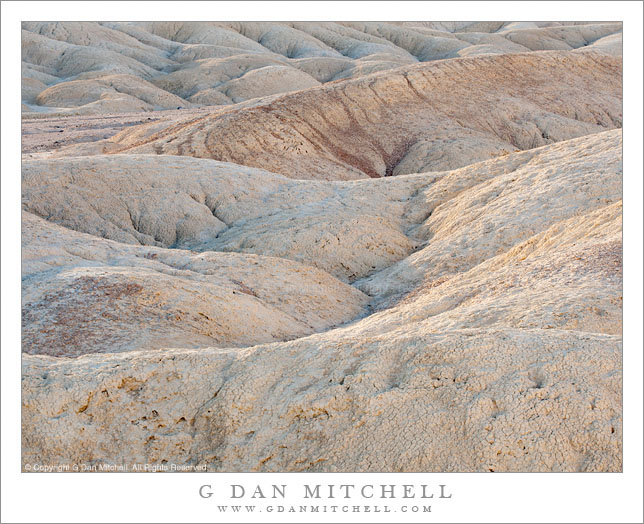
Hills and Gullies, Twenty Mule Team Canyon

Hills and Gullies, Twenty Mule Team Canyon

Hills and Gullies, Twenty Mule Team Canyon. Death Valley National Park, California. April 2, 2009 © Copyright 2009 G Dan Mitchell – all rights reserved.

Morning light across the shapes of hills and gullies, Twenty Mule Team Canyon, Death Valley National Park.

This is a photograph I made back in 2009 when I managed to get to Twenty Mule Team Canyon before sunrise and then continued to shoot for several hours. Though this area is very close to one of the most popular and oft-photographed locations in Death Valley National Park, it gets relatively few visitors from what I’ve seen. While it doesn’t generally present the huge and expansive vistas of some of the more famous areas, it is a great playground for those of us who enjoy the eroded and rounded landforms and the seemingly infinite variations of color and texture.

Here I tried to fill the frame completely with these shapes that have been produced by water eroding the relatively soft earth. The light was very interesting and a bit complex. Some diffused light was coming straight down from the sky, hence the bits of blue shadow in some of the gullies. At the same time, slightly diffused sunlight was directly striking the earth in a few spots. And in some of the foreground areas additional illumination was being reflected into the scene from nearby formations.

G Dan Mitchell Photography
About | Flickr | Twitter | FacebookGoogle+ | 500px.com | LinkedIn | Email

Text, photographs, and other media are © Copyright G Dan Mitchell (or others when indicated) and are not in the public domain and may not be used on websites, blogs, or in other media without advance permission from G Dan Mitchell.

(Basic EXIF data may be available by “mousing over” large images in posts when this page is viewed on the web. Leave a comment if you want to know more.)

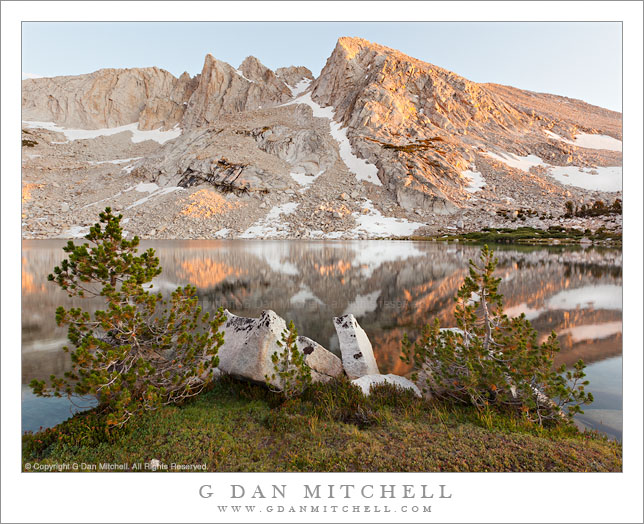
Sheep Peak, McCabe Lakes Basin, Sunset

Sheep Peak, McCabe Lakes Basin, Sunset

Sheep Peak, McCabe Lakes Basin, Sunset. Yosemite National Park, California. September 18, 2011. © Copyright 2011 G Dan Mitchell – all rights reserved.

The last light of the day touches the top of Sheep Peak in the McCabe Lakes Basin, Yosemite National Park.

This was a beautiful and fun evening! We were camped at the lower lake in this basin for a few days. The routine, roughly speaking goes something like this: Up before dawn and off to photograph some morning subject until the light goes or the energy wears down; back to camp for breakfast; do camp chores and generally hang out and shoot the breeze into the afternoon; dinner sometime around 3:00 or 4:00; then off to whatever locations is on the agenda for the evening shoot; back to camp after dark. On this evening we all were on the same page and we all headed up to this lake, a few hundred feet higher and no more than a mile from our camp.

The walk was steep but mostly pleasant, at least as long as one went relatively slowly and stayed out of the creek with its willow thickets and instead found a route through the forest nearby. Eventually the route – there is no trail – began to level out at a meadowy area below the lake. This was gave a false sense that the climb was over, but at least the walk up the meadow was very enjoyable, as the small outlet stream twisted through grassy meadow and past the occasional boulder and some trees, with the higher peaks visible above. At the upper end of this meadow was the lake’s basin, with a tall peak on top of the headwall at the upper end, forest beyond the shoreline meadows to the left, and rugged talus slopes and rocky peaks along the right shoreline.

Here we split up and looked for our own shots. As I sometimes do, I found “the spot” and more or less worked it until the light went away. I walked along the thin shoreline meadow, resisting the temptation to just set up and start shooting, and eventually came to this little group of shoreline rocks and trees that I could use as the close element of photographs of the lake and the peaks beyond as the day came to an end.

G Dan Mitchell Photography
About | Flickr | Twitter | FacebookGoogle+ | 500px.com | LinkedIn | Email

Text, photographs, and other media are © Copyright G Dan Mitchell (or others when indicated) and are not in the public domain and may not be used on websites, blogs, or in other media without advance permission from G Dan Mitchell.

(Basic EXIF data may be available by “mousing over” large images in posts when this page is viewed on the web. Leave a comment if you want to know more.)

Fractured Granite Ledges

Fractured Granite Ledges

Fractured Granite Ledges. Yosemite National Park, California. July 27, 2011. © Copyright 2011 G Dan Mitchell – all rights reserved.

Exfoliated and fractured granite ledges form patterns in late afternoon light, Yosemite National Park.

While this particular spot happens to be in the neighborhood of Tenaya Creek, similar features may be found throughout Yosemite and in many other parts of the Sierra. These rocks have probably been eroded in just about every way possible. They have been broken away from the underlying rock via exfoliation. The area was obviously glaciated. No doubt freezing water helped to widen the patterns of cracks and break up the rocks.

I made the photograph in late afternoon light when the sun was just barely above a low ridge beyond the upper edge of the photograph. The zoom was cranked out as wide as it goes in order to capture a good width and density of these wonderfully broken up rocks and the trees and other plants that somehow manage to live on and among them.

G Dan Mitchell Photography
About | Flickr | Twitter | FacebookGoogle+ | 500px.com | LinkedIn | Email

Text, photographs, and other media are © Copyright G Dan Mitchell (or others when indicated) and are not in the public domain and may not be used on websites, blogs, or in other media without advance permission from G Dan Mitchell.

(Basic EXIF data may be available by “mousing over” large images in posts. Leave a comment if you want to know more.)