
Tag Archives: light

Kit Fox Hills

Kit Fox Hills
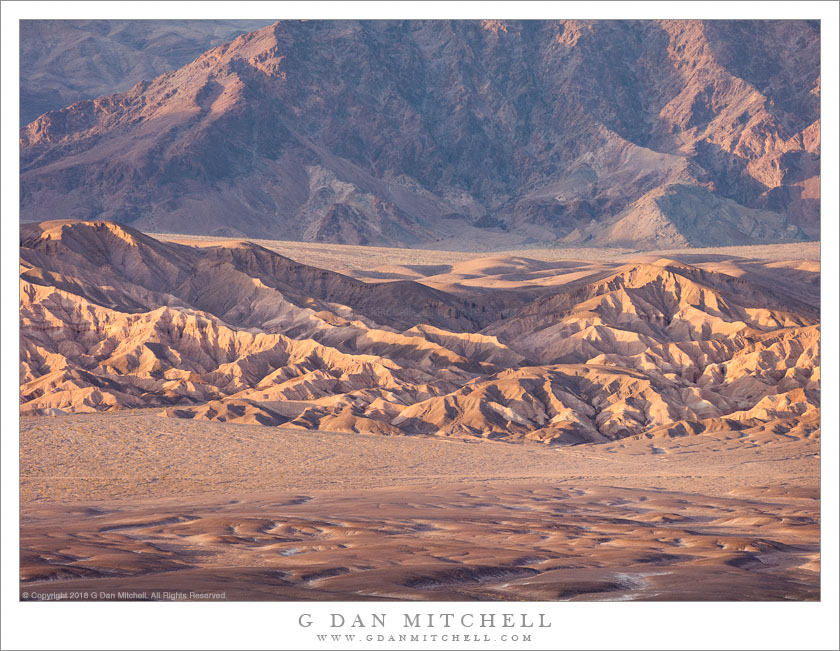
Evening light on the Kit Fox HIlls, Death Valley

Kit Fox Hills. © Copyright 2018 G Dan Mitchell – all rights reserved.

Evening light on the Kit Fox HIlls, Death Valley

This photograph was a bit of a lucky catch. I had gone to an elevated location where I had a more commanding view of a wide section of Death Valley, but late-afternoon clouds had drifted in above the Cottonwood Mountains to the west and the light ranged from filtered to “blah.” I try to “read” the clouds to predict what may come, and my reading on the conditions was that a small gap between the bottom of the cloud bank and the top of the mountains would produce a brief bit of good light just before the sun dropped beyond the peaks. These predictions don’t always pan out, but this one did. The light first appeared a great distance away at the upper end of the valley, but soon worked its way south across the Grapevine Mountains and then flowed across the low Kit Fox Hills.

I’ve been intrigued by this small row of furrowed hills for a long time. Their coloration and patterns let them stand out from the less differentiated material of the washes above and below them. I did a bit of reading about them during this recent trip, and I understand that they are a remnant of a very old earthquake fault along the west side of the valley. (There are fault zones along the sides of Death Valley, separating the rising mountains from the valley, which is largely filled with material washed down from the mountains.)


G Dan Mitchell is a California photographer and visual opportunist. His book, “California’s Fall Color: A Photographer’s Guide to Autumn in the Sierra” is available from Heyday Books and Amazon.
Blog | About | Flickr | Twitter | Facebook | Google+ | LinkedIn | Email


All media © Copyright G Dan Mitchell and others as indicated. Any use requires advance permission from G Dan Mitchell.
Dunes, First Light

Dunes, First Light
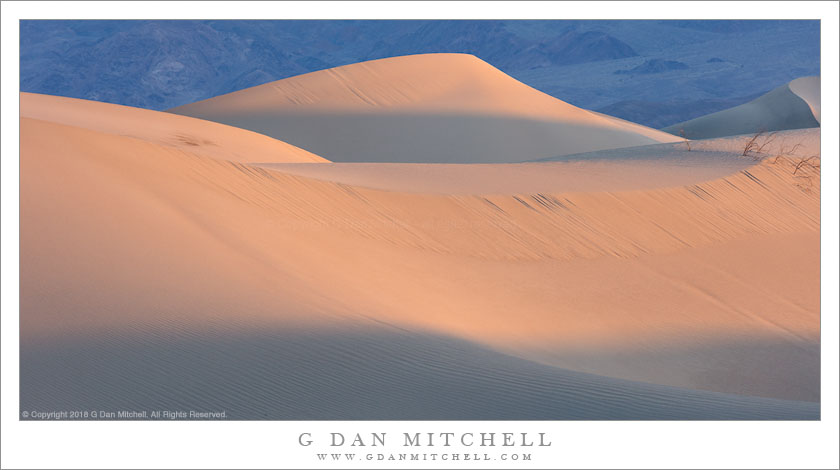
First light on Death Valley sand dunes

Dunes, First Light. © Copyright 2018 G Dan Mitchell – all rights reserved.

First light on Death Valley sand dunes

No matter how many times I experience it — and I’ve experienced it a lot! — the instant when the first sunlight suffuses the landscape is always magical. Invariably, it sneaks up on me, even though I plan to be there for it and have probably calculated the precise time of the light’s arrival. Perhaps it is because I’m engaged in photographing the pre-sunrise light, a phenomenon that also is transitory. To this day, it still somehow surprises me when this light arrives in complete silence and stillness. Somehow it seems like there should be music or a rising wind… but it is just the light.

Sand dunes provide unending possibilities for photography, and they are a remarkable canvas on which the light can paint. In the middle of the day this sand would be a sort of bland off-white color. But for a few moments at the start and end of the day the sand takes on almost gaudy colors of sky and sunlight, and the soft shadows both emphasize the forms of the dunes and produce their own shapes and lines. Non-photographers probably wonder how we can force ourselves out of bed a couple hours before dawn and drive or hike long distances the pre-dawn darkness. We wonder how the rest of the world can sleep through it!


G Dan Mitchell is a California photographer and visual opportunist. His book, “California’s Fall Color: A Photographer’s Guide to Autumn in the Sierra” is available from Heyday Books and Amazon.
Blog | About | Flickr | Twitter | Facebook | Google+ | LinkedIn | Email


All media © Copyright G Dan Mitchell and others as indicated. Any use requires advance permission from G Dan Mitchell.

Trees In Sun, Cliff In Shadow

Trees In Sun, Cliff In Shadow
Sun from behind an ice-rimmed granite monolith lights a row of trees at the edge of a meadow

Trees In Sun, Cliff In Shadow. © Copyright 2018 G Dan Mitchell – all rights reserved.

Sun from behind an ice-rimmed granite monolith lights a row of trees at the edge of a meadow

I made this photograph on a day of somewhat ephemeral conditions. There had been snow the day before — light snow, but in very cold conditions. On this morning the storm had passed, but it was so cold that a thin layer of snow was still there. It was in the meadows, on the branches of trees, and collected on every small irregularity on the granite cliffs above Yosemite Valley. At the moment I made this photograph the sunlight, shining through thin clouds, had just arrived on the closest trees, while those in the distance remained in cold shadows.

The light and the snow patterns on the face of the granite monolith are remarkable. The small amount of snow — perhaps only and inch or two — brought the patterns of cracks and small ledges into relief, making visible features that we might overlook on a warmer day And the light on the cliff is rather blue since the face is illuminated not by direct sunlight, but instead by the giant “light panel in the sky,” which happens to be very blue!


G Dan Mitchell is a California photographer and visual opportunist. His book, “California’s Fall Color: A Photographer’s Guide to Autumn in the Sierra” is available from Heyday Books and Amazon.
Blog | About | Flickr | Twitter | Facebook | Google+ | LinkedIn | Email


All media © Copyright G Dan Mitchell and others as indicated. Any use requires advance permission from G Dan Mitchell.

Windows, Brick Building, Night

Windows, Brick Building, Night
“Windows, Brick Building, Night” — Light from the interior of an industrial building spills through windows and into an alley

This building was a surprise to me. As I recall from past visits, I’m pretty sure that it had been more or less abandoned at one point, and I typically found it completely dark when I photographed there at night. I specifically recall photographing around it and having to content with a very dark environment, the sort where exposures of many minutes were necessary. But on this visit I found it, instead, to be a source of light. The interior was clear and well-lit, and large expanses of windows allowed the light to spread from the building onto the surroundings.

On a slightly technical level a few things seemed notable about photographing this structure. First, it is an example of how well current photographic technology can handle some very challenging light situations. The subjects in this photograph ranged from a bare lightbulb inside the building (visible as the brightest area in the central window) to virtually black shadows on the close side of the building wall. Yet a single exposure was sufficient to capture enough image data to protect the highlights and retain some detail in even the darkest areas. The second observation has to do with the inevitable changes that time brings to places like this. I have photographed here for about fifteen years, and on this visit I saw many changes. I lamented many of them, especially the places now off limits, knocked down, or modified almost beyond recognition. But at the same time, the re-opening of some of the old structures has made them more photographically interesting — as in the case of this building where there is now sufficient light for photography.


Leave a comment or question using the form. (Click the title to see the full article and to comment if you are viewing it on the home page.)

G Dan Mitchell is a California photographer and visual opportunist. His book, “California’s Fall Color: A Photographer’s Guide to Autumn in the Sierra” (Heyday Books) is available directly from him. Blog | Bluesky | Mastodon | Substack Notes | Flickr | Email

All media © Copyright G Dan Mitchell and others.