Tag Archives: mammoth

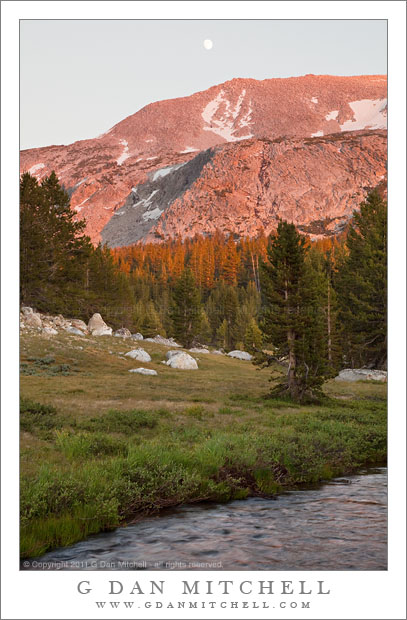
Sunset and Moonrise, Kuna Crest

Sunset and Moonrise, Kuna Crest

Sunset and Moonrise, Kuna Crest. Yosemite National Park, California. August 10, 2010. © Copyright 2011 G Dan Mitchell – all rights reserved.

The nearly- full moon rises above the sunset light on Kuna Crest, Yosemite National Park.

Kuna Crest runs up Lyell Canyon between the Lyell and Dana forks of the Tuolumne River with the Sierra crest at one end and Mammoth Peak at the other. (Mammoth Peak is the large peak straight in front of you as you top Tioga Pass entering Yosemite National Park.) This ridge can catch great sunset light during the summer, and as I came down from the pass, heading back toward my camp at Porcupine Flat, and saw the almost full moon appearing over the shoulder of the ridge I decided to quickly stop and make a few exposures as the last light was about to leave the forest and soon after the peaks.

If you have tried photographing a scene that includes the moon in the early evening you know that the exposure is a tricky thing. The moon is lit by daylight, so it isn’t too surprising that the “correct” exposure for the moon is close to a normal daytime exposure. But that is not the right exposure for the rest of the scene, which turns out to be quite a bit darker than daylight at this time of day. In this scene things were even more complicates as the very saturated red colors on the ridge were quite “hot,” while the foreground meadow and forest was in shade and both darker and cooler in color. Basically, the dynamic range between the moon and the foreground was too large for a single exposure… so I made several.

At the time of exposure I thought that I might need as many as three component images in the final photograph – they would be one exposed for the bright ridge and sky, one exposed for the rather dark and shadowed foreground, and possibly a third that correctly exposed the moon. To be on the safe side I bracketed four exposures. When I began to work on the image I figured out that in this case I could construct a final “believable” image from two exposures if I was careful and could make some additional adjustments during post.

This is an example of a shot in which the use of a graduated neutral density filter could have been problematic, but where exposure blending could work very well. (“Exposure blending” is one term for the process of manually combining two component exposures using masked layers in Photoshop. No, it is not the same thing as HDR photography.) One of the things that would have been quite tricking using graduated neutral density filters is that the division between the brighter upper half and the darker lower half is not linear. Instead, the roughly follows the curved boundary between the lower meadow and dark trees and the still sunlit trees and the peak and sky.

G Dan Mitchell Photography
About | Flickr | Twitter | FacebookGoogle+ | 500px.com | LinkedIn | Email

Text, photographs, and other media are © Copyright G Dan Mitchell (or others when indicated) and are not in the public domain and may not be used on websites, blogs, or in other media without advance permission from G Dan Mitchell.

(Basic EXIF data may be available by “mousing over” large images in posts. Leave a comment if you want to know more.)
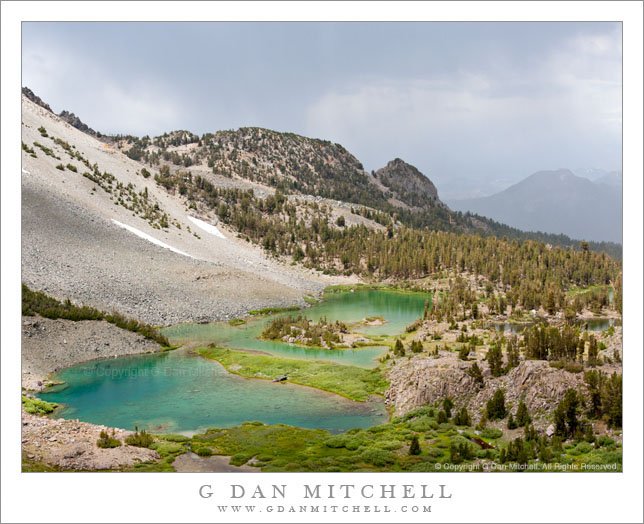
Mammoth Peak and Kuna Crest, Overflowing Tuolumne River

Mammoth Peak and Kuna Crest, Overflowing Tuolumne River

Mammoth Peak and Kuna Crest, Overflowing Tuolumne River. Yosemite National Park, California. June 19, 2011. © Copyright G Dan Mitchell – all rights reserved.

Mammoth Peak and the Kuna Crest loom above as the Tuolumne River overflows its banks and floods surrounding meadows on a frosty spring morning, Yosemite National Park.

As I drove from Lee Vining Canyon over Tioga Pass and toward the Tenaya Lake area early in the morning, I came to the Tuolumne River where it passes under the bridge beneath the highway in the Tuolumne Meadows area. Just at about this moment the sun was rising high enough to begin to warm the frost covered meadow, at least the parts of it that were not flooded by the high water of the Tuolumne. Overnight it had risen almost to the level of the bridge and was so high that after passing under the bridge a small portion split off and headed into the trees to the right of the main branch. In a few weeks this flooded area and its reflecting surface will be gone, and there will just be a meadow and people will hike though it.

The backlight comes across the shoulder of Mammoth Peak, the high point near the end of the long snow-covered ridge of Kuna Crest, which runs parallel to Lyell Canyon toward Donohue Pass and the Sierra Crest.

G Dan Mitchell Photography | Flickr | Twitter (follow me) | Facebook (“Like” my page) | LinkedIn | Email
Text, photographs, and other media are © Copyright G Dan Mitchell (or others when indicated) and are not in the public domain and may not be used on websites, blogs, or in other media without advance permission from G Dan Mitchell.

Alpenglow, Mammoth Peak

Alpenglow, Mammoth Peak

Alpenglow, Mammoth Peak. Yosemite National Park, California. July 22, 2010. © Copyright G Dan Mitchell – all rights reserved.

Alpenglow lights the face of Mammoth Peak beyond a small tarn near the summit of Tioga Pass, Yosemite National Park.

This was very close to the last exposure I made on this productive late-July day last year. After photographing for a few hours in the vicinity of Tioga Pass, I ended up right at the pass as the day came to an end. Braving hordes of mosquitos – comes with the territory! – I worked the area around the pass itself, building compositions out of juxtapositions of the water in the small meltwater ponds, shoreline meadow and boulders, grasses growing along the edge of the water, the surrounding pine forests, and the more distant peaks of Kuna Crest. In this photograph, what is very nearly the very last direct light of the day is bathing the slopes of Mammoth Peak, which still had a fair amount of snow on its flanks even in late July.

This scene posed a few technical challenges. First, there is obviously a great distance between the foreground granite boulder and the very distance mountain. I wanted the foreground to be in optimal sharpness, so I used a relatively small aperture to maintain sufficient sharpness on the far ridge. There was also a fairly large dynamic range in the scene, ranging from soft but direct light on the snow fields of the peak to the dark areas within the forest on the other side of the pond. I wasn’t certain that I’d be able to handle the full dynamic range in one exposure, so I made three – one longer exposure to get a bit more light from the shadows and another shorter one on the dark side to avoid blowing out the brighter areas of the sky. In post, I discovered that there was enough detail in the shadows that I could get everything I needed from a single exposure, though I had to do some work with curves to get create an image the conforms more closely to the way I saw the scene at the time.

G Dan Mitchell Photography | Flickr | Twitter (follow me) | Facebook (“Like” my page) | LinkedIn | Email
Text, photographs, and other media are © Copyright G Dan Mitchell (or others when indicated) and are not in the public domain and may not be used on websites, blogs, or in other media without advance permission from G Dan Mitchell.

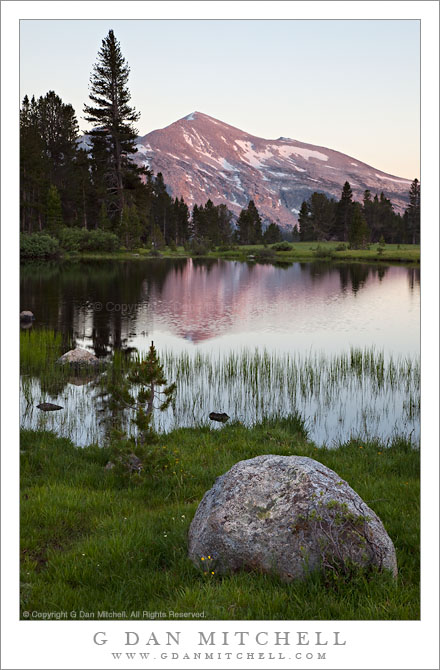
Mammoth Peak Reflected in Tioga Tarn

Mammoth Peak Reflected in Tioga Tarn

Mammoth Peak Reflected in Tioga Tarn. Yosemite National Park, California. July 22, 2010. © Copyright G Dan Mitchell – all rights reserved.

Mammoth Peak in sunset light, reflected in the still surface of Tioga Tarn, Tioga Pass, Yosemite National Park.

This view of Mammoth Peak on Kuna Crest in the Yosemite High Country from the Tioga Tarns at the top of Tioga Pass is a classic Sierra Nevada scene. The foreground tarns are lush green in the early summer after the snow melts out and fall into shadow early in the evening as the sun drops behind the ridge between this area and Gaylor Lakes. Mammoth Peak, however, has an almost unobstructed line of sight to the west, so this peak continues to hold the sunset light until the last possible minute. (Don’t let the peaceful appearance of the scene fool you – I was being devoured by clouds of mosquitos as I made these exposures.)

In order to deal with the extremely large dynamic range between the Mammoth Peak snow fields in direct sun and the very dark shadows of the nearby forest I resorted to exposure blending and a few other post-processing techniques. With exposure blending, I make two exposures, one optimized for the brightest areas of the scene and the second a slightly longer exposure to capture a bit more of the shadow detail. In post I began with the darker frame, since that presented Mammoth Peak the way I remembered it. Then I placed to other exposure beneath it and used a mask layer to reveal some of the lighter areas from the lower layer.


G Dan Mitchell is a California photographer and visual opportunist. His book, “California’s Fall Color: A Photographer’s Guide to Autumn in the Sierra” (Heyday Books) is available directly from him.

G Dan Mitchell: Blog | Bluesky | Mastodon | Substack Notes | Flickr | Email


All media © Copyright G Dan Mitchell and others as indicated. Any use requires advance permission from G Dan Mitchell.