
Tag Archives: mnwr

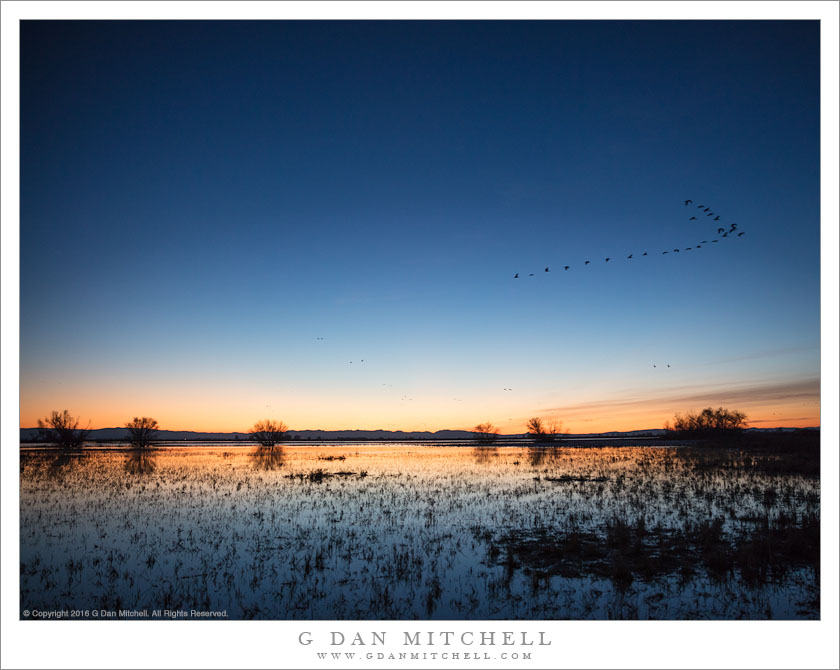
Geese, Wetland Pond, Dusk

Geese, Wetland Pond, Dusk
Geese depart in dusk sky above a San Joaquin Valley wetland pond

Geese, Wetland Pond, Dusk. San Joaquin Valley, California. December 26, 2016. © Copyright 2016 G Dan Mitchell – all rights reserved.

Geese depart in dusk sky above a San Joaquin Valley wetland pond

This photograph might be just a little bit deceptive. It looks still and quiet — and, in a sense, it is — but this time of evening can be one of great motion and sound, too. These margins of the day at dawn and dusk are when the birds “switch gears,” moving from place to place and activity to activity at the moments of light-dark transition.

But let’s go with the still and quiet notion for now. In fact, after a busy day of traveling around to find and photograph birds and related subjects, a couple of friends and I made a decision to pick this spot and stay put. We often try to second-guess the birds, but they weren’t giving us any obvious or useful hints about their plans for this evening. So we stopped, and we waited. Birds did appear, and we had at least one great assembly and fly-in not far from our location, but eventually the light faded and things slowed down and it became… still and quiet.


G Dan Mitchell is a California photographer and visual opportunist. His book, “California’s Fall Color: A Photographer’s Guide to Autumn in the Sierra” is available from Heyday Books and Amazon.
Blog | About | Flickr | Twitter | FacebookGoogle+ | LinkedIn | Email


All media © Copyright G Dan Mitchell and others as indicated. Any use requires advance permission from G Dan Mitchell.
Five Cranes, Sunrise Light

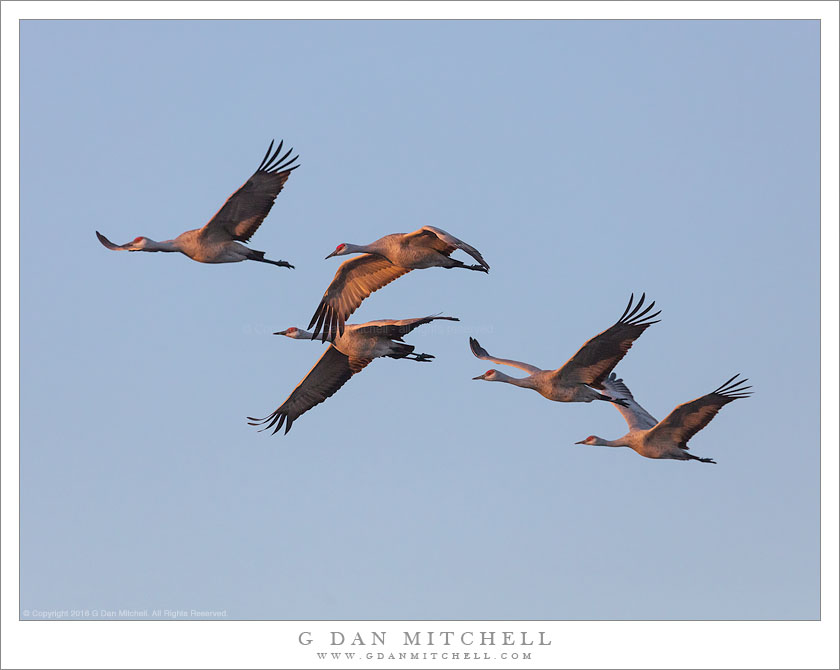
Five Cranes, Sunrise Light
Five lesser sandhill cranes fly toward the sunrise

Five Cranes, Sunrise Light. San Joaquin Valley, California. December 26, 2016. © Copyright 2016 G Dan Mitchell – all rights reserved.

Five lesser sandhill cranes fly toward the sunrise

“High horns, low horns, silence, and finally a pandemonium of trumpets, rattles, croaks, and cries that almost shakes the bog with its nearness, but without yet disclosing whence in comes. At last a glint of sun reveals the approach of a great echelon of birds. On motionless wing they emerge from the lifting mists, sweep a final arc of sky, and settle in clangorous descending spirals to their feeding grounds. A new day has begun on the crane marsh.” — Aldo Leopold, “A Sand County Almanac”

When I began photographing California Central Valley migratory (and native) birds a few years back, the initial draw was geese — snow geese, Ross’s geese, and others. But soon I become aware of the sandhill cranes, and I remembered reading Aldo Leopold’s descriptions of these birds all the way back in college. Something in his description was magical and even though I did not know these birds, I remembered his description.

The cranes’ distinctive cry is the first thing I listen for at dawn in the wetlands. They often seem to settle into places a bit more remote than those favored by geese, at least until later in the season. Their flocks are not as large. They often fly in small groups of three, four, or a few more. Their pattern of flight is more level, their wings work more slowly, and they often glide. They also people. Frequently I’ll spot a group heading straight towards me, but with very few exceptions they divert and take a path to one side.


G Dan Mitchell is a California photographer and visual opportunist. His book, “California’s Fall Color: A Photographer’s Guide to Autumn in the Sierra” is available from Heyday Books and Amazon.
Blog | About | Flickr | Twitter | FacebookGoogle+ | LinkedIn | Email


All media © Copyright G Dan Mitchell and others as indicated. Any use requires advance permission from G Dan Mitchell.
The Cranes Return

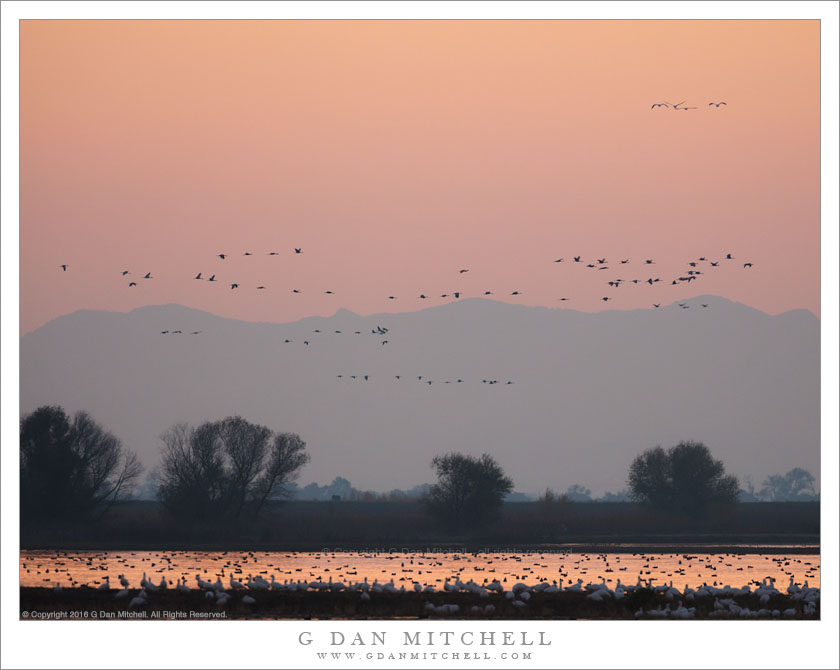
The Cranes Return
Lesser sandhill cranes return to wetland marshes in fading dusk light

The Cranes Return. San Joaquin Valley, California. December 3, 2016. © Copyright 2016 G Dan Mitchell – all rights reserved.

Lesser sandhill cranes return to wetland marshes in fading dusk light

There is a natural cycle to the day during the winter at these San Joaquin Valley wetland marshes — actually there are multiple cycles. One is the cycle of the animals themselves, responding to the dawn, moving to daytime activities, coming and going, then settling in once again for the night. Another is the cycle of the photographer or viewer of this wildlife, whose own patterns are inextricably linked to those of the birds and the light, but who also may sometimes choose when and where to focus efforts.

The midday and early afternoon hours are, at least most of the time, relatively quiet and slow. It makes sense that during the times of day when conditions are the most stable that the birds would also be more settled. (There are seasonal exceptions, including the late winter time when the winter residence of many birds is coming to an end and another migration cycle is about to begin.) The evening brings another transition, and one of the final and most impressive moments often comes after sunset with the dusk fly-in of the sandhill cranes. Long strings of these birds appear (usually from the south in this place), flying low and straight paths toward the places where they will land and spend the night.


G Dan Mitchell is a California photographer and visual opportunist. His book, “California’s Fall Color: A Photographer’s Guide to Autumn in the Sierra” is available from Heyday Books and Amazon.
Blog | About | Flickr | Twitter | FacebookGoogle+ | LinkedIn | Email


All media © Copyright G Dan Mitchell and others as indicated. Any use requires advance permission from G Dan Mitchell.
Three Snow Geese

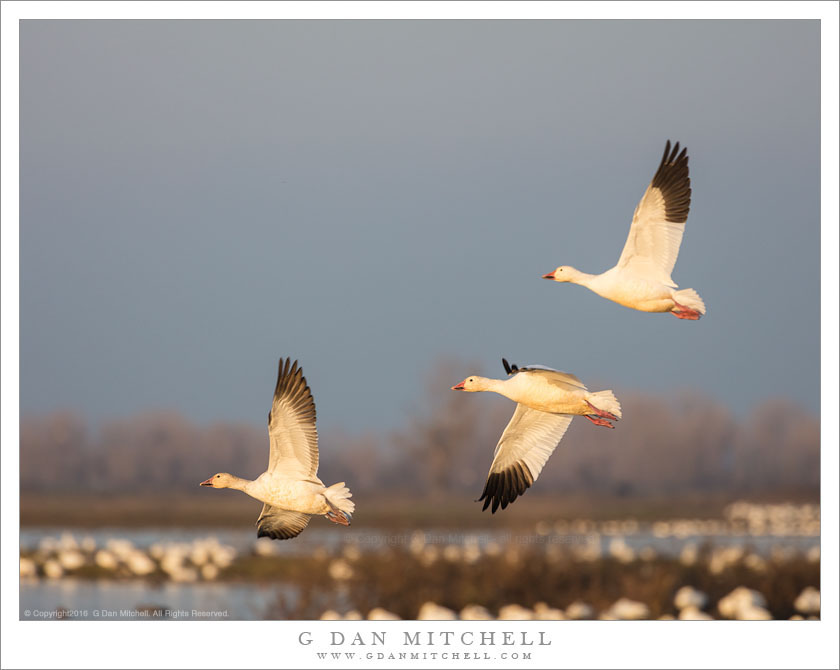
Three Snow Geese
Three snow geese in flight over San Joaquin Valley wetlands

Three Snow Geese. San Joaquin Valley, California. December 3, 2016. © Copyright 2016 G Dan Mitchell – all rights reserved.

Three snow geese in flight over San Joaquin Valley wetlands

There are many ways to photograph geese in these California Central Valley locations, where they spend the winter months after migrating down from points far to the north. Great flocks of them settle in on ponds in these areas, or sometimes gather in fields. At other times giant flocks fill the sky, especially when something spooks them and thousands will take to the air at once, producing a sound that is the combination of their excited cries and the rush of wind from their wings. Large groups of them come and go throughout the day. Occasionally smaller groups, like this trio, arrive and circle before finding a spot to land and join the flock.

I confess that part of the fun with these groups comes from the challenge of trying to track and photograph them as they move so quickly. With practice one can find a few hints about their trajectory — they will circle a few times and they always land facing into the breeze — but they move fast, the light on their feathers changes, and they spend most of their time facing in the wrong direction! I saw this group coming in from a good distance away, and I tracked them as they approached a spot to my right, banked into a turn, and passed in front of me as they crossed to my left, circled away, and then returned to face the wind and land.


G Dan Mitchell is a California photographer and visual opportunist. His book, “California’s Fall Color: A Photographer’s Guide to Autumn in the Sierra” is available from Heyday Books and Amazon.
Blog | About | Flickr | Twitter | FacebookGoogle+ | LinkedIn | Email


All media © Copyright G Dan Mitchell and others as indicated. Any use requires advance permission from G Dan Mitchell.