Tag Archives: national

Visiting (And Photographing) Yosemite In Summer

Today I’m sharing something I wrote elsewhere in response to a question by someone who plans to visit and photograph Yosemite National Park in late August. I have changed elements of the original post, shortening the original question and editing my own response a bit. Enjoy!
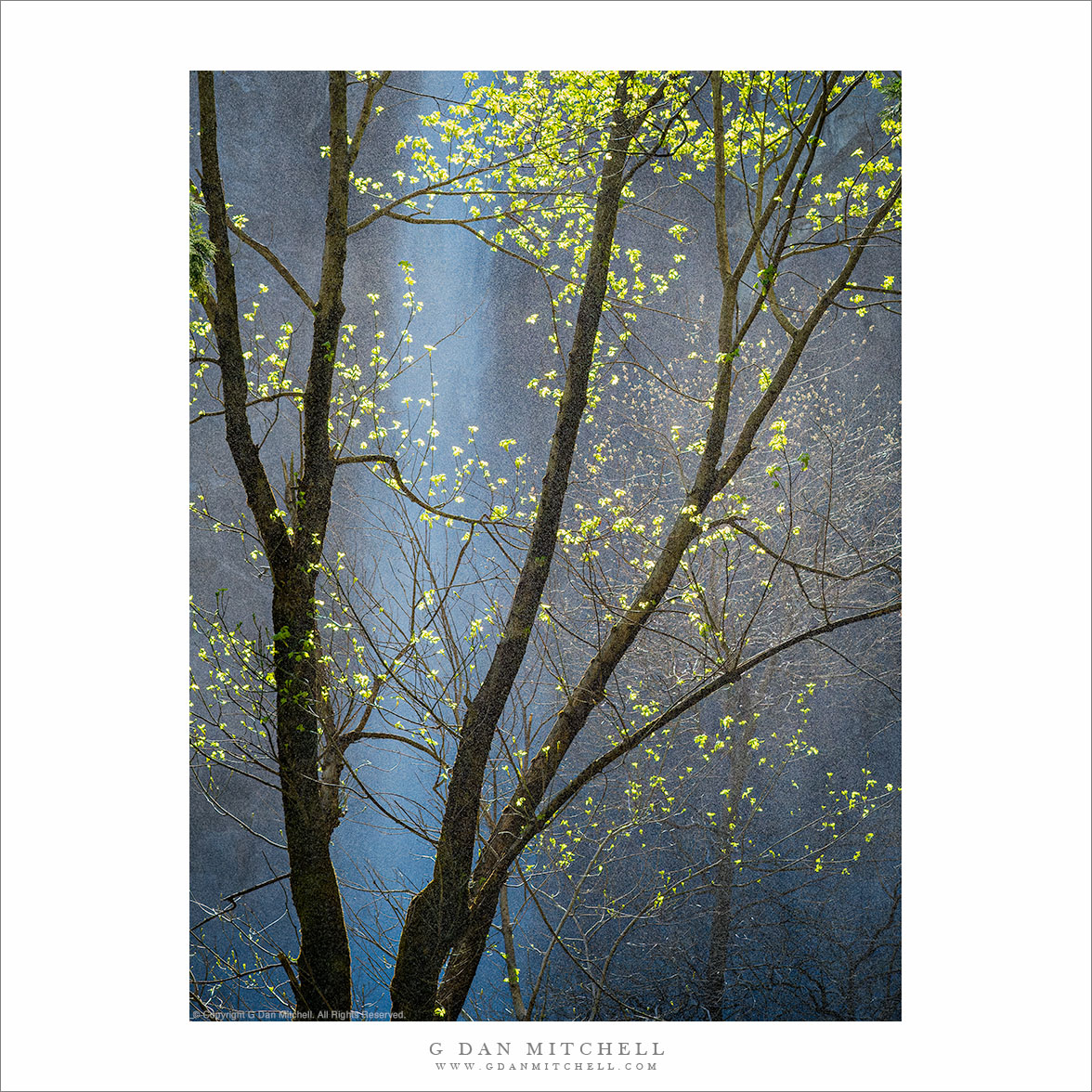
Spring Trees, Waterfall Mist
“Spring Trees, Waterfall Mist ” — Waterfall mist fills the air around sunlit maple trees with new spring leaves, Yosemite National Park

I’ve never been to Yosemite but I have a chance to visit for a week in late August. I’ve heard that’s a very busy time, but that’s the time I have available and I’d love to see it.

I’ve ordered Michael Frye’s book  but am hoping for some additional information. I’m thinking of coming in the south entrance and am wondering of this is a good approach. Also, if anyone has any lodging ideas I’d love to hear them.

Michael’s book (“The Photographers Guide to Yosemite“) is a great place to start. It will help you find some of the subjects that you probably have in mind to photograph, and it is full of Michael’s general situational knowledge and experience about the park. Michael has an intimate knowledge of the place — not just of locations, but of daily and seasonal variations and more.

You are right that this will be a very busy time in Yosemite — it is more or less peak season! This affects not only the Valley, but also high country areas such as Tuolumne Meadows. Here are some thoughts about your visit.

Continue reading Visiting (And Photographing) Yosemite In Summer
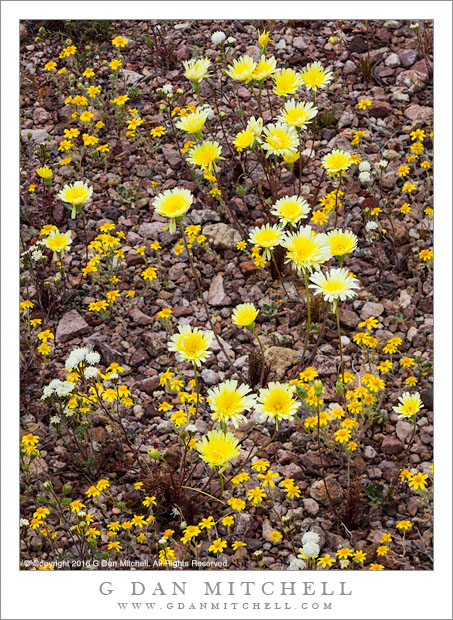
Desert Wildflowers

Desert Wildflowers
A carpet of desert spring flowers, Death Valley National Park

Desert Wildflowers. Death Valley National Park, California. March 29, 2016. © Copyright 2016 G Dan Mitchell – all rights reserved.

A carpet of desert spring flowers, Death Valley National Park

My alternative title for this photograph might have been “What’s Underfoot.” We were a bit too later for this year’s (near?) superbloom in parts of southern Death Valley National Park, but we still found plenty of flowers during out late March visit. Many desert plants are opportunistic, holding off on their blooms in dry years and then going exuberantly wild in wetter years. This wasn’t one of the truly wet seasons, though it was wetter than the recent drought years might have suggested, and in many places the flowers responded.

I made this photograph in one of those Death Valley locations that might seem both very special and not at all special, depending on your orientation to the place. We drove out on a long road that traverses a high valley. By comparison to, say, the high peaks of the Sierra, the terrain seems unremarkable, with vast stretches of undifferentiated desert vegetation leading to dry and rocky ridges. But the vast space is special, in and of itself, and there turns out to be more to look at and experience than might first be apparent. I knew from previous visits that thick wildflowers were a possibility, and I knew that if we just pulled off the road and looked that we would find them. At one of these stops I simply took my camera and walked off a bit and found a dense carpet of plants and flowers, taking full advantage of this brief period of sunlight and a bit of moisture.


G Dan Mitchell is a California photographer and visual opportunist. His book, “California’s Fall Color: A Photographer’s Guide to Autumn in the Sierra” is available from Heyday Books and Amazon.
Blog | About | Flickr | Twitter | FacebookGoogle+ | LinkedIn | Email


All media © Copyright G Dan Mitchell and others as indicated. Any use requires advance permission from G Dan Mitchell.

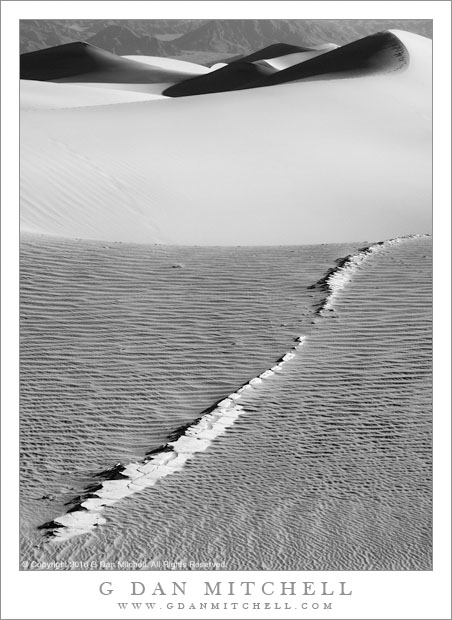
Dunes Interrupted

Dunes Interrupted
A curving diagonal of rock across sand dunes, Death Valley National Park

Dunes Interrupted. Death Valley National Park, California. March 30, 2016. © Copyright 2016 G Dan Mitchell – all rights reserved.

A curving diagonal of rock across sand dunes, Death Valley National Park

The sand dunes of Death Valley are more complex things than they might appear to be. For example, I have read that beneath their surface they actually hold quite a bit of moisture — quite a contradiction to our intuition about their dryness. (That intuition is based on fact — they can be hot and dry places, and the surface layer of the dunes is quite dry.) At the right times of day and of season they can be cool places, and they support plant and animal life.

These dunes also appear to stand on top of quite un-dune-like features. Around their edges you can find hints. You cross flat playa surface to get to them, and this surface holds abundant evidence of the work of water. In places you can even find areas that mimic perfectly the surfaces of contemporary playas, with their sedimentary formations covered with cracks. Here the edge of what must be a rather old example of this cuts diagonally across the landscape and still manages to poke its edge through the sand.


G Dan Mitchell is a California photographer and visual opportunist. His book, “California’s Fall Color: A Photographer’s Guide to Autumn in the Sierra” is available from Heyday Books and Amazon.
Blog | About | Flickr | Twitter | FacebookGoogle+ | LinkedIn | Email


All media © Copyright G Dan Mitchell and others as indicated. Any use requires advance permission from G Dan Mitchell.

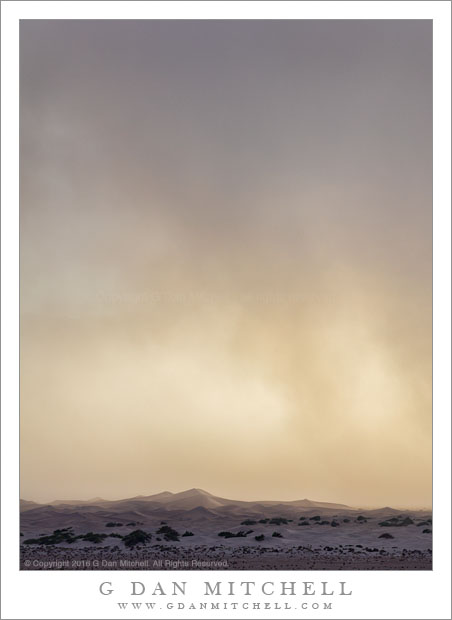
Dust Storm, Dunes, Evening Light

Dust Storm, Dunes, Evening Light
A dust storm rages above sand dunes at the end of the day, Death Valley National Park

Dust Storm, Dunes, Evening Light. Death Valley National Park, California. March 28, 2016. © Copyright 2016 G Dan Mitchell – all rights reserved.

A dust storm rages above sand dunes at the end of the day, Death Valley National Park

This was a wild evening, featuring an apocalyptic combination of tremendously strong winds, huge clouds of blowing sand and dust, periodic downpours of rain, and light that changed constantly from ominous and dark to luminous clouds backlit by sun to threads of virgo, and more. I had never seen quite this combination of conditions in Death Valley at one time.

Photography was quite challenging. Because sunset was approaching (and I continued to photograph into the dusk), it was often quite dark. The screaming winds made it virtually impossible to shoot from the tripod, so I was mostly reduced to bracing my camera against the window frame of my vehicle and working with the camera handheld. In the rough conditions I was forced to work from a distance with a long lens, since photographing inside the windblown clouds of dust and sand was not a good idea. Here the clouds and the dust above the sand dunes momentarily thinned, creating a backlit glow from the low angle sun about to drop behind mountains to the west.


G Dan Mitchell is a California photographer and visual opportunist. His book, “California’s Fall Color: A Photographer’s Guide to Autumn in the Sierra” is available from Heyday Books and Amazon.
Blog | About | Flickr | Twitter | FacebookGoogle+ | LinkedIn | Email


All media © Copyright G Dan Mitchell and others as indicated. Any use requires advance permission from G Dan Mitchell.