

Tag Archives: outdoor

Exposure for Outdoor Photography, by Michael Frye

Exposure for Outdoor Photography by Michael Frye

Craft and Vision has just released Michael Frye’s new ebook, Exposure for Outdoor Photography. The book seems to be directed at the many folks who own DSLRs or non-DSLR cameras and are striving to advance beyond the point and shoot approach to their photography. The book takes a straightforward approach to some of the most important topics related to exposure. It begins with a basic description of, well, the basics of exposure – shutter speed, aperture, and ISO and some of the important terminology and concepts related to these factors. Michael keeps the level of detail to a minimum, but the basics are all there, including an explanation of the how and why of using the histogram display – which is probably just about exactly the right approach for his intended audience.

After getting the basics out of the way, the book moves to a series of ten “cases studies,” each of which uses one of his photographs to explore a particular aspect of exposure. The subjects of the case studies include using the histogram, dealing with both large and small depth of field, freezing motion or controlling motion blur, the tradeoffs of moving to higher ISO, recovering highlights in bright scenes, how to handle extremely bright highlights such as direct sun, and a nod to the zone system (in very simplified form) and HDR and exposure blending concepts. Rather than presenting the concepts in theoretical form, he uses his one photographs to provide practical examples for the case studies.

There are a number of things I appreciate about the book, and I think many readers may also agree:

  1. Rather than presenting rules that you must follow, Michael presents the concepts and explains/demonstrates the effects of some of the choice under discussion. He is careful to point out that there usually is no “perfect” exposure, and that there are different ways to get the result you have in mind. (Near the end of the book he even provides some examples of photographs that intentionally “violate” the exposure rules.)
  2. He strikes a good balance between too little and too much detail. He avoids the pitfalls of trying to make things so simple that they end up being simple-minded and of trying to cover all possibilities to the extent that many readers simply end up confused. This is probably an ideal balance for photographers who are taking first steps towards fuller understanding and control of exposure in their photographs.
  3. The case study photographs effectively illustrate the concepts that he covers. In addition, many of them are just plain fine photographs. (Two of my favorites are the Tuolumne Meadows photograph and one of geese in beautiful morning light.)

The ebook concept seems to be catching on quickly and there are plenty of good reasons for this. The visual quality of the text and illustrations is excellent. The books can be read on a laptop or a tablet. They are easy to purchase, and the cost is very low.

The book is now available from site affiliate Craft And Vision, and I understand that there may be a discount price during the first few days of availability.

G Dan Mitchell is a California photographer whose subjects include the Pacific coast, redwood forests, central California oak/grasslands, the Sierra Nevada, California deserts, urban landscapes, night photography, and more.
Blog | About | Flickr | Twitter | FacebookGoogle+ | 500px.com | LinkedIn | Email

Text, photographs, and other media are © Copyright G Dan Mitchell (or others when indicated) and are not in the public domain and may not be used on websites, blogs, or in other media without advance permission from G Dan Mitchell.
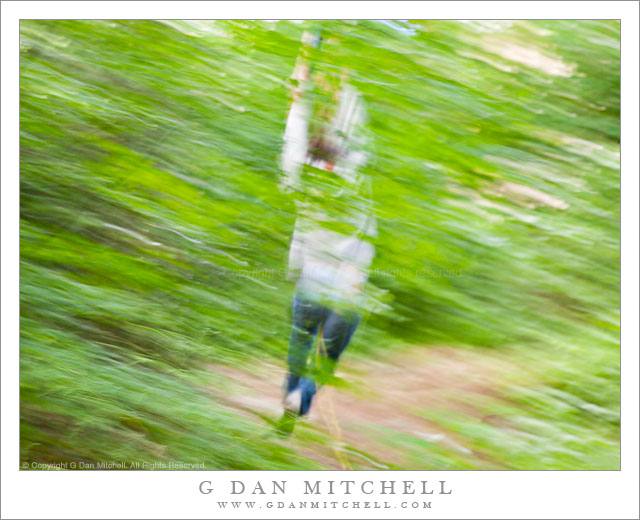
Zip Line

Zip Line - A person flies through forest trees on a zip line.
A person flies through forest trees on a zip line.

Zip Line. Woodinville, Washington. June 21, 2009. © Copyright 2009 G Dan Mitchell – all rights reserved.

A person flies through forest trees on a zip line.

There probably isn’t a whole lot to say about this photograph, so instead I’ll just say…

Happy New Year, 2012!

G Dan Mitchell is a California photographer whose subjects include the Pacific coast, redwood forests, central California oak/grasslands, the Sierra Nevada, California deserts, urban landscapes, night photography, and more.
Blog | About | Flickr | Twitter | FacebookGoogle+ | 500px.com | LinkedIn | Email

Text, photographs, and other media are © Copyright G Dan Mitchell (or others when indicated) and are not in the public domain and may not be used on websites, blogs, or in other media without advance permission from G Dan Mitchell.
First Light on Zabriskie Point Hills

First Light on Zabriskie Point Hills

First Light on Zabriskie Point Hills. Death Valley National Park, California. April 3, 2009. © Copyright 2009 G Dan Mitchell – all rights reserved.

The first morning light touches hills at Zabriskie Point with ridges of the Panamint Range visible in the distance, Death Valley National Park, California.

When I visit Death Valley – typically, at least once each year – I usually try to seek out some of the less iconic scenes. However, I still do visit the icons, too. And Zabriskie Point at dawn may be the best known and perhaps the most photographed “icon” in the park. When I do go to Zabriskie it is usually for one of two reasons. First, if the light or conditions are truly special, I’ll be there with everyone else when the sun comes up! Second, I have a vague project to try to photograph aspects of Zabriskie that are different from the icon views across Gower Gulch or of Manley Beacon. This photographs sort of fits into that second category.

Those who have photographed here more than once become acquainted with the way that the morning light typically unfolds at Zabriskie. The pre-dawn light begins to softly light the entire scene, and before long the very first dawn light strikes the highest ridges of the Panamint Range on the opposite side of the Valley to the west. This light works its way down the face of that range, gradually illuminating the ridges and valleys of the range and spreading horizontally. It then begins to hit the Valley floor and works its way east and closer to Zabriskie and the rest of the ranges along the east side of the Valley. Although the closest hills are in shadow, one can almost sense the beams of light over head that are reaching into the Valley and sense that the angle of this light is gradually working down toward the closest ridges. Then the first light appears on the higher features around Zabriskie Point, at first soft but quickly increasing in intensity.

This photograph was made at this moment when that firs light arrives. The subject is a darker and rugged ridge that rises between the usual vantage points and the backdrop of the distant Panamint range, which in this photograph is somewhat obscured by the hazy atmosphere on a day when giant dust storms were just beginning to develop further north in the Valley.

G Dan Mitchell is a California photographer whose subjects include the Pacific coast, redwood forests, central California oak/grasslands, the Sierra Nevada, California deserts, urban landscapes, night photography, and more.
Blog | About | Flickr | Twitter | Facebook | Google+ | 500px.com | LinkedIn | Email

Text, photographs, and other media are © Copyright G Dan Mitchell (or others when indicated) and are not in the public domain and may not be used on websites, blogs, or in other media without advance permission from G Dan Mitchell.

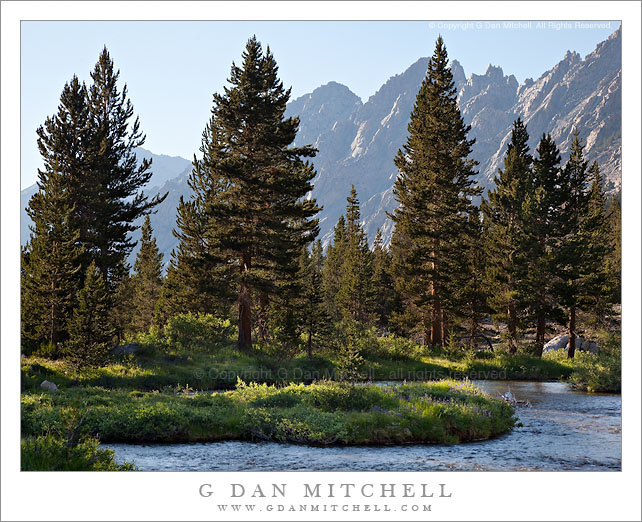
Afternoon, Upper Bubbs Creek

Afternoon, Upper Bubbs Creek

Afternoon, Upper Bubbs Creek. Kings Canyon National Park, California. July 31, 2010. © Copyright G Dan Mitchell – all rights reserved.

Late afternoon light on the forest and distant peaks on Upper Bubbs Creek, Kings Canyon National Park.

Since this photograph comes from an entirely different adventure, a bit of background information is probably in order. Among my summer pack trips, each year I join my friends from the talusdancers, a loosely connected group of folks who like to backpack, for at least one “big trip” in the Sierra. I’ve been doing this for nearly 15 years now. This year’s trip revisited some familiar spots (Tyndall Creek in the upper Kern), some that I had not visited for quite a few years (Forrester Pass), and one area that I have never before visited despite thinking about it for over 30 years (Milestone Basin and the Lake South America area). Near the end of July we headed out of Onion Valley to cross Kearsarge Pass, turned south to enter the Upper Kern River drainage via Forrester Pass, explored there for a few day, and then exited by way of brutal Shepherd Pass.

Forrester Pass is the second-highest point on the John Muir Trail (or “the JMT,” as most refer to it) at 13,200′, and we planned to cross it from north to south on the third day of our trip. At the end of day two we dropped down to Vidette Meadow and then headed up canyon to upper Bubbs Creek where the old Center Basin trail splits off from the main JMT where we made camp. This photograph was made in the late afternoon as we lazed about, doing a bit of laundry and thinking about the big climb ahead of us the next day. The view beyond the foreground and the closer trees is back down the canyon of Bubbs Creek, with the lowering sun lighting the canyon walls.

This photograph is not in the public domain and may not be used on websites, blogs, or in other media without advance permission from G Dan Mitchell.

G Dan Mitchell Photography | Twitter | Friendfeed | Facebook | Facebook Fan Page | Email