Tag Archives: pink

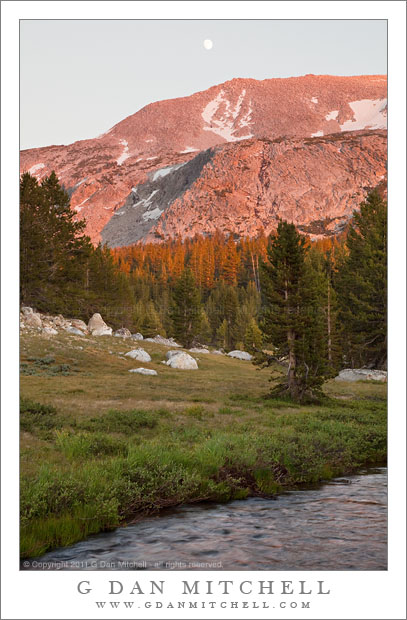
Sunset and Moonrise, Kuna Crest

Sunset and Moonrise, Kuna Crest

Sunset and Moonrise, Kuna Crest. Yosemite National Park, California. August 10, 2010. © Copyright 2011 G Dan Mitchell – all rights reserved.

The nearly- full moon rises above the sunset light on Kuna Crest, Yosemite National Park.

Kuna Crest runs up Lyell Canyon between the Lyell and Dana forks of the Tuolumne River with the Sierra crest at one end and Mammoth Peak at the other. (Mammoth Peak is the large peak straight in front of you as you top Tioga Pass entering Yosemite National Park.) This ridge can catch great sunset light during the summer, and as I came down from the pass, heading back toward my camp at Porcupine Flat, and saw the almost full moon appearing over the shoulder of the ridge I decided to quickly stop and make a few exposures as the last light was about to leave the forest and soon after the peaks.

If you have tried photographing a scene that includes the moon in the early evening you know that the exposure is a tricky thing. The moon is lit by daylight, so it isn’t too surprising that the “correct” exposure for the moon is close to a normal daytime exposure. But that is not the right exposure for the rest of the scene, which turns out to be quite a bit darker than daylight at this time of day. In this scene things were even more complicates as the very saturated red colors on the ridge were quite “hot,” while the foreground meadow and forest was in shade and both darker and cooler in color. Basically, the dynamic range between the moon and the foreground was too large for a single exposure… so I made several.

At the time of exposure I thought that I might need as many as three component images in the final photograph – they would be one exposed for the bright ridge and sky, one exposed for the rather dark and shadowed foreground, and possibly a third that correctly exposed the moon. To be on the safe side I bracketed four exposures. When I began to work on the image I figured out that in this case I could construct a final “believable” image from two exposures if I was careful and could make some additional adjustments during post.

This is an example of a shot in which the use of a graduated neutral density filter could have been problematic, but where exposure blending could work very well. (“Exposure blending” is one term for the process of manually combining two component exposures using masked layers in Photoshop. No, it is not the same thing as HDR photography.) One of the things that would have been quite tricking using graduated neutral density filters is that the division between the brighter upper half and the darker lower half is not linear. Instead, the roughly follows the curved boundary between the lower meadow and dark trees and the still sunlit trees and the peak and sky.

G Dan Mitchell Photography
About | Flickr | Twitter | FacebookGoogle+ | 500px.com | LinkedIn | Email

Text, photographs, and other media are © Copyright G Dan Mitchell (or others when indicated) and are not in the public domain and may not be used on websites, blogs, or in other media without advance permission from G Dan Mitchell.

(Basic EXIF data may be available by “mousing over” large images in posts. Leave a comment if you want to know more.)
Trees in Silhouette, Olmsted Point, Sunset

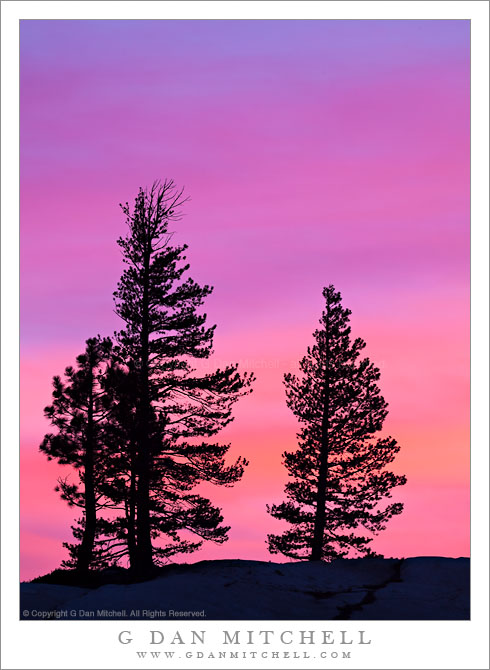
Trees in Silhouette, Olmsted Point, Sunset

Trees in Silhouette, Olmsted Point, Sunset. Yosemite National Park, California. June 18, 2011. © Copyright G Dan Mitchell – all rights reserved.

Trees at Olmsted Point are silhouetted against a brilliantly colorful spring sunset sky, Yosemite National Park.

I think everyone should occasionally get to post a just plain gaudy color sunset – and this is mine. While photographing Mount Conness from Olmsted Point was my primary goal on this evening, I also had some opportunities to swing the tripod around and point at other things from time to time. This is about as close as I can come to capturing the nearly hallucinogenic color of the sky as the brightest cloud illumination was centered directly overhead and beginning to move off to the west.

The color saturation was so intense that I had to under expose this by at least a stop in order to avoid blowing out the red channel and in order to retain some differentiation among the various shadings of color as they transitioned from very pink/red through orange and purple and on towards blue.

G Dan Mitchell Photography | Flickr | Twitter (follow me) | Facebook (“Like” my page) | LinkedIn | Email
Text, photographs, and other media are © Copyright G Dan Mitchell (or others when indicated) and are not in the public domain and may not be used on websites, blogs, or in other media without advance permission from G Dan Mitchell.

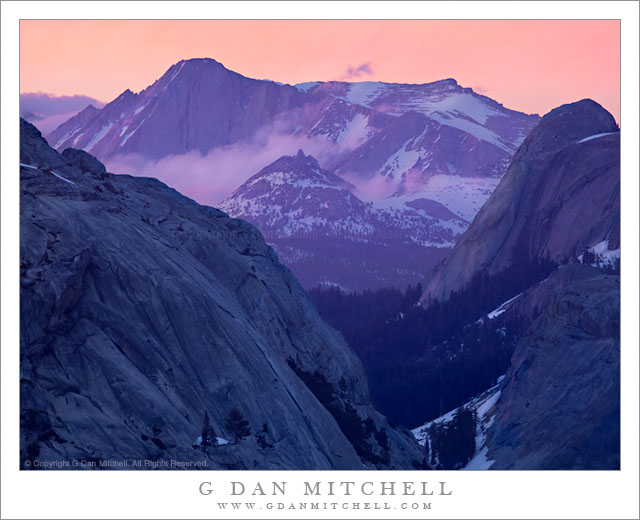
Alpenglow Clouds, Mount Conness

Alpenglow Clouds, Mount Conness

Alpenglow Clouds, Mount Conness. Yosemite National Park, California. June 18, 2011. © Copyright G Dan Mitchell – all rights reserved.

Clouds lit by alpenglow drift across the face of Mount Conness beyond the Tenaya Creek drainage, Yosemite National Park.

Earlier this week I posted another photograph of the same evening. This one was shot a bit earlier (believe it or not!) than the other photograph, as the intense and perhaps unexpected color display was just getting started. I’ll have more to write about the phenomenon in a future blog post that uses this evening as an example, but it almost seem like the sunset progressed backwards (oxymoron alert!) as it went on. It had begun with very boring and low contrast light, somewhat flattened by a haze that took on an increasingly ghastly blue-green hue as the light began to fade. Although the surroundings were spectacular on this opening day of Tioga Pass Road, the light and atmospheric conditions seemed to be conspiring to show them it their worst (literal and figurative) light.

But just at dusk a hint of pink appeared in some of the clouds ringing Mount Conness, the tall peak in the upper left. At first it was so faint that only those of us who were looking for it might have noticed, and we perhaps thought that we were simply trying to convince ourselves that something was going to happen. But the color increased, and as the more distant areas picked up better light, they shone through the foreground haze more clearly, and this haze faded in the same way that a scrim does in a theater when the front lights dim and the stage lights rise.

I find that this type of scene provides some of the most difficult technical and judgment challenges. So often the goal in an image, especially if it is going to be a print, is to try to get as much light into the scene as possible. A lot of the work in post-processing, at least for me, is done with the goal of trying to fill the image with light by means of various careful adjustments, often involving the use of masked curve layers. But here, the coloration depends upon not being overly bright – too much light either decreases the intensity of the pink and purple shadings or else sends them off into the land of the grotesque and gaudy. And the light in shadows – and there are a lot of shaded areas in this scene! – is very blue, much more so than the untrained eye would imagine when looking at the scene in person. This requires another set of tricky and subjective judgments – it would not look right to leave portions of the scene as blue “as they really were,” nor would it look right if the blue were diminished too much. But how much is right? There is no objective answer that I know of, so the goal (for example, on the large granite face of Polly Dome at the left) is to come up with a balance that seems blue enough but not too blue. A similar issue arises in these dark areas when it comes to deciding how bright is bright enough. Believe it or not, virtually nothing in this image is actually black, with the possible exception of a few very tiny areas in the lower left. The luminosity of the very dark areas had to be lifted a bit… but how much is just right? Again, a matter of personal judgment about which there is no objectively right answer.

All of that technical stuff aside, this evening provided one of the most glorious, albeit brief, displays of sublime light I have seen in the Sierra.

G Dan Mitchell Photography | Flickr | Twitter (follow me) | Facebook (“Like” my page) | LinkedIn | Email
Text, photographs, and other media are © Copyright G Dan Mitchell (or others when indicated) and are not in the public domain and may not be used on websites, blogs, or in other media without advance permission from G Dan Mitchell.

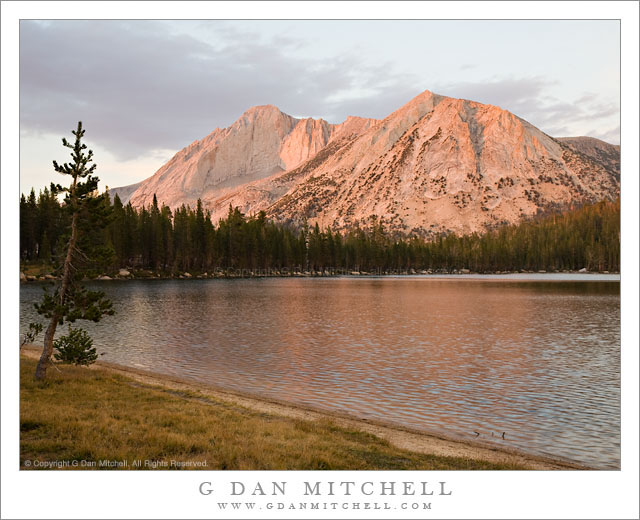
Mount Conness and Lower Young Lake, Sunset

Mount Conness and Lower Young Lake, Sunset

Mount Conness and Lower Young Lake, Sunset. Yosemite National Park, California. September 11, 2007. © Copyright G Dan Mitchell – all rights reserved.

Alpenglow lights Mount Conness above Lower Young Lake in the Yosemite National Park back-country.

I was recently going through a large portion of my archive in search of a variety of photographs of Mount Conness, a well-known peak along the northeast edge of Yosemite National Park on the crest of the Sierra. This is perhaps not the best known peak in Yosemite for most people – they are obviously going to be far more familiar with the cliffs and domes around Yosemite Valley or with Mount Lyell (the tallest peak in the park) or perhaps Mount Dana (second highest peak, and towering above the Tioga Pass entrance.) Mount Conness is found a bit further “north” along the crest, and while it may be less known, it is certainly no less visible once you know where to look. You can see it in the distance towering above Tenaya Lake if you stop at the iconic Olmsted Point overlook. It is visible from many places along the road to Tuolumne Meadows. Once you get away from roads and into the high country it can be seen from almost any high point with an open view in the direction of the peak, including places like Vogelsang High Sierra Camp.

This photograph was made on a quiet late-season evening at Lower Young Lake, a place that I return to frequently, most of the time in the off-season when fewer people are there and the fall colors of the high country are starting to appear. The peak (and many other features in this area) are beautifully illuminated late in the day as this high ridge is open without obstruction to the west. The light on the peak was magical on this evening, being colorful and contrasting with the higher and more drab clouds, but not being as gaudily bright as it can be on other evenings.

G Dan Mitchell Photography | Flickr | Twitter (follow me) | Facebook (“Like” my page) | LinkedIn | Email
Text, photographs, and other media are © Copyright G Dan Mitchell (or others when indicated) and are not in the public domain and may not be used on websites, blogs, or in other media without advance permission from G Dan Mitchell.