
Tag Archives: plant

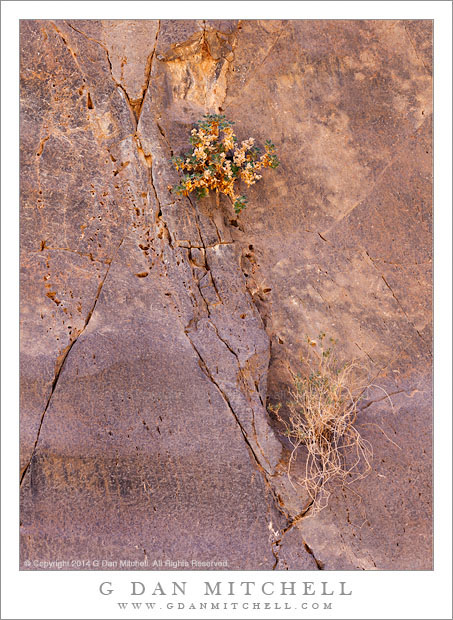
Desert Holly, Black Formation

Desert Holly, Black Formation

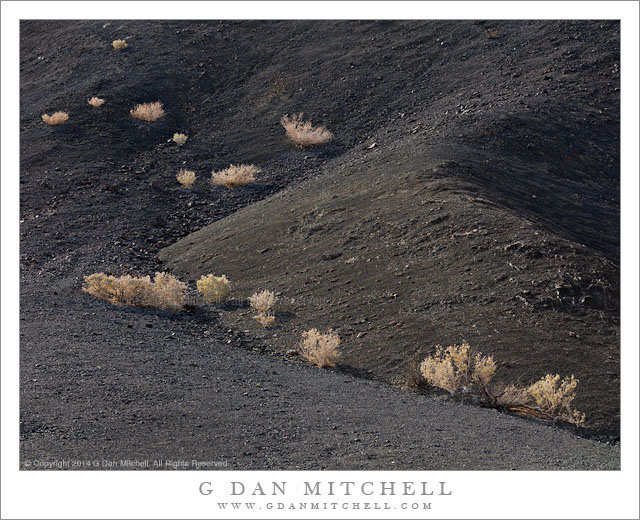
Desert Holly, Black Formation. Death Valley National Park, California. April 3, 2014. © Copyright 2014 G Dan Mitchell – all rights reserved.

Desert Holly plants grow on a black formation, Death Valley National Park

This area of Death Valley National Park, not far from the popular Zabriskie Point overlook, shares some of the same geology with that often crowded location. However, you don’t have to go too far from that parking lot to find locations where you can be almost alone, especially early in the morning. This area is one such spot—easily accessible but not marked in any sort of obvious way. Yet it is a great place to spend hours looking at geological forms, sparse plants, and spare effects of light and color.

The desert holly plants grow in some of the most arid locations, and often appear to be the only plants that are able to survive where it grows. You might find a plant or two in a rocky wash, growing out of a crack in a rock wall, or on this dark (volcanic?) material. One can only imagine how hot this black earth must get in the heat of the Death Valley summer! Besides often being the only visible living thing in some very stark areas, desert holly also can change its appearance depending upon how the leaves are doing and on where the light comes from. Light from behind the plant can make it take on an almost golden glow.

G Dan Mitchell is a California photographer and visual opportunist whose subjects include the Pacific coast, redwood forests, central California oak/grasslands, the Sierra Nevada, California deserts, urban landscapes, night photography, and more.
Blog | About | Flickr | Twitter | FacebookGoogle+ | 500px.com | LinkedIn | Email

Text, photographs, and other media are © Copyright G Dan Mitchell (or others when indicated) and are not in the public domain and may not be used on websites, blogs, or in other media without advance permission from G Dan Mitchell.
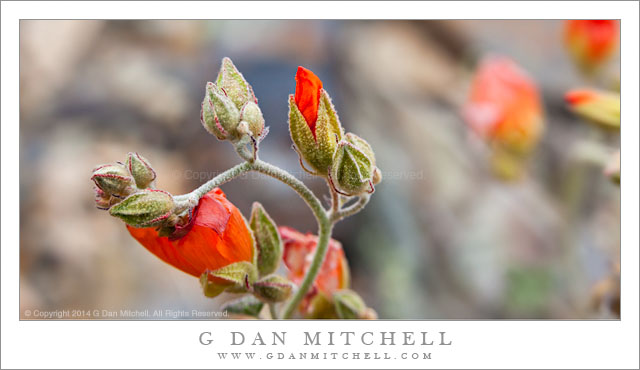
Desert Mallow Buds

Desert Mallow Buds
Desert Mallow Buds

Desert Mallow Buds. Death Valley National Park, California. April 2. 2014.© Copyright 2014 G Dan Mitchell – all rights reserved.

Desert mallow buds begin to open, Death Valley National Park

Much to our surprise, in this third of three straight California drought years, we found an abundance of wildflowers during our early April visit to Death Valley National Park this year. Throughout the state, things are not on their normal yearly cycles. Because of the very serious drought, many plants did not come up at all during the usual winter time frame, and now that spring is here we see many others blooming much earlier than usual. We had assumed, along with a lot of other people, that the widespread drought was going to make this a very poor year for desert wildflowers.

We were wrong. Even outside the park on the drive there we started to see a lot of flowers in the arid portions of Southern California and to the east of the southern end of the Sierra Nevada. Many desert plants are very opportunistic, bursting forth when a bit of rain falls at the right time, and rain had recently fallen out here. Oddly enough, as I photographed these opening desert mallow buds here in the desert mountains of the park… it was very cold and starting to snow!

G Dan Mitchell is a California photographer and visual opportunist whose subjects include the Pacific coast, redwood forests, central California oak/grasslands, the Sierra Nevada, California deserts, urban landscapes, night photography, and more.
Blog | About | Flickr | Twitter | FacebookGoogle+ | 500px.com | LinkedIn | Email

Text, photographs, and other media are © Copyright G Dan Mitchell (or others when indicated) and are not in the public domain and may not be used on websites, blogs, or in other media without advance permission from G Dan Mitchell.
Old and New Ferns

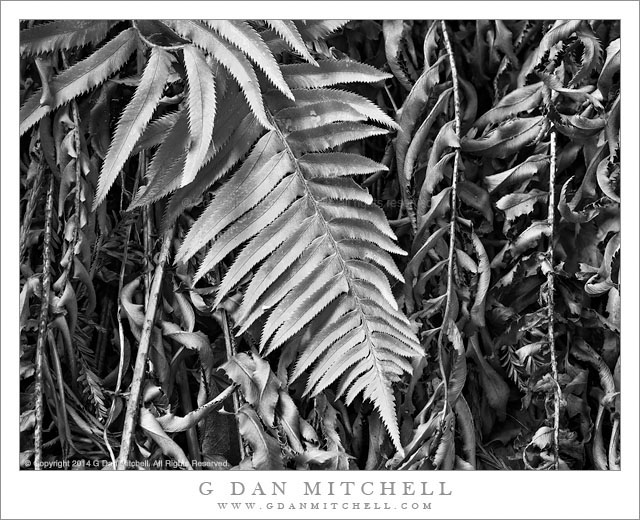
Old and New Ferns
Old and New Ferns

Old and New Ferns. Muir Woods National Monument, California. March 14, 2014. © Copyright 2014 G Dan Mitchell – all rights reserved.

New ferns grow against a backdrop of last year’s dead ferns

These ferns are an easily visible part of the annual cycle of growth and decay in the redwood forest. At the right time of the year they can produce very lush green growth in some areas, but later on in the season they die back and they are instead dry and brown. Each spring, after rain and as the days get longer, the cycle starts again and the new green shoots appear against the backdrop of the old, dead plants.

This is such a spot, and the main frond is, indeed, this year’s new growth. The shriveled plants underneath, hanging straight down the bit of hillside, are the brown plants left from the previous year. I initially was thinking of a color photograph when I made the exposure, looking at the obvious contrasts between the new and old and especially between the green and brown colors. But somehow, as I looked at it in post, the color rendition wasn’t working and it started to feel like monochrome might be more interesting. (Yes, sometimes I do not know which way I’ll go with a photograph at the time of exposure, and the post-processing phase ends up being as much a time of discovery as the time when I make the initial exposure.)

G Dan Mitchell is a California photographer and visual opportunist whose subjects include the Pacific coast, redwood forests, central California oak/grasslands, the Sierra Nevada, California deserts, urban landscapes, night photography, and more.
Blog | About | Flickr | Twitter | FacebookGoogle+ | 500px.com | LinkedIn | Email

Text, photographs, and other media are © Copyright G Dan Mitchell (or others when indicated) and are not in the public domain and may not be used on websites, blogs, or in other media without advance permission from G Dan Mitchell.

An Informal (and Surprising!) Death Valley Wildflower Report

Gilia Buds
Gilia Buds

Gilia Buds. Death Valley National Park, California. April 2, 2014. © Copyright 2014 G Dan Mitchell – all rights reserved.

Gilia buds opening on a rainy day, Death Valley National Park

This is going to be a sort of hybrid post, covering two subjects and out of phase with my normal daily photograph posts. Think of it as a bonus post—a photograph and an informal report on Death Valley National Park wildflowers. The description of this photograph follows the report on Death Valley wildflower conditions.

Wildflower Conditions

By now it is no longer news that California and other parts of the west are in the throes of a very serious drought. The situation is especially serious in California, which is now experiencing the worst in a series of three below-normal precipitation years. Many parts of the state are experiencing what have been described as historic drought conditions. The situation remains critical—and many of us are worried about the upcoming wildfire season—though recent March and early April rains brought a bit of relief.

All spring I have been hearing that the drought would make this a poor year for desert wildflowers in Death Valley. However, I knew that Death Valley had experienced some rain events in the past few months and that desert plants are quite opportunistic, often quickly blooming in response to moisture. I know Death Valley fairly well, though I’m no expert on wildflowers. However, I had a hunch that we might be surprised by how the wildflower season would play out.

We visited the park for several days right around the beginning of April. Even before we arrived, we saw a decent number of wildflowers as we drove across other desert areas on the way to the park. It seemed like plants were acting in the opportunistic manner I describe above and quickly sprouting up and blooming in response to recent rains. As we entered the park and crossed Towne Pass we (especially my wife, who is passionate about photographing the “small things”) began to notice a lot of wildflowers in many places, including whole beds of colorful flowers in many places along this drive. While we did not see the tremendous blooms on the Valley floor that can occasionally occur, once we got up into higher country we saw flowers everywhere, at least when we slowed down and looked. There was more rain and snow during our visit, and the additional moisture is bound to encourage other plants and flowers to grow.

I just saw a report at the Desert USA website (which names the flowers in ways that I cannot hope to do) confirming what we saw—that there is actually a substantial bloom of desert wildflowers in many places. If you have the opportunity to head out that way soon, do so!

About the Photograph

Believe it or not, it was snowing lightly when I made this photograph! We began our day by driving on gravel roads before sunrise to reach a high location in the Panamint Range from which we planned to photograph at sunrise. The sunrise photography turned out to be a challenge, as it was cloudy at first light and the clouds only increased as the sunrise progressed. Soon we began to notice snow falling on nearby peaks, though it did not fall where we were until after we moved on. Later, in a less exposed location but with temperatures in the low thirties, we encountered our first very light snowfall, and we could see that it was snowing more heavily on the peaks and ridges around us.

We moved on, heading up into Wildrose Canyon. My original plan had been to drive to the end of the road, but by the time we reached the Charcoal Kilns it was snowing hard enough that this no longer seemed like a great idea. In fact, other drivers with two-wheel drive vehicles were having problems ascending the last section of the road to the kilns. We photographed the snowy conditions here and back in Wildrose Canyon, and then as the snow abated a bit we drove on, heading back in the direction of Emigrant Pass. Not far from the pass we found a hillside covered with a spectacular display of flowers. At first it was some cacti that caught our attention, but as we got out and looked around we saw many, many flowers all around. These gilia buds had not yet opened into their more showy display.

G Dan Mitchell is a California photographer and visual opportunist whose subjects include the Pacific coast, redwood forests, central California oak/grasslands, the Sierra Nevada, California deserts, urban landscapes, night photography, and more.
Blog | About | Flickr | Twitter | FacebookGoogle+ | 500px.com | LinkedIn | Email

Text, photographs, and other media are © Copyright G Dan Mitchell (or others when indicated) and are not in the public domain and may not be used on websites, blogs, or in other media without advance permission from G Dan Mitchell.