Tag Archives: post

Kit Fox Hills and Death Valley Buttes, Dusk

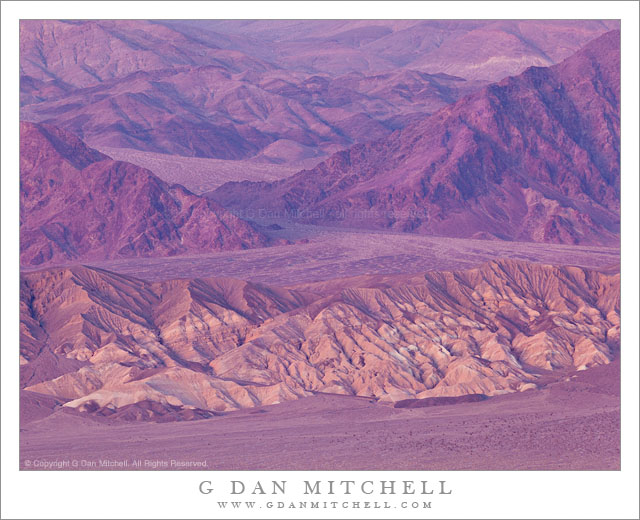
Kit Fox Hills and Death Valley Buttes, Dusk - Post-sunset light on the Kit Fox Hills, Death Valley Buttes, and the slopes of the Grapevine Mountains, Death Valley National Park
Post-sunset light on the Kit Fox Hills, Death Valley Buttes, and the slopes of the Grapevine Mountains, Death Valley National Park

Kit Fox Hills and Death Valley Buttes, Dusk. Death Valley National Park, California. January 3, 2012. © Copyright 2012 G Dan Mitchell – all rights reserved.

Post-sunset light on the Kit Fox Hills, Death Valley Buttes, and the slopes of the Grapevine Mountains, Death Valley National Park.

The view of the eroded Kit Fox Hills and the larger masses of Death Valley Buttes beyond with ascending ridges and valleys of the Amargosa Range beyond is one that I’ve been working on for a few years now. During the day these formations are interesting, but in many ways not much more so than any of scores of other hills, washes, rocky ridges and so forth throughout the park and other desert areas. But sometimes the light does absolutely incredible things to these hills along the east side of the Valley.

I first saw this happen during a previous visit when evening clouds lit up in astonishing and almost surreal ways after the sun had set. As the sky to the west of Death Valley began to glow in the post-sunset light a wash of amazing and intense color began to fill the scene. I’m not even sure how to describe the color. Rose? Purple? Pink? Some combination of the three and more? At that time I was shooting from a small hill in a less visited portion of the Valley, and I I photographed a large “fan” along the base of huge mountains not far from Stovepipe Wells. While the colors in that photograph are, indeed, real, I have a heck of a time convincing people that this is the case. I end up doing so much explaining that I don’t show the photograph all that often!

This light is similar, though a bit less intense. The light was fading quickly at this point, and I only had a few moments of this particularly beautiful light, which might have been hard to see in person since it was getting late. I photographed this from yet another spot that it just a bit off the beaten track, though not far at all from some very popular areas. In fact, as I worked alone as the evening came on, I could swing my camera around and use my longest focal length to see hordes of people visiting and photographing another nearby feature, oblivious to the light in this spot far to their east.

G Dan Mitchell is a California photographer whose subjects include the Pacific coast, redwood forests, central California oak/grasslands, the Sierra Nevada, California deserts, urban landscapes, night photography, and more.
Blog | About | Flickr | Twitter | FacebookGoogle+ | 500px.com | LinkedIn | Email

Text, photographs, and other media are © Copyright G Dan Mitchell (or others when indicated) and are not in the public domain and may not be used on websites, blogs, or in other media without advance permission from G Dan Mitchell.

Lamp Post, Brooklyn Bridge

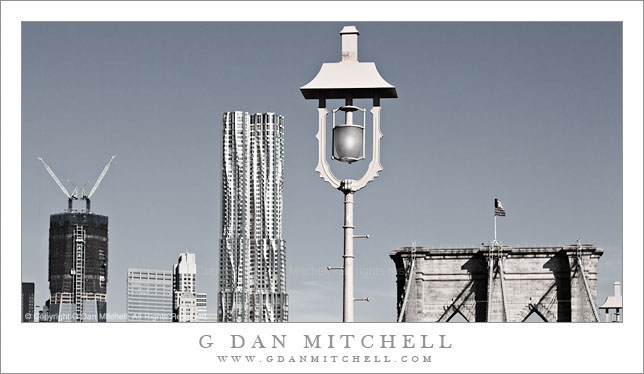
Lamp Post, Brooklyn Bridge - A Brooklyn Bridge lamp-post stands against a backdrop of several iconic lower Manhattan structures, New York City

Lamp Post, Brooklyn Bridge. New York City, New York. August 23, 2011. © Copyright 2011 G Dan Mitchell – all rights reserved.

A Brooklyn Bridge lamp-post stands against a backdrop of several iconic lower Manhattan structures, New York City.

I was surprised to find that I apparently never posted this photograph after our August trip to New York City. We had taken the subway over to Brooklyn very early in the morning to meet our son, and then wandered around some areas of Brooklyn near the waterfront where there is a view of lower Manhattan. Eventually we worked our way over to the Bridge with the plan being to walk back to Manhattan.

As we walked along I noticed several things that seem to characterize this bridge. Some of the features are pretty obvious to the point of being iconic – the pattern of the support cables for example. But these lamps kept distracting me, so I decided to see how I could photograph them. At this point, it occurred to me that I could actually leave out most of the bridge except for the lamp post (and a bit of the top of one of the towers) and then line it up with a bunch of other recognizable stuff on the lower Manhattan skyline. I chose to desaturate this image quite a bit in post, which explains the somewhat unusual color palette.

G Dan Mitchell is a California photographer whose subjects include the Pacific coast, redwood forests, central California oak/grasslands, the Sierra Nevada, California deserts, urban landscapes, night photography, and more.
Blog | About | Flickr | Twitter | FacebookGoogle+ | 500px.com | LinkedIn | Email

Text, photographs, and other media are © Copyright G Dan Mitchell (or others when indicated) and are not in the public domain and may not be used on websites, blogs, or in other media without advance permission from G Dan Mitchell.

Red Wing Blackbird, Fence Post

Red Wing Blackbird, Fence Post

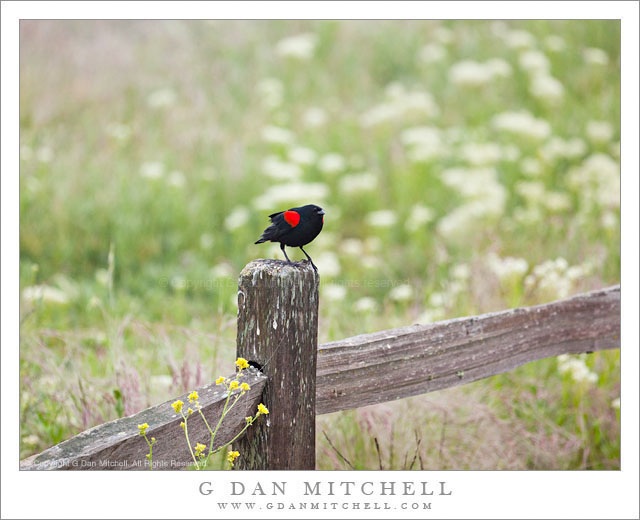
Red Wing Blackbird, Fence Post. Calero Hills, California. April 18, 2009. © Copyright 2009 G Dan Mitchell – all rights reserved.

A redwing blackbird pauses atop a fence post in front of central California oak/grassland, Calero County Park.

Photographed on the same morning as another recent shot of this same type of bird, the bright red upper wings of this redwind blackbird provide a striking contrast to its jet black body. This bird was on a fence surrounding an old manmade pond at the Calero County Park south of San Jose, California – a place that I can drive to in little more than 15 minutes, and where I have hiked extensively for a number of years. These birds often flock around this small lake on winter and early spring mornings. Here it was still overcast, though the low fog from earlier in the morning was now dispersing.

G Dan Mitchell is a California photographer whose subjects include the Pacific coast, redwood forests, central California oak/grasslands, the Sierra Nevada, California deserts, urban landscapes, night photography, and more.
Blog | About | Flickr | Twitter | FacebookGoogle+ | 500px.com | LinkedIn | Email

Text, photographs, and other media are © Copyright G Dan Mitchell (or others when indicated) and are not in the public domain and may not be used on websites, blogs, or in other media without advance permission from G Dan Mitchell.

What a Photograph Is and What It Ain’t

Every so often I post something lengthy in some photography forum or another, and sometimes I want to get as much mileage out of it as a can… so I share it here. Recently there was a discussion about exposure blending and HDR and related stuff in one such forum and people were trying to decide whether HDR is a good, bad, useful, or indifferent thing. I posted a few times in that thread, but here is the final thing I added.

A poster read and quoted the following:

With our knowledge of post-processing techniques, are we involuntarily pre-disposed to see what could have been rather than what is? Does that limit our ability to appreciate the “what is”?

And then responded this way:

It definitely didn’t seem to limit Ansel’s appreciation of what is. You can see quotes throughout all of his books for many varying scenes on how beautiful it was. But then he will also say that he envisioned the final print as ‘stronger’ and did what was necessary to achieve his vision of the scene. Unless you aren’t talking about a live scene but rather a photo – a ‘plain’ photo that tried to capture ‘what is’. I don’t photograph to try and recreate what is. I would find that a waste of time and boring and leaving little in the way of artistic interpretation of the scene. I try to create a photograph using whatever tools necessary to achieve my vision of a given scene and hopefully with a somewhat unique outcome. But I will never limit myself to trying to replicate ‘reality’ as my eye saw it. I still appreciate what is, just not in my photos.

After that I offered up:

This brings up an interesting subject and one that seems to afflict landscape photography discussions more than it does discussions of other types of photography, namely this notion that a photograph “captures” what is “real” and that this can and should be its goal – and, by extension, anything that “manipulates” that “real” thing is somehow wrong and should be called out.

There is very little support anywhere for that idea, at least in the pure form that some seem to think it might have. Virtually every landscape photographer has said or will tell you today and shows through his or her own work that the idea of a photograph as an objective record of “what was there” is both impossible and undesirable. “Recording” the objective, physical nature of the subject – whatever the heck that even is – is almost completely missing the point.

First, it is impossible.

If we assume that the landscape that we see when in its actual presence at the time of the exposure is an objective and real thing, it is obvious that the camera cannot accurately capture that thing. There is a whole list of reasons for this to be the case, and it could include the following and more:

  1. The reality of the place is a continuum of light and seasons and atmosphere and more, yet the photograph only “captures” a tiny slice of the continuum that defines that subject.
  2. The camera cannot record all of the elements that define the nature of that subject – not the movement of air, the smell, the warmth of the sun, the exertion required (or not) to be there, and much more.
  3. The camera cannot “see” the scene the same way that our visual system does – which is the primary subject of this thread. I’ll just point out that bright clouds don’t blow out and shadows are not blocked and leaves don’t blur in the wind when we use our visual system to view them directly.
  4. The photographer’s most basic choices “edit” and transform the reality of the scene in important ways: where to place the camera, when to click the shutter, what to include/exclude from the scene, focal length, whether aperture choices make everything in focus or are selective, what the shutter speed does to moving elements of the scene, and much more.
  5. Other things that would make this list too long for this thread… ;-)

Second, even if it were possible it would be undesirable.

Let’s use Adams as an example. What moves many about his photographs is not the extent to which they are objectively “real” – fundamentally, they are not real. (The last time I checked, the world was not black and white.) What sets his work apart is the way that he used the tools at hand to interpret (not literally reproduce) the subjects of his photographs and the resulting personality and point of view that are expressed in his work. In other words, the literal subjects were, arguably, primarily a means for Adams to share his point of view and his passions through his photographs. In the end, the photographs tell us more about Adams than they tell us about his subjects. (I used Adams here because he is most likely to be known to all reading the thread, but virtually any other “landscape” photographer’s work would serve as well.)

To loop back to the thread, virtually all serious landscape (and other) photographers understand that it is an essentially unquestioned truth that photographs do not and cannot “accurately” portray the real subject, that they inherently (and aren’t we glad!) express a point of view, and that the notion of a pure “unmanipulated” “capture” is a strange and impossible concept. (Yet, for reasons that I won’t explore here, it seems to persist…)

This means that things are complicated. There is no “right” mode of expression, no “right” or wrong techniques, and no “right” type or amount of modification of a photograph in post. It is all relative and subjective. Some who like to imagine that a world of absolutes would simplify things find this difficult to understand and accept. Wouldn’t it be simpler if we could just declare that HDR or exposure blending or adding saturation or using curves or cloning out a spot were “wrong” because they were manipulations of the original “truth” of the scene and dismiss them as being objectively wrong or even dishonest, unethical, or immoral? But we can’t, if for no other reason than once you start down that absolutist road you would have to exclude most or arguably even all photography.

In the end it is about judgment and taste and the power of the photographer’s personal expression – and not simply an accounting of which techniques were used. Perhaps the least important thing about a photograph is how it was made.