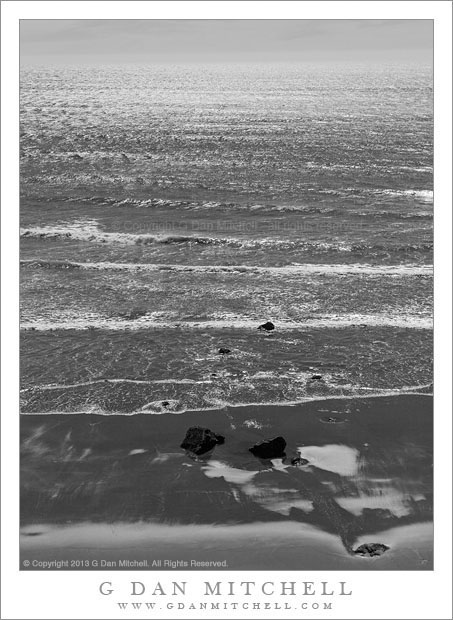
The incoming swell stretches toward that distant horizon beyond a few rocks on an Oregon beach
As we drove south along the Oregon coast in August we passed through Port Oxford. Just below this town the highway briefly curved landward before heading south again, traveling along the edge of a long and wide beach featuring impressive sea stacks and long strings of waves coming in off of the Pacific. I found a spot with a few dark, back-lit rocks to break up the uniformity of the horizontal lines of beach, surf, horizon, and sky, and shot straight toward the sun and its brilliant reflections on the surface of the ocean.
G Dan Mitchell is a California photographer and visual opportunist whose subjects include the Pacific coast, redwood forests, central California oak/grasslands, the Sierra Nevada, California deserts, urban landscapes, night photography, and more. Blog | About | Flickr | Twitter | Facebook | Google+ | 500px.com | LinkedIn | Email
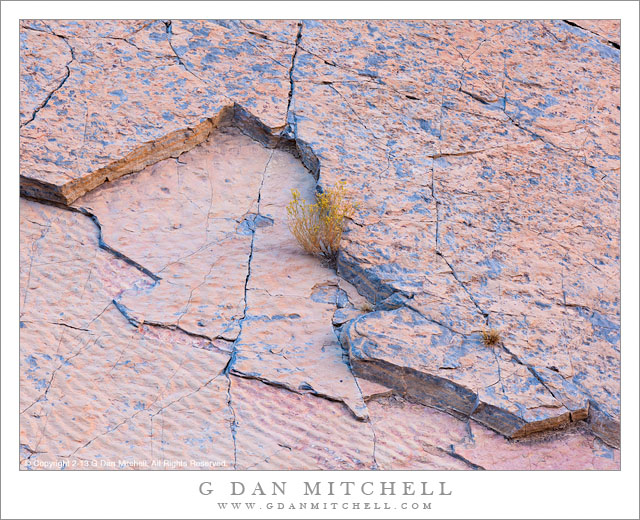
Pink and blue canyon wall and plants in midday light reflected from a nearby cliff
This is the second photograph I made along this section of curiously colorful cliff face deep in the “narrows” of a Death Valley National Park canyon. I have visited this place a number of times – it isn’t all that hard to get to – and often found it to be a very challenging photographic subject. I have shot it before, but mostly made it work by including people in the frame or by shooting subjects above the canyon rather than at the bottom. Because it is so deep – and it lacks the beautiful reddish rock of the Southwest – the depths of the canyon are often simply dark and somewhat drab.
As I passed through this time I took a slower pace than sometime, and I’m sure I saw things that I had overlooked before. This was certainly the first time that I had noticed the pink tinge to the rocks in this spot, much less the subtle blue tones of the underlying layers, the interesting rippled patterns, and the glow of light from an opposite canyon wall. I almost kept going but something told me to slow down and spend a bit of time here looking around, and I finally decided to see what compositions I could make out of the cracked rock and very sparse plants.
G Dan Mitchell is a California photographer and visual opportunist whose subjects include the Pacific coast, redwood forests, central California oak/grasslands, the Sierra Nevada, California deserts, urban landscapes, night photography, and more. Blog | About | Flickr | Twitter | Facebook | Google+ | 500px.com | LinkedIn | Email
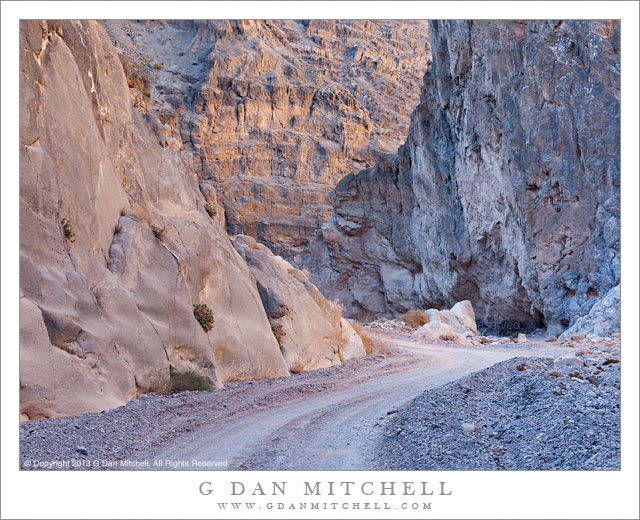
Titus Canyon road passes through the Narrows as light reflects down from canyon walls high above
Titus Canyon road is a well-known “attraction” in Death Valley National Park, traveling from the eastern park boundary in the Amargosa Valley near the town of Beatty, Nevada over the Grapevine Mountains and then down to Death Valley itself. It is also known as a fairly rough road, subject to washouts and closures after storms – not a true four-wheel-drive road, but certainly not for the faint of heart of those who are not accustomed to rough desert and mountain driving. (Many chose to forgo the long drive and instead hike into the canyon from its mouth, from which the spectacular “narrows” section is easily accessible.)
I have been getting to better know the country through which this road passes as I’ve driven it many times during the past decade or so. More recently I have been slowing down and taking nearly the full day to drive its length – and in doing so I am able to see and photograph things that I used to miss. Oddly, since it is often regarded as the main attraction of the route, I’ve often found it very difficult to photograph the narrows section near the end of the road just before it spills out at the top of a giant alluvial fan along the edge of Death Valley. Perhaps it is the predominantly gray color of the rocks – once you’ve photographed the canyons of the Southwest, California rock just looks so drab! This time I think I passed through the narrows section at what must have been just about the ideal time of day and season, and light hitting upper canyon walls was reflecting down into the bottom of the canyon and creating some interesting, albeit subtle, colors and soft reflections on the rocks.
G Dan Mitchell is a California photographer and visual opportunist whose subjects include the Pacific coast, redwood forests, central California oak/grasslands, the Sierra Nevada, California deserts, urban landscapes, night photography, and more. Blog | About | Flickr | Twitter | Facebook | Google+ | 500px.com | LinkedIn | Email
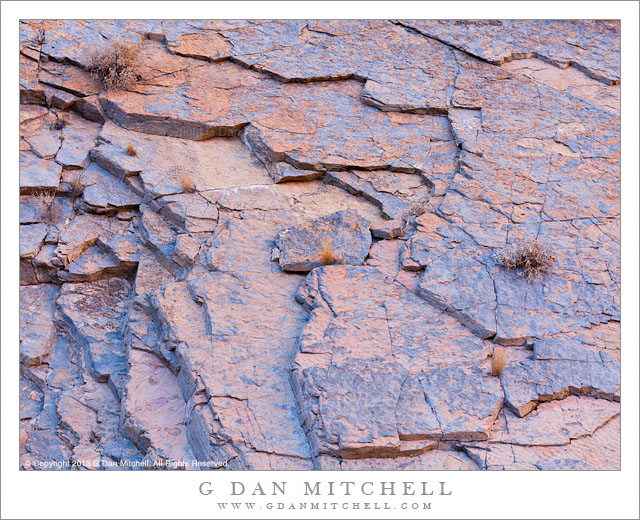
A few plants grow on fractured pink and blue canyon rock illuminated by light reflected from nearby cliffs
In my experience, the geology of Death Valley mostly features relatively subdued coloration. While this geology is laid bare by the lack of thick vegetation, the colors are mostly shades of gray, white, tan, with occasional blues and greens from mineral deposits. But you rarely will see here the intense colors of, say, the sandstone formations of the Southwest. (Sorry to disappoint anyone, but if you have seen some photographs featuring intensely colorful deposits in places like “Artist Palette,” you may be a bit disappointed to see the real thing!) This is not entirely bad news, as subtle colors can also be very beautiful, and even these colors can become intensified in the right light… and that does occur in Death Valley.
This photograph perhaps tells a story that is partially about the color of rock and a bit about the light, and is also about keeping my eyes open for the fleeting and sometimes surprising examples of color. I was in a place that is not known for brilliant colors, at least not in the walls of this narrow canyon. As I passed through a narrow and twisting section, two things happened, and even though I’ve been there before this was the first time that I noticed them at this point. First, the steep, almost seems cliff-like wall has fractured layers and slabs that remind me a bit of exfoliating granite that I know so well from the Sierra. These layers alternate pinkish rock (that this non-geologist thinks look like some sort of sandstone) with inner layers that have a blue cast. Second, at the right time of day when the light strikes the upper walls of the narrow canyon, the light reflects down into its depths and warms the color of the light, emphasizing these subtle colors to produce what is, at least for Death Valley, some rather striking coloration.
G Dan Mitchell is a California photographer and visual opportunist whose subjects include the Pacific coast, redwood forests, central California oak/grasslands, the Sierra Nevada, California deserts, urban landscapes, night photography, and more. Blog | About | Flickr | Twitter | Facebook | Google+ | 500px.com | LinkedIn | Email
Photographer and visual opportunist. Daily photos since 2005, plus articles, reviews, news, and ideas.
Manage Consent
To provide the best experiences, we use technologies like cookies to store and/or access device information. Consenting to these technologies will allow us to process data such as browsing behavior or unique IDs on this site. Not consenting or withdrawing consent, may adversely affect certain features and functions.
Functional
Always active
The technical storage or access is strictly necessary for the legitimate purpose of enabling the use of a specific service explicitly requested by the subscriber or user, or for the sole purpose of carrying out the transmission of a communication over an electronic communications network.
Preferences
The technical storage or access is necessary for the legitimate purpose of storing preferences that are not requested by the subscriber or user.
Statistics
The technical storage or access that is used exclusively for statistical purposes.The technical storage or access that is used exclusively for anonymous statistical purposes. Without a subpoena, voluntary compliance on the part of your Internet Service Provider, or additional records from a third party, information stored or retrieved for this purpose alone cannot usually be used to identify you.
Marketing
The technical storage or access is required to create user profiles to send advertising, or to track the user on a website or across several websites for similar marketing purposes.

 G Dan Mitchell is a California photographer and visual opportunist whose subjects include the Pacific coast, redwood forests, central California oak/grasslands, the Sierra Nevada, California deserts, urban landscapes, night photography, and more.