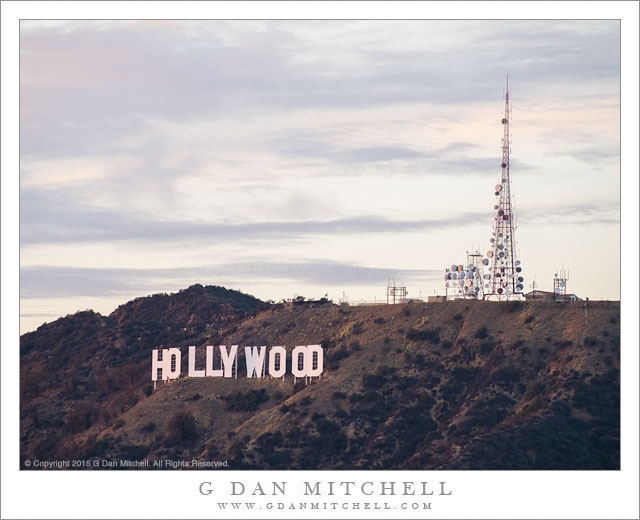
Yes. That sign. I suppose that everyone (probably) needs a photograph of the thing and, believe it or not, this is my first. There I was. There the sign was. The light was attractive. I photographed it. ;-)
During a four-day visit to Southern California we ended up making a drive up north to central Los Angeles to visit a museum, and since I had never been to the Griffith Observatory before — really! — we decided to correct that. In the late afternoon we headed to Griffith Park with, or so it seemed, about half of the population of the Los Angeles basin. We eventually caught a shuttle and soon found ourselves among the crowd at the observatory. Crowds aside, it is quite a place… and there, off to the right, was the famous sign. As something of an iconophobe, I have to admit that I did not realize that it would be visible from here!
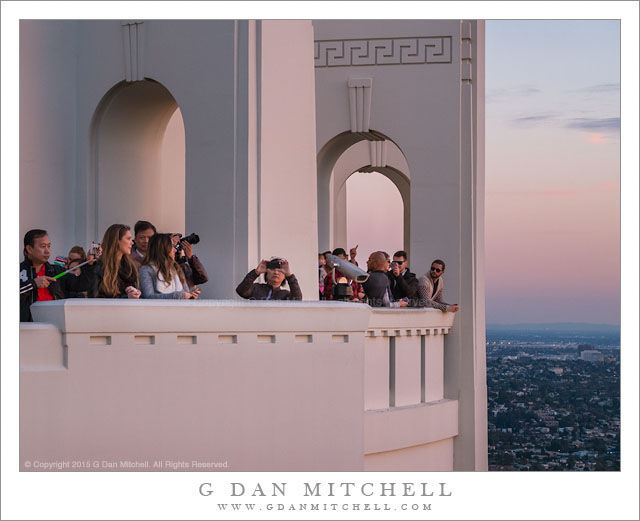
Visitors to Griffith Observatory overlook Los Angeles twilight.
We were in Southern California over the Thanksgiving holiday, visiting our daughter and son-in-law. On the weekend we decided to head up to Los Angeles for various things, including a visit to the Frans Lanting show at the Annenberg Space for Photography. We finished up there, headed out for food (of course!) and then decided to head to Griffith Park.
We were apparently among approximately 350,000 people with the same idea! I’m not sure what a typical crowd looks like here, but this one was huge. We finally abandoned our rental car well below the observatory and found a shuttle bus that went up the hill. We arrived a bit before sunset and found that hordes were already there. But I can see why — it is a spectacular location. Although I was only carrying my “little camera,” I decided to see what I could come up with. Eventually I photographed the actual sunset, but first I turned the camera towards the people crowded onto the walkways around the observatory and standing in the beautiful light watching the evening develop.
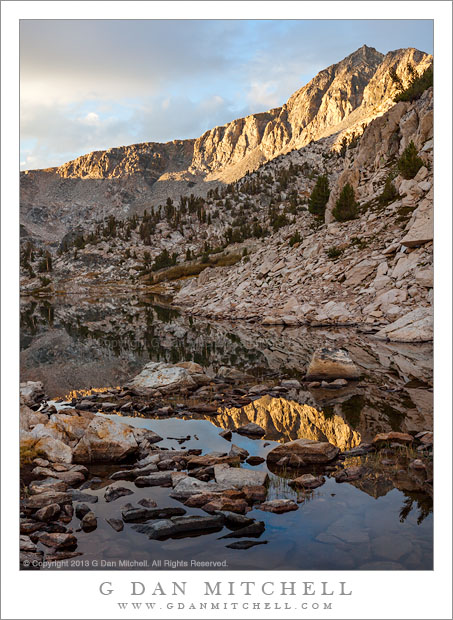
Early morning light and cloud-filled sky reflected in the surface of an unnamed sub-alpine lake in the southern Sierra Nevada range, Kings Canyon National Park
This may have been the morning with the most dramatic light during our mid-September trip to photograph in the High Sierra back-country of Kings Canyon National Park, when a group of four photographs spent 6 nights in a beautiful 11,000′ location not far to the west of the crest of the range. Our camp was on a small rise just above my camera position, and we spent out days either looking at variations on essentially this view or wandering about in the alpine “neighborhood,” exploring and making photographs.
I have some experience with Sierra weather and I can often make some decent judgments about what is going on and where things may be headed. However, during this “shoulder season” when the transition from summer to fall and towards winter is taking place, all bets are off! During the summer, when it isn’t just another blue sky day in the Sierra, a common pattern starts with fairly clear weather, introduces a few small clouds by mid or late morning, and then builds toward possible thunderstorms and afternoon/evening showers. But this morning began with overcast that was distinctly un-thunderstorm-like, the sort of thing that I find almost impossible to read. Were we seeing some evidence of a larger pattern related to the onset of winter-season Pacific fronts? Was it merely a local weather situation that would dissipate as the day wore on? In the end, we did end up with showers late in the afternoon – as we did on over half of the days on this trip – but on this morning the only thing I knew for certain was that the light on the peaks below the cloud-dotted sky was exceptionally beautiful.
G Dan Mitchell is a California photographer and visual opportunist whose subjects include the Pacific coast, redwood forests, central California oak/grasslands, the Sierra Nevada, California deserts, urban landscapes, night photography, and more. Blog | About | Flickr | Twitter | Facebook | Google+ | 500px.com | LinkedIn | Email
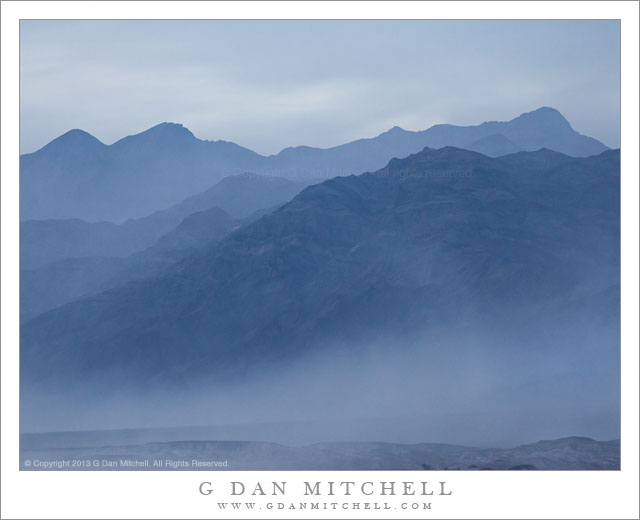
Strong desert winds whip up a dusk sandstorm below the Grapevine Mountains, Death Valley National Park
To look at many photographs – including my own – of places like Death Valley, a viewer unfamiliar with the desert might begin to imagine a place of clear skies (with appropriate beautiful clouds), brilliant sun, intense colors, flowers, plants, and much more. While all of those things can be found in the desert, the fact that they are often more the exception than the rule may at least partially account for their popularity as photographic subjects. Yes, I have seen stunningly beautiful and colorful sunrises and sunsets, while standing in quiet and still air and in comfortable temperatures. However, I have also experienced rain, snow, very powerful winds, sand and dust storms, intense cold, nearly debilitating heat, and more.
This photograph was made during some of the less-than-lovely conditions that are quite common at this time of year, namely very strong winds and the resulting sand storm. Near the middle of the day I had caught my first glimpses of sand/dust rising up into the sky from some nearby dunes. Having been through this before, I was not fooled by the fact that the air remained almost completely still at my location at that time – and it wasn’t long at all until the winds become more general and began to lift sand and dust into the air across the entire end of the valley and then carry clouds of this material northward. I cannot say that I enjoy being in such conditions at all. Sand gets into everything, stuff that isn’t tied down blows away, breathing and opening your eyes can be a challenge. (Later, when I returned to camp in the darkness, I couldn’t face the idea of breaking out the camp stove and trying to cook and eat in the strong winds… so I wimped out and went to the restaurant at Stove Pipe Wells!) But as uncomfortable as these conditions can be, they are also visually special and impressive, so I headed out to the far side of the Valley, figuring that I might be able to shoot back into and across the sand storm while remaining on its edge. I shot through the late afternoon and continued as the sun set, leaving behind the murky, dust-filled atmosphere that shrouded everything. As twilight came on, the winds shifted, and dust clouds that had been blowing away from me began to move south down the valley towards me, obscuring the base of the Grapevine Mountains along the edge of Death Valley.
G Dan Mitchell is a California photographer and visual opportunist whose subjects include the Pacific coast, redwood forests, central California oak/grasslands, the Sierra Nevada, California deserts, urban landscapes, night photography, and more. Blog | About | Flickr | Twitter | Facebook | Google+ | 500px.com | LinkedIn | Email
Photographer and visual opportunist. Daily photos since 2005, plus articles, reviews, news, and ideas.
Manage Consent
To provide the best experiences, we use technologies like cookies to store and/or access device information. Consenting to these technologies will allow us to process data such as browsing behavior or unique IDs on this site. Not consenting or withdrawing consent, may adversely affect certain features and functions.
Functional
Always active
The technical storage or access is strictly necessary for the legitimate purpose of enabling the use of a specific service explicitly requested by the subscriber or user, or for the sole purpose of carrying out the transmission of a communication over an electronic communications network.
Preferences
The technical storage or access is necessary for the legitimate purpose of storing preferences that are not requested by the subscriber or user.
Statistics
The technical storage or access that is used exclusively for statistical purposes.The technical storage or access that is used exclusively for anonymous statistical purposes. Without a subpoena, voluntary compliance on the part of your Internet Service Provider, or additional records from a third party, information stored or retrieved for this purpose alone cannot usually be used to identify you.
Marketing
The technical storage or access is required to create user profiles to send advertising, or to track the user on a website or across several websites for similar marketing purposes.

 G Dan Mitchell is a California photographer and visual opportunist. His book, “California’s Fall Color: A Photographer’s Guide to Autumn in the Sierra” is available from Heyday Books and Amazon.