
Tag Archives: stock

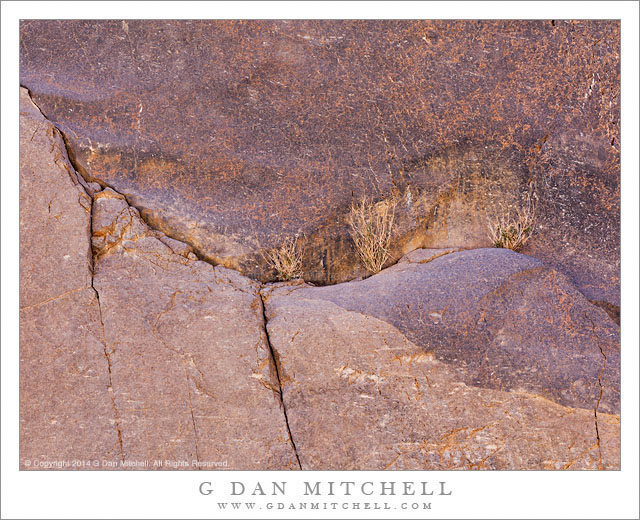
Curves, Desert Canyon

Curves, Desert Canyon

Curves, Desert Canyon. Death Valley National Park. April 1, 2014. © Copyright 2014 G Dan Mitchell – all rights reserved.

Small dry plants grow in a curving crack in a two-toned desert canyon, Death Valley National Park

Passing through this deep and narrow canyon, I always watch the rock walls for little odds and ends of shape and form and color and occasional surprising bits of vegetation. If you had asked me about this section of canyon after my first passage some years ago, I might well have mentioned how narrow and deep it is and perhaps how dusty. I might have commented on the way the bottom remains in shade even in the midday heat. But repeated visits have shown me that there is much more to see, and the fact that I still see new things on every visit tells me that there is far more yet to be discovered.

On one hand this is a pretty plain photograph of some rocks with cracks running through them. On the other hand, I think there are some stories behind the scent that are interesting to contemplate. At least I think so! If you look closely you will see some very dry plants that have grown in this curving crack. It is hard to imagine a more inhospitable place for a plant to grow—perhaps a dozen feet up the nearly solid rock wall of an arid and hot desert canyon. Yet somehow these plants found a way, as did and do many other plants throughout this desert landscape. Behind the small, delicate, and even intimate element of these plants is the backdrop of a small section of a massive rock wall that towers out of sight above the frame of the photograph. Here is a boundary between two sorts of rock—I’m not enough to a geologist to make technical observations, but I do note that the upper layer is darker and more solid while the lower is lighter and has more cracks in its surface. From the upper left a crack follows the junction of the two rock layers, but for some reason the crack leaves the junction and curves back upwards into the darker rock, and it is in this surprising bit of geological dissonance that the small plants took root.

G Dan Mitchell is a California photographer and visual opportunist whose subjects include the Pacific coast, redwood forests, central California oak/grasslands, the Sierra Nevada, California deserts, urban landscapes, night photography, and more.
Blog | About | Flickr | Twitter | FacebookGoogle+ | 500px.com | LinkedIn | Email

Text, photographs, and other media are © Copyright G Dan Mitchell (or others when indicated) and are not in the public domain and may not be used on websites, blogs, or in other media without advance permission from G Dan Mitchell.

Spring Oaks, Sierra Foothills

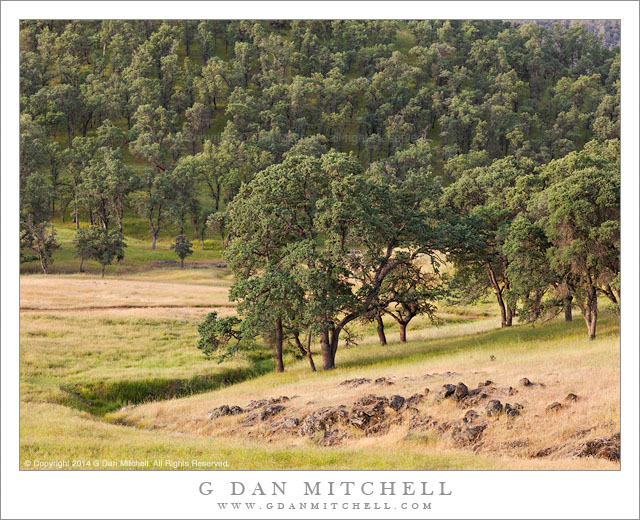
Spring Oaks, Sierra Foothills

Spring Oaks, Sierra Foothills. Tuolumne County, California. May 4, 2014. © Copyright 2014 G Dan Mitchell – all rights reserved.

Spring oak trees and meadows, Sierra Nevada foothills

In this drought year Tioga Pass, the trans-Sierra route through Yosemite National Park, opened earlier than usual. For me, the opening of this pass marks the end of the winter season and the beginning of the summer, with its easier access to the high country. Virtually every year I mark this event by visiting the Yosemite high country on the opening day or as close to it as possible. This year’s early May opening fell on a busy weekend, so I couldn’t be there on the actual opening day, but two days later I was able to squeeze in a one-day up-and-back trip from the San Francisco Bay Area.

I was up way before dawn and on the road before 4:00 AM. During the winter months such a start time would get me into the Sierra for dawn photography, but with the longer days at this time of year the sun rose when I was still in the foothills. While many might regard the foothill terrain as something to pass through on the way to the more interesting goal, I have come to love the soft, curving foothills, with their covering of grasses (green at this time of year, but brown to golden most of the time) and oak trees, either standing individually or as part of large oak forests. When I came to this spot, where I have stopped to photograph before, I found the meadows in that transitional state between the remaining greens of this year’s (meager) spring moisture and browns of California’s summer.

G Dan Mitchell is a California photographer and visual opportunist whose subjects include the Pacific coast, redwood forests, central California oak/grasslands, the Sierra Nevada, California deserts, urban landscapes, night photography, and more.
Blog | About | Flickr | Twitter | FacebookGoogle+ | 500px.com | LinkedIn | Email

Text, photographs, and other media are © Copyright G Dan Mitchell (or others when indicated) and are not in the public domain and may not be used on websites, blogs, or in other media without advance permission from G Dan Mitchell.
Light and Dark Sandstone

Light and Dark Sandstone

Light and Dark Sandstone. Point Lobos State Reserve, California. April 27, 2014. © Copyright 2014 G Dan Mitchell – all rights reserved.

A bit or remaining red sandstone sits on top of an underlying layer of lighter rock, Point Lobos State Reserve

Near the end of April I found time for a quick visit to Point Lobos State Reserve, south of Carmel in the Monterey Peninsula/Big Sur region. This is a place I have photographed for many years, so I know specific rocks and trees quite well. Photographing here often provides a sort of tension between continuing to refine how I see things that I have known for decades and trying to locate new subjects. In addition to the constantly changing patterns of the Pacific Ocean itself and the mostly stable elements of the rocky shoreline and forests, the weather always changes and the wildlife provides unending variations.

When I decided to go there on this morning I should have remembered that this is the weekend of the annual Big Sur Marathon, which mostly closes sections of the coast highway in the area for an hour or more at a time. But I didn’t remember… until I got to the Carmel Valley road block. I lined up for the periodic car caravans that were scheduled to leave every 90 minutes, picked up a cup of coffee and waited. Eventually we followed a highway patrol vehicle down the highway, and I soon turned off into an almost entirely deserted Point Lobos State Reserve. The solitude I found on this day when few others came to the park made up for the delay in getting there! Because the light was filtered through high clouds I decide to spend some time photographing these beautifully sea-sculpted sandstone formations along the rocky shoreline.

G Dan Mitchell is a California photographer and visual opportunist whose subjects include the Pacific coast, redwood forests, central California oak/grasslands, the Sierra Nevada, California deserts, urban landscapes, night photography, and more.
Blog | About | Flickr | Twitter | FacebookGoogle+ | 500px.com | LinkedIn | Email

Text, photographs, and other media are © Copyright G Dan Mitchell (or others when indicated) and are not in the public domain and may not be used on websites, blogs, or in other media without advance permission from G Dan Mitchell.

Desert Holly, Black Formation

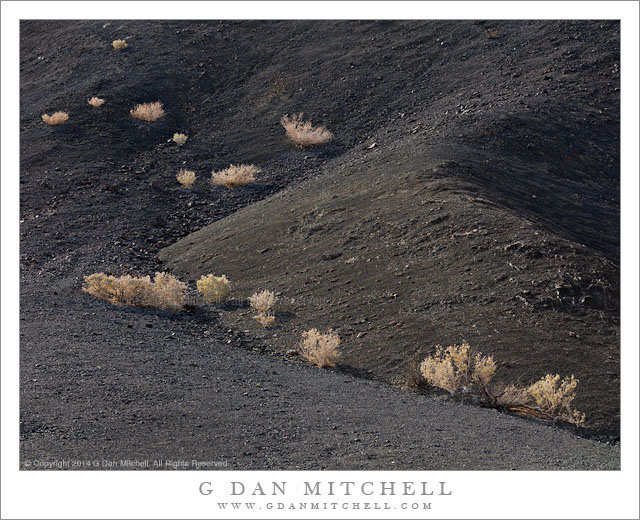
Desert Holly, Black Formation

Desert Holly, Black Formation. Death Valley National Park, California. April 3, 2014. © Copyright 2014 G Dan Mitchell – all rights reserved.

Desert Holly plants grow on a black formation, Death Valley National Park

This area of Death Valley National Park, not far from the popular Zabriskie Point overlook, shares some of the same geology with that often crowded location. However, you don’t have to go too far from that parking lot to find locations where you can be almost alone, especially early in the morning. This area is one such spot—easily accessible but not marked in any sort of obvious way. Yet it is a great place to spend hours looking at geological forms, sparse plants, and spare effects of light and color.

The desert holly plants grow in some of the most arid locations, and often appear to be the only plants that are able to survive where it grows. You might find a plant or two in a rocky wash, growing out of a crack in a rock wall, or on this dark (volcanic?) material. One can only imagine how hot this black earth must get in the heat of the Death Valley summer! Besides often being the only visible living thing in some very stark areas, desert holly also can change its appearance depending upon how the leaves are doing and on where the light comes from. Light from behind the plant can make it take on an almost golden glow.

G Dan Mitchell is a California photographer and visual opportunist whose subjects include the Pacific coast, redwood forests, central California oak/grasslands, the Sierra Nevada, California deserts, urban landscapes, night photography, and more.
Blog | About | Flickr | Twitter | FacebookGoogle+ | 500px.com | LinkedIn | Email

Text, photographs, and other media are © Copyright G Dan Mitchell (or others when indicated) and are not in the public domain and may not be used on websites, blogs, or in other media without advance permission from G Dan Mitchell.