
Tag Archives: white

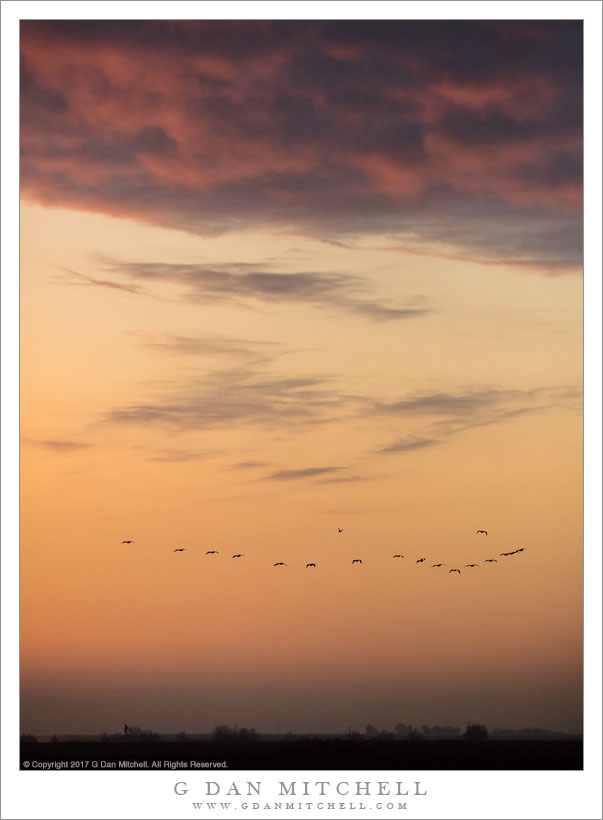
White Pelicans, Winter Sky

White Pelicans, Winter Sky
A flock of white pelicans flies toward post sunset light above the San Joaquin Valley

White Pelicans, Winter Sky. San Joaquin Valley, California. January 1, 2017. © Copyright 2017 G Dan Mitchell – all rights reserved.

A flock of white pelicans flies toward post sunset light above the San Joaquin Valley

There are many things about the winter landscape of the Great Central Valley of California that are worth of attention and photography: the agricultural lands, the distant mountains, but especially the vast sky with its cloud landscapes, and the birds. I made this photograph earlier this year — actually on the first day of 2017! I hope to be out photographing this same subject again on the first day of 2018, too.

For many years I’ve known about and been interested in the brown pelicans that are commonly found along the California coast. However, I’m almost embarrassed to admit (as a long time Californian) that I was completely unaware of the beautiful white pelicans that are found in many locations in the state, including these inland wetland areas. This group flew over in the twilight sky and lined up in a form paralleling that of the evening clouds.


G Dan Mitchell is a California photographer and visual opportunist. His book, “California’s Fall Color: A Photographer’s Guide to Autumn in the Sierra” is available from Heyday Books and Amazon.
Blog | About | Flickr | Twitter | FacebookGoogle+ | LinkedIn | Email


All media © Copyright G Dan Mitchell and others as indicated. Any use requires advance permission from G Dan Mitchell.

White-Faced Ibis

White-Faced Ibis
White-faced ibis wading in shallow water

White-Faced Ibis. San Joaquin Valley, California. December 1, 2017. © Copyright 2017 G Dan Mitchell – all rights reserved.

White-faced ibis wading in shallow water

Late each fall I begin heading out into California’s Great Central Valley to photograph migratory birds and the winter (plus a bit of autumn) landscape of this place. That landscape is largely agricultural, but Americans had enough foresight in the past — and one hopes we’ll return to those roots again soon — to put aside many areas in this midst of these areas for the use of birds, largely migratory birds who spend their summers thousand of miles to the north and then magically appear in my neighborhood during the colder months. Here, under the Central Valley’s open sky (often obscured by tule fog at this time of year!) I find cranes, herons, ibises, geese, egrets, hawks, eagles, and more.

Yesterday I made my first real bird photography foray of the new season. As usual, I was up and on the road many hours before dawn, arriving at my destination a half hour before sunrise to find the place socked in by tule fog so thick that bird photography wasn’t really possible at first. I took my time, slowing down to synchronize with the less-hectic flow of time here, and a bit later in the day came upon a group of ibises feeding near the edge of a pond. The coloration of ibises used to confuse me. Guides show everything from nearly black to quite colorful, but the first time I saw these birds they looked dark and, to be honest, somewhat drab. However, as this photograph shows, in the right light their feathers can produce a wild array of color including red, blue, green, yellow and more.


G Dan Mitchell is a California photographer and visual opportunist. His book, “California’s Fall Color: A Photographer’s Guide to Autumn in the Sierra” is available from Heyday Books and Amazon.
Blog | About | Flickr | Twitter | FacebookGoogle+ | LinkedIn | Email


All media © Copyright G Dan Mitchell and others as indicated. Any use requires advance permission from G Dan Mitchell.
Grove of Slender Aspens, Autumn

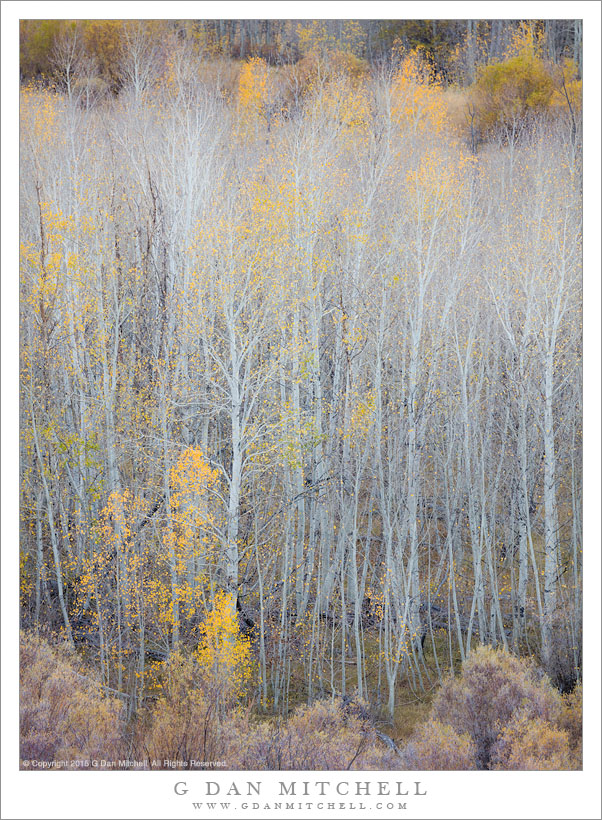
Grove of Slender Aspens, Autumn
An eastern Sierra grove of slender aspens with a hint of fall color remaining

Grove of Slender Aspens, Autumn. Eastern Sierra Nevada, California. October 10, 2015. © Copyright 2015 G Dan Mitchell – all rights reserved.

An eastern Sierra grove of slender aspens with a hint of fall color remaining

There are interesting subtleties to the autumn transition of aspen color in the eastern Sierra. Unlike forests in some other areas, where the trees are more similar across wide areas, and thus tend to change colors at the same time, in the Sierra the color change has many variations of region, climate, moisture, and elevation. It is quite possible to arrive at a grove to find that almost all of the leaves have fallen… only to visit another grove not too far away where the color change is still getting underway.

This is a somewhat unusual little grove. The trees are very slender and crowded closely tighter. They are also, generally, smaller than those in the more-or-less typical Sierra aspen grove, where trees may be larger but also tend to be bent and even misshapen. These slender trees stand tall and straight, and at the time I made the photograph they had lost nearly all of their leaves, leaving a somewhat ghostly forest of bare trunks.


G Dan Mitchell is a California photographer and visual opportunist. His book, “California’s Fall Color: A Photographer’s Guide to Autumn in the Sierra” is available from Heyday Books and Amazon.
Blog | About | Flickr | Twitter | FacebookGoogle+ | LinkedIn | Email


All media © Copyright G Dan Mitchell and others as indicated. Any use requires advance permission from G Dan Mitchell.
Great Egret, Airborne

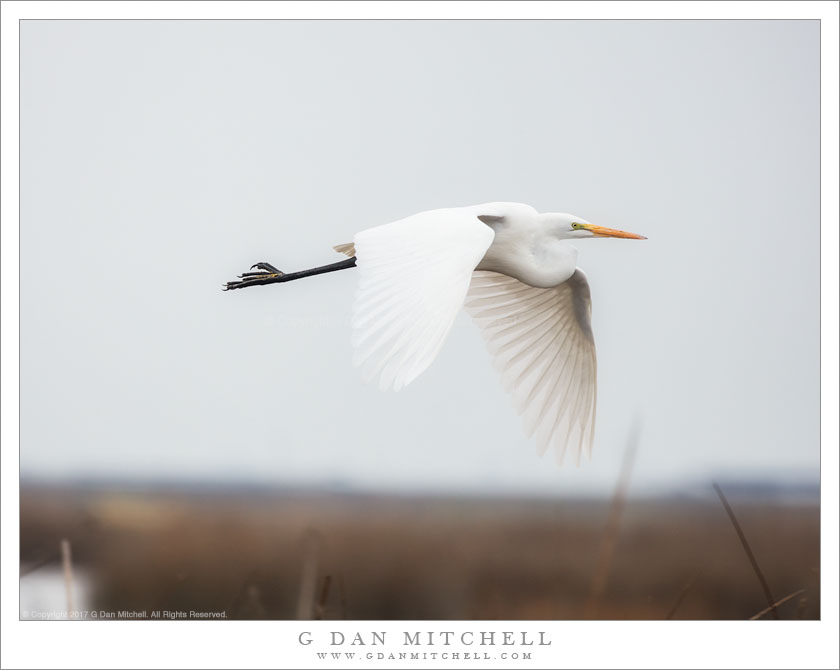
Great Egret, Airborne
A great egret flies past, skimming above wetland plants

Great Egret, Airborne. Central Valley, California. January 16, 2017. © Copyright 2017 G Dan Mitchell – all rights reserved.

A great egret flies past, skimming above wetland plants

In some ways these magnificent birds are very accessible, but in other they can be hard to photograph in interesting ways. They are common at the locations where I frequently photograph birds, and when I have decent cover (shooting from a vehicle or similar) I can frequently get relatively close to them without scaring them into flight. The key is a very slow and cautious approach and sensitivity to the body language of the bird — there are often hints when egrets think that I am getting too close. From just outside that boundary the egrets are large enough to fill the frame in good conditions, and I have lots of photographs of them on the ground feeding. Perhaps too many!

That’s the problem. An egret on the ground is interesting, but not often quite as interesting as an egret in the air. (Grounded egrets can be beautiful in the right light and with the right background and so forth.) In flight they are beautiful birds, typically using slow wing motion and often gliding, and they assume impressive poses when taking off and when landing. However, the lift off is sudden and the flight path typically takes the bird away from me. But sometimes I get lucky, as I did with this specimen. I was actually unaware of its presence and, in fact, it may have been unaware of mine. I had stopped to photograph something else when the bird suddenly flew into range from my left and passed in front of me as it made a gentle turn around my position. I’ve learned to react fairly quickly and to get the camera up and tracking, but in the best of circumstances it is still a challenge. The first couple of frames are almost humorously off-target, but then I found my subject and centered it in the frame as it passed by very closely.


G Dan Mitchell is a California photographer and visual opportunist. His book, “California’s Fall Color: A Photographer’s Guide to Autumn in the Sierra” is available from Heyday Books and Amazon.
Blog | About | Flickr | Twitter | FacebookGoogle+ | LinkedIn | Email


All media © Copyright G Dan Mitchell and others as indicated. Any use requires advance permission from G Dan Mitchell.