Tag Archives: wildlife

Stretching The Wings

Stretching The Wings
A Ross’s goose raises its wings in a San Joaquin Valley wetland pond

Stretching The Wings. © Copyright 2018 G Dan Mitchell – all rights reserved.

A Ross’s goose raises its wings in a San Joaquin Valley wetland pond

This weekend here in the San Francisco Bay Area it finally truly felt like the start of the summer season — even though the actual start of summer is still a few weeks away. It is hot! The sky is cloudless blue here, unless you head to the coast in the mornings. It is time to go outside in sunlight early in the morning. And by now these geese are somewhere above the Arctic Circle, collected in their remote breeding areas.

I photographed these last winter. I often don’t get this close, but I was already settled into a spot when the flock came to me! A large group landed very close. I remained quiet and still and they came even closer, where I was able to observe them as interacting individuals and not just as the totality of the flock.


See top of this page for Articles, Sales and Licensing, my Sierra Nevada Fall Color book, Contact Information and more.

G Dan Mitchell is a California photographer and visual opportunist. His book, “California’s Fall Color: A Photographer’s Guide to Autumn in the Sierra” is available from Heyday Books and Amazon.
Blog | About | Flickr | Twitter | Facebook | LinkedIn | Email


All media © Copyright G Dan Mitchell and others as indicated. Any use requires advance permission from G Dan Mitchell.
Five Cranes, Morning Sky

Five Cranes, Morning Sky
Five sandhill cranes pass overhead against blue morning sky

Five Cranes, Morning Sky. © Copyright 2018 G Dan Mitchell – all rights reserved.

Five sandhill cranes pass overhead against blue morning sky

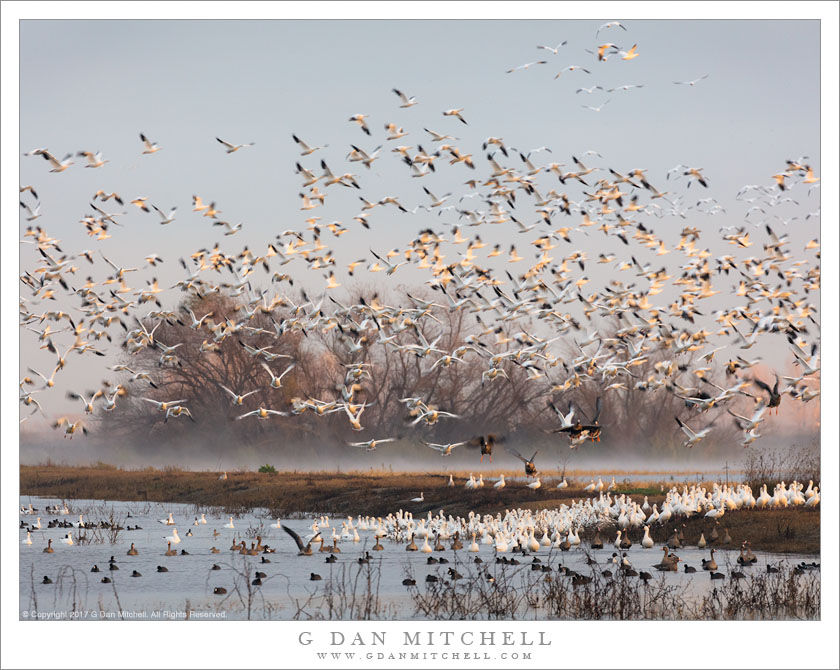
Cranes just might be on my mind this week due to a little snippet on a television program I saw last week. In it a couple of people, a photographer and a wildlife proponent, we sitting along the edge of a watery area in, if memory serves, the state of Nebraska. All it took in this brief clip was the sound of these birds, the site of them in flight and on the ground, and all of the associations with being in their ancient presence came back. If you’ve experienced it, you know — the moist air, the cold, the short winter days, and then the sound and sight of these birds.

There are lots of ways to photograph these birds. I often place them in the landscape, but here I wanted to focus on the birds themselves, as a group of them flew overhead in late-day light. Compared to certain other birds you might see in the same places and at the same times, the cranes have a more “stately” pattern of flight. They takeoff at a relatively low angle, and they often fly horizontally for a good distance before they gain much elevation. In smaller groups they fly beak-to-tail in undulating lines. Their wing motion is slower than that of, say, geese. Oddly, however, for birds that often seem so low-key, there are exceptions. One is the familiar “dance” that they do during mating season, when individuals extend their winds and jump into the air. In addition, I’ve sometimes caught then doing very strange things in flight — sudden twists and turns, beak pointed up toward the sky, and more.


See top of this page for Articles, Sales and Licensing, my Sierra Nevada Fall Color book, Contact Information and more.

G Dan Mitchell is a California photographer and visual opportunist. His book, “California’s Fall Color: A Photographer’s Guide to Autumn in the Sierra” is available from Heyday Books and Amazon.
Blog | About | <a href=”http://www.flickr.com/photos/gdanmitchel

Avocet, Sunset Reflection

Avocet, Sunset Reflection
An avocet feeds in shallow water reflecting sunset light

Avocet, Sunset Reflection. © Copyright 2018 G Dan Mitchell – all rights reserved.

An avocet feeds in shallow water reflecting sunset light

I remember, many years ago, taking a college class that included a section on birds in the San Francisco Bay Area. The birding gene didn’t initially take for me — that came many years later — but I remember what must have been a very effective presentation on differences among shore birds. The birds found along the edges of bodies of water vary greatly in size and shape, from very small to quite large, and their leg and bill sizes vary, too. What I recall is the obvious point, that I hadn’t thought of before, that each bird, with its long or short legs and its long or short bill, is adapted to a different niche in this environment, and even to differing depths of water.

The avocet is a striking bird in many ways. This one, like most that I’ve seen, was an almost solitary specimen. If another was nearby I did not see it. The bird has long legs, which it puts to use by wading in a few inches of water as it feeds. The long, curved beak allows it to reach down and pluck edibles out of the water. This one was feeding close to the shoreline and moving toward water that reflects the sunset sky, so I held still and waited for it to move into just the right position, where the colors of reflected sky were most strongly reflected in the water.


G Dan Mitchell is a California photographer and visual opportunist. His book, “California’s Fall Color: A Photographer’s Guide to Autumn in the Sierra” is available from Heyday Books and Amazon.
Blog | About | Flickr | Twitter | FacebookGoogle+ | LinkedIn | Email


All media © Copyright G Dan Mitchell and others as indicated. Any use requires advance permission from G Dan Mitchell.
Red-Wing Blackbird

Red-Wing Blackbird
A red-wing blackbird perched among wetland plants

Red-Wing Blackbird. © Copyright 2018 G Dan Mitchell – all rights reserved.

A red-wing blackbird perched among grasses

The red-wing blackbird (and the similar tri-color blackbird) are among those birds that are found all over the place here in California. I’ve encountered them in agricultural areas and on trails in coastal hills parks, in huge groups or as solitary individuals. They often perch, and they aren’t too hard to photograph with a long lens, though their very dark feathers can provide some exposure challenges. When they take to the air they often move quickly and can be hard to track.

The red patches are not always visible. In fact, when I first saw this individual I did not see them. But the bird seemed content to remain in one spot for a while, so I settled in with the bird in the viewfinder and waited. Typically the first thing I’ll do is to try to grab an initial photograph that is at least usable. But they I wait and watch for something beyond that, something that might show the animal in a special way. As I watched this bird, all of a sudden it puffed out its feathers and exposed those brilliant red patches for a few seconds.


G Dan Mitchell is a California photographer and visual opportunist. His book, “California’s Fall Color: A Photographer’s Guide to Autumn in the Sierra” is available from Heyday Books and Amazon.
Blog | About | Flickr | Twitter | FacebookGoogle+ | LinkedIn | Email


All media © Copyright G Dan Mitchell and others as indicated. Any use requires advance permission from G Dan Mitchell.