Autumn colors arrive along the shoreline of an Eastern Sierra lake
This photograph represents a bit of a step back from the more intense Sierra Nevada colors of some of my other fall color photographs. Here many of the colors are muted, and the light is soft. The upper trees have already lost their leaves — early, as a result of the drought — and the foreground plants lining the lakeside marsh have largely gone dormant. A few conifers and some sagebrush appear around the edges of the frame.
This lake in the Eastern Sierra is the location of some spectacular fall color, too. In fact, this photograph intentionally looks away from some peak colors that were occurring nearby on this morning. After photographing so much intense color for several weeks, I think I was enjoying the muted quality of autumn storm light as it began to rain and eventually rain on this beautiful and quiet October morning.
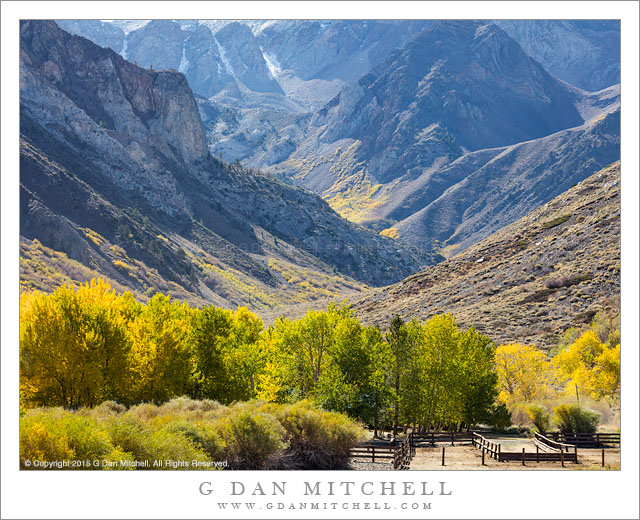
Autumn cottonwood and willow color at the McGee Creek pack station at the base of McGee Canyon
These eastern Sierra Nevada canyons have long fascinated me. My initial orientation to the range came from decades of approaching the mountains from the west, where they rise gradually, beginning almost imperceptibly with small irregularities and hills far out in the eastern portions of the Great Central Valley and then build slowly over many miles to eventually reach the Sierra crest. I “discovered” the east side of the range decades later, and was amazed by the contrast. Rather than beginning in the gentle west side grassland and agricultural areas, the base of the east side is frequently high desert, a spare and dry land of sage and open vistas. The Sierra begins abruptly, and in some cases you can stand at the actual base of the escarpment and look almost straight up to peaks that are many thousands of feet above you. The east side is cut by many short but deep canyons, where steep creeks drain a terrain originally cut by glaciers. In a very short distance — often traversed in a single day — one can move from high desert to the alpine zone.
In addition to focusing on that landscape, this photograph includes an element representing another component of life on the east side, a trailhead pack station. Here, too, my experience was such that I only recognized the role of these outfits more recently. For decades I was primarily oriented to the range as a backpacker and, to be honest, I regarded those using pack animals as representing an intrusion in the wilderness experience that I sought. (On the other hand, I recall many years ago seeing the occasional individual backpacker leading a single donkey along the trail, something you almost never see any more.) A few years ago I began to work with photographic colleagues who use pack trains once each year to get into the back country to photograph in ways that are more or less impossible when traveling on foot, and before long I had my first real experience with packers. I’m less certain of my old disdain for those who rely on pack animals, and I’m now much more aware of the long history of these pack outfits in the eastern Sierra. My perspective has changed. While I think that their place must evolve, I also have come to think of them as an intrinsic part of what makes the Sierra the Sierra, and I have acquired a real respect for the wranglers and the work they do.
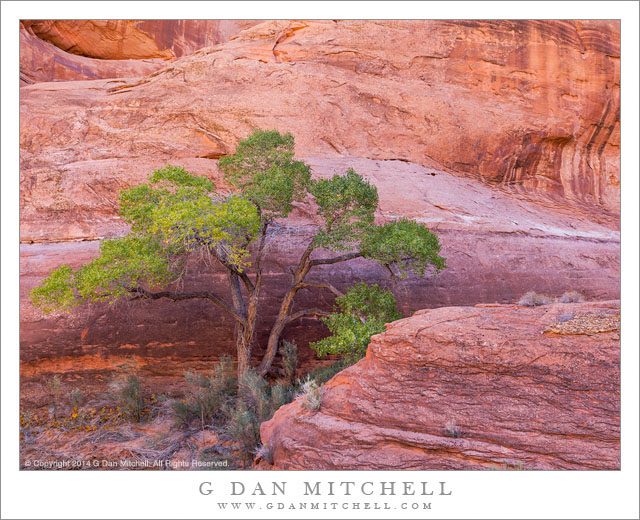
A fall color-tinged cottonwood tree grows in the depths of a red rock canyon, Utah
It is time to begin the Utah posts — I already have perhaps a month of photographs to share. (I still have more photographs from my late-summer back-country Yosemite shoot in the queue, but they can wait for a bit.) Utah, especially the southwest portion that I have visited frequently during the past few years, is an intriguing place for this California photographer. After decades of happily photographing my increasingly familiar home territory, it has been a special experience to work in a place where almost everything is new to me. I’ve gone there will few specific expectations, and I’ve made a point of not seeking out the familiar icons — though I have stumbled onto a few of them. (Yes, I do have a photograph of the Watchman. ;-) Compared to the gray tones of California granite, the red rock country of the Southwest is absolutely wild. Combine that rock with intense colors of green plants, yellow/gold fall foliage, blue sky and the effect is very different from what I’m used to shooting.
On my recent visit I managed to get into a number of canyons and gulches, which are perhaps the most magical of Utah places. In many cases, including the canyon where I made this photograph, the visit often begins in a place that looks nothing like this canyon scene — some dry, shallow wash or perhaps out on the flatlands above the canyon, where the air is dry and warm. I follow a path downstream and soon the wash becomes deeper and the walls rockier, and before long these walls rise to become cliffs and the world outside and above disappears, replaced by cool and moist air and water in the bottom of the echoing canyon. Trees and brush grow here, and sometimes you are caught up short when you encounter the sacred traces of people who made this world their home centuries ago. This photograph was made in such a canyon. At a stream crossing I made an almost random decision to climb up onto a higher route around a bend in the stream rather than following the the stream along the bottom of the canyon. As I crossed the slightly higher area I looked down into this world of red rock where a solitary cottonwood tree grows against the curving patterns of the rock.
G Dan Mitchell is a California photographer and visual opportunist whose subjects include the Pacific coast, redwood forests, central California oak/grasslands, the Sierra Nevada, California deserts, urban landscapes, night photography, and more. Blog | About | Flickr | Twitter | Facebook | Google+ | 500px.com | LinkedIn | Email
Autumn foliage on a steep, rocky eastern Sierra Nevada slope
This is a bit of a complicated photograph, and I’ll try to make some sense out of it below. The back story is that I was in the eastern Sierra doing some fall color photography, and early on this Saturday morning I had gone to a fairly popular location for photography. It is a place that I’ve photographed many times, going all the way back to a few years ago just before the huge popularity of digital cameras began to bring sometimes-overwhelming numbers of photographers to the area. I was quite sure that there would be large groups there on this morning, including photography workshop participants lined up along the shoreline of the nearby lake, but I also knew that there would be plenty of other things for me to photograph without joining the crowd.
I began by making some photographs of small things — little vignettes of a few aspen leaves, some rocks and boulders, light shining through branches holding colorful leaves. As I did this I saw that the far side of the canyon was going to remain in shadow after the sun began to wash things out elsewhere, so I decided to use a long lens and photograph trees and rocks in that location from a distance. Most of the photographs feature more obvious subjects such as an individual grove of colorful trees, but in this one I decided to just go with the complexity of the scene, which includes broken rocks, brush, and a few small aspen trees.
G Dan Mitchell is a California photographer and visual opportunist whose subjects include the Pacific coast, redwood forests, central California oak/grasslands, the Sierra Nevada, California deserts, urban landscapes, night photography, and more. Blog | About | Flickr | Twitter | Facebook | Google+ | 500px.com | LinkedIn | Email
Photographer and visual opportunist. Daily photos since 2005, plus articles, reviews, news, and ideas.
Manage Consent
To provide the best experiences, we use technologies like cookies to store and/or access device information. Consenting to these technologies will allow us to process data such as browsing behavior or unique IDs on this site. Not consenting or withdrawing consent, may adversely affect certain features and functions.
Functional
Always active
The technical storage or access is strictly necessary for the legitimate purpose of enabling the use of a specific service explicitly requested by the subscriber or user, or for the sole purpose of carrying out the transmission of a communication over an electronic communications network.
Preferences
The technical storage or access is necessary for the legitimate purpose of storing preferences that are not requested by the subscriber or user.
Statistics
The technical storage or access that is used exclusively for statistical purposes.The technical storage or access that is used exclusively for anonymous statistical purposes. Without a subpoena, voluntary compliance on the part of your Internet Service Provider, or additional records from a third party, information stored or retrieved for this purpose alone cannot usually be used to identify you.
Marketing
The technical storage or access is required to create user profiles to send advertising, or to track the user on a website or across several websites for similar marketing purposes.


 G Dan Mitchell is a California photographer and visual opportunist. His book, “California’s Fall Color: A Photographer’s Guide to Autumn in the Sierra” is available from Heyday Books and Amazon.