
Tag Archives: zabriskie

Photographing Icons – Or Not

Yesterday I shared elsewhere a photograph that someone had posted featuring a line-up of scores of photographers, arrayed tripod-to-tripod, ready to photograph one of those iconic views that we all know so well. I suspect that we have all been to such places and either found the experience of seeing and photographing them to be powerful… or we might have been repulsed by the crowds of people all apparently trying to “capture” the same thing, among them perhaps a number of folks who might be trying to almost literally recreate versions of the scene that they had seen elsewhere.

The point of the share (seen here and here) was not complimentary. My reaction to the photograph was to wonder, even more than usual, why people would want to make photographs that way. I phrased it as, more or less, “yet another reason to avoid photographing icons.”

However, a person wrote to me after I posted and pointed out, with a bit of anger and with some justification I think, that complaining about and putting down those who want to photograph a beautiful place might seem a bit pretentious and self-righteous.

She has a point.

While there is something a bit troubling about seeing dozens of people lined up to make the very same photograph, some of us might be a bit too quick to jump to overly negative conclusions. Perhaps there is a way to cast this as a positive lesson, rather than ridicule. So let me engage in a bit of reflection and honesty. Continue reading Photographing Icons – Or Not

Detail, Red Cathedral

Detail, Red Cathedral
“Detail, Red Cathedral” — The eroded and fluted face of the Red Cathedral, Zabriski Point, Death Valley National Park.

I have recently posted other photographs made in the area of Zabriskie Point in Death Valley, including one other of this feature sometimes known as the Red Cathedral. It stands to the right of the more famous and recognizable parts of the Zabriskie Point Landscape where, for example, Manley Beacon is one of the most well-known visual icons in the park.

This detail photograph was made using a long lens very shortly after the first morning light had arrived on this feature. In my experience, getting good light on Red Cathedral can be a tricky thing. Parts of it face away from the sun and towards Death Valley and because its face is deeply fluted it can be tricky avoiding blocked shadows. But increasing exposure too much creates problems with saturated colors on the brightest strata that cut through its face. If you shoot it in the morning, light somewhat softened by some high clouds can be helpful, and that is what I had on this morning – the sun light is direct, but it is also filtered a bit by passing through broken clouds to the east.


Leave a comment or question using the form. (If you are reading this on the home page, click the article title to see the full article and the comment form.

G Dan Mitchell is a California photographer and visual opportunist. His book, “California’s Fall Color: A Photographer’s Guide to Autumn in the Sierra” (Heyday Books) is available directly from him. Blog | Bluesky | Mastodon | Substack Notes | Flickr | Email

All media © Copyright G Dan Mitchell and others.

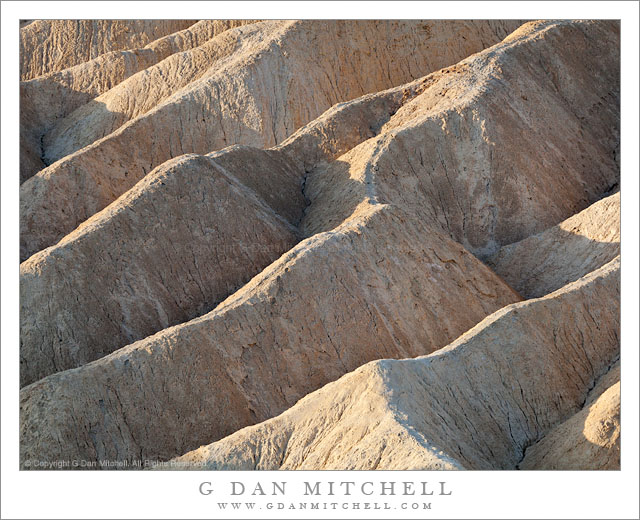
Morning Light, Zabriskie Point, Detail

Morning Light, Zabriskie Point, Detail

Morning Light, Zabriskie Point, Detail. Death Valley National Park, California. April 2, 2009. © Copyright 2009. G Dan Mitchell – all rights reserved.

Detail of eroded gullies and hills at the edge of Gower Gulch in morning light, Zabriskie Point, Death Valley National Park.

This photograph focuses on a small section of the contorted and folded geological shapes along the edges of Gower Gulch at Zabriskie Point in Death Valley National Park. These details fascinate me, not only for the amazing variety of forms that they present but also because they change continuously as the light changes. Here they are illuminated by fairly stark light from early morning sun light that has just appeared as the sun rose above the hills to the east. The contrasts between the brightly lit tops of the small hills and the deeply shadowed gullies is clear, but if you look closely you may be able to see that the shadows are lit, as well, by the light reflected into them from the obscured sunlit faces of the gullies that are not visible from this position.

When I return to Zabriskie, I may take a few moments to make photographs of momentary soft light as the first sun strikes Manley Beacon, but I have become much more interested in photographing these small details of the scene. I usually work with a very long lens, and continue to shoot long after the “golden hour” sunrise light has gone since some of the small subjects are better lit by higher light.

G Dan Mitchell is a California photographer whose subjects include the Pacific coast, redwood forests, central California oak/grasslands, the Sierra Nevada, California deserts, urban landscapes, night photography, and more.
Blog | About | Flickr | Twitter | Facebook | Google+ | 500px.com | LinkedIn | Email

Text, photographs, and other media are © Copyright G Dan Mitchell (or others when indicated) and are not in the public domain and may not be used on websites, blogs, or in other media without advance permission from G Dan Mitchell.

First Light on Zabriskie Point Hills

First Light on Zabriskie Point Hills

First Light on Zabriskie Point Hills. Death Valley National Park, California. April 3, 2009. © Copyright 2009 G Dan Mitchell – all rights reserved.

The first morning light touches hills at Zabriskie Point with ridges of the Panamint Range visible in the distance, Death Valley National Park, California.

When I visit Death Valley – typically, at least once each year – I usually try to seek out some of the less iconic scenes. However, I still do visit the icons, too. And Zabriskie Point at dawn may be the best known and perhaps the most photographed “icon” in the park. When I do go to Zabriskie it is usually for one of two reasons. First, if the light or conditions are truly special, I’ll be there with everyone else when the sun comes up! Second, I have a vague project to try to photograph aspects of Zabriskie that are different from the icon views across Gower Gulch or of Manley Beacon. This photographs sort of fits into that second category.

Those who have photographed here more than once become acquainted with the way that the morning light typically unfolds at Zabriskie. The pre-dawn light begins to softly light the entire scene, and before long the very first dawn light strikes the highest ridges of the Panamint Range on the opposite side of the Valley to the west. This light works its way down the face of that range, gradually illuminating the ridges and valleys of the range and spreading horizontally. It then begins to hit the Valley floor and works its way east and closer to Zabriskie and the rest of the ranges along the east side of the Valley. Although the closest hills are in shadow, one can almost sense the beams of light over head that are reaching into the Valley and sense that the angle of this light is gradually working down toward the closest ridges. Then the first light appears on the higher features around Zabriskie Point, at first soft but quickly increasing in intensity.

This photograph was made at this moment when that firs light arrives. The subject is a darker and rugged ridge that rises between the usual vantage points and the backdrop of the distant Panamint range, which in this photograph is somewhat obscured by the hazy atmosphere on a day when giant dust storms were just beginning to develop further north in the Valley.

G Dan Mitchell is a California photographer whose subjects include the Pacific coast, redwood forests, central California oak/grasslands, the Sierra Nevada, California deserts, urban landscapes, night photography, and more.
Blog | About | Flickr | Twitter | Facebook | Google+ | 500px.com | LinkedIn | Email

Text, photographs, and other media are © Copyright G Dan Mitchell (or others when indicated) and are not in the public domain and may not be used on websites, blogs, or in other media without advance permission from G Dan Mitchell.