Noted landscape photographer (and friend!) Charles Cramer will present a free talk at De Anza College in Cupertino, California at 6:00 p.m. on Friday, June 10. The event is open to the public. Judging by the crowd at the last talk of his that I attended (at the Palo Alto Camera Club) in the SF Bay Area, I recommend arriving early. I’ll be there for sure – not just because I’m a big fan of Charlie’s work, but also because the presentation will be in the classroom where I teach almost every day.
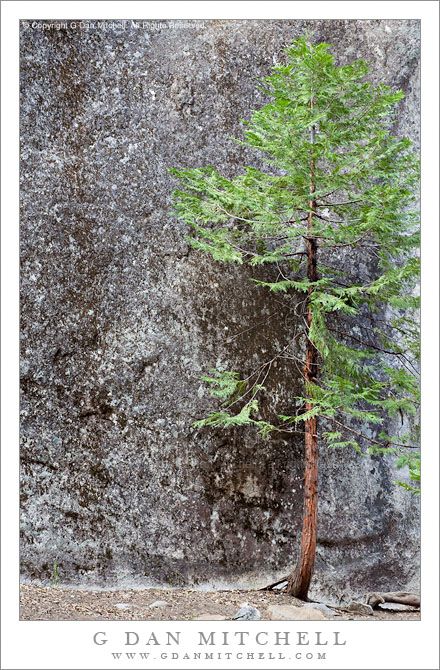
A young tree grows against a granite wall along the north side of Yosemite Valley.
This tree (and its nearby oak partner) and I have become good friends over the past few years. I first photographed it in the fall some years back, though the oak made a better shot at that time given its fall color leaves. But every time I walk along a certain area under the cliffs on the north side of Yosemite Valley I check in here to see what the light is doing.
During the first weekend of May I was in the Valley for photography and to visit the reception for Michael Frye’s exhibit at the Ansel Adams Galley. After spending an enjoyable hour and a half or so viewing Michael’s prints and meeting and talking with a wonderful group of photographers and photography enthusiasts at the Gallery I left to go wander a bit and make some photographs. When I came to this spot, clouds were starting to appear in the late afternoon sky above the Valley. This is a kind of ideal light since these conditions soften but don’t completely destroy the sunlight, and diffused light gets down into the forest and fills out the shadows.
I love the texture of these huge blocks of flat granite, covered with lichen. I like the visual quality of this rock, but I also like the physical quality of it; this probably dates back to a time some years ago when I was a rock climber for a few years. So while the tree seems like the main subject here, the rock surface is for me just as important.
From time to time people ask about the border around my photographs and the inclusion of various text elements within them. Since the question came up again recently I thought I’d explain.
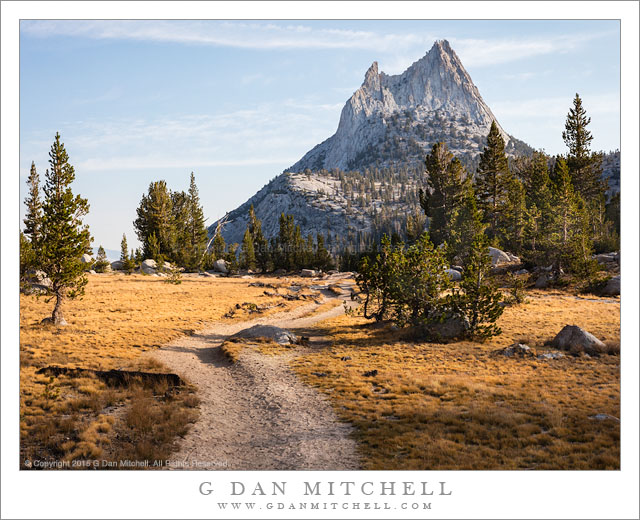
The John Muir Trail crosses Cathedral Pass near Cathedral Peak on a late-summer morning
First, borders and watermarks and all the rest are an intrusion in an image, and we would all prefer to see photographs without those elements – preferably in the form of beautiful prints. Prints are the target output for my photography, and online versions are merely stand-ins for the prints. In an ideal world, it would be lovely to be able to share photographs online in an equivalent form.
However, I have to balance my desire to share with the realization that being overly innocent about these things is unwise.Opinions about this vary widely — ranging from those who feel fine about putting full size photographs out there “as is” to those who won’t share anything online at all. My position lies between those extremes. I think that it is possible to enjoy my photographs as they are presented on the web — at least that’s what people tell me! I also understand that no technique can completely thwart the bad guys. So I have arrived at a balance that works for me.
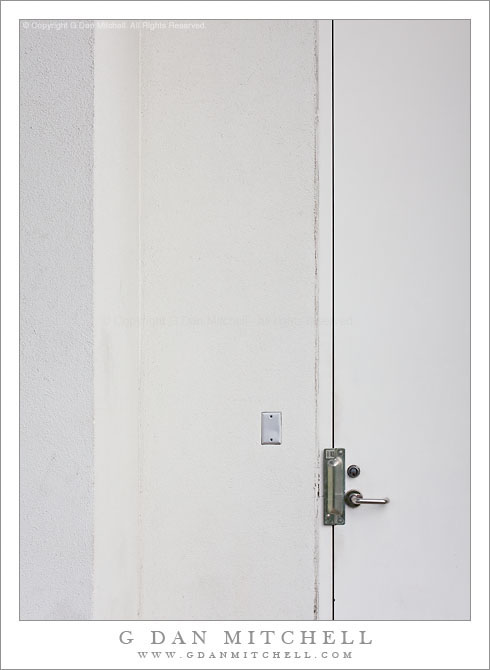
White door and stucco on a building in San Francisco, California.
As I photograph the various usual subjects that appear here, I always have a few background subjects that I’m always looking out for. One of my projects might be described as “urban minimalism,” featuring subjects from the urban environment that are very simple. This is probably about as minimalist as I can get with such images. (Though, now that I’ve written that, I’m starting to think of some even “more minimalist” possibilities. Funny.)
This one gets perilously close to the infamous “Polar Bear in Snowstorm” photo that people imagine from time to time. It is a white door in a white door frame against a white wall. Believe it or not, I had to go back and forth for a while to decide whether to print it in color or black and white – and, no, I’m not joking. Much of the image changes little when I switch between the two interpretations. However, there is a slight coloration to the “white” wall (that is almost certainly not displayed accurately on your monitor) and there is some real color on the metal security cover over the lock. But still… it is almost all shades of white in the end.
Photographer and visual opportunist. Daily photos since 2005, plus articles, reviews, news, and ideas.
Manage Consent
To provide the best experiences, we use technologies like cookies to store and/or access device information. Consenting to these technologies will allow us to process data such as browsing behavior or unique IDs on this site. Not consenting or withdrawing consent, may adversely affect certain features and functions.
Functional
Always active
The technical storage or access is strictly necessary for the legitimate purpose of enabling the use of a specific service explicitly requested by the subscriber or user, or for the sole purpose of carrying out the transmission of a communication over an electronic communications network.
Preferences
The technical storage or access is necessary for the legitimate purpose of storing preferences that are not requested by the subscriber or user.
Statistics
The technical storage or access that is used exclusively for statistical purposes.The technical storage or access that is used exclusively for anonymous statistical purposes. Without a subpoena, voluntary compliance on the part of your Internet Service Provider, or additional records from a third party, information stored or retrieved for this purpose alone cannot usually be used to identify you.
Marketing
The technical storage or access is required to create user profiles to send advertising, or to track the user on a website or across several websites for similar marketing purposes.