(Note: 21MP cameras were state-of-the-art when I wrote this. While that is no longer the case, the explanation of the concept still applies to comparisons between more recent higher MP cameras cameras with differing sensor resolutions. And, years later, camera reviewers are still making the mistake that I address here.)
A frequent photography discussion forum meme is that “this old camera with fewer photosites produces sharper images than this newer camera with more photosites. In fact, I have carefully inspected 100% crops from both and the evidence is clear!”
Not so fast.
Let’s imagine that the comparison is being made between the full-frame 12MP Canon 5D and the full-frame 21MP Canon 5D2, both of which I own and use. If you put the same lens on both cameras, set the lens to the same aperture, and point both cameras at the same subject, the lens will project exactly the same image onto the sensors of both. Let’s say that you do this under controlled conditions, and you decide to compare the two captures to see if the 21MP camera is really sharper than the 12MP camera.
You want to compare closely, so you display both images as “100% magnification crops” – portions of the image that show each individual pixel from the original photograph as an individual pixel on your computer monitor. You display the two images side by side and, squinting closely and looking back and forth between the two, you notice that the 21MP original is certainly no sharper than the 12MP original and that the 21MP image actually looks a bit less sharp! You decide that a) higher MP cameras are less sharp than lower MP cameras (you have the evidence!), and/or b) the camera companies are pulling a fast one on us.
You are actually wrong. Dead wrong.
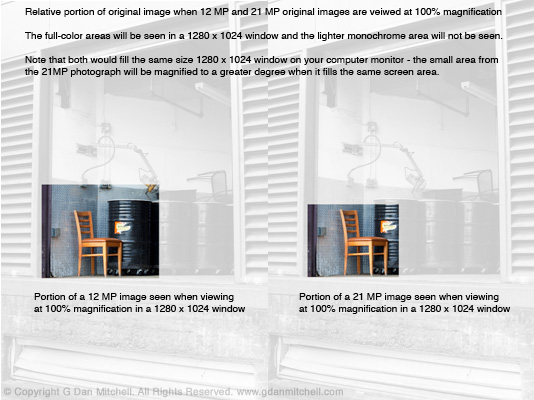
When gazing too long and too intently at a computer screen, it is easy to forget that the real world is not always represented accurately on the screen. In this case, the error is a result of viewing on a computer screen rather than making more realistic comparisons, for example between two prints of equal size. With the screen image comparison, you might overlook a fact that explains why the sharper (or at least equally sharp) camera appears to be less sharp. A look at the above illustration will help.
The image includes two copies of a full-frame photograph. Think of the one on the left as representing the photograph made on a 12 MP camera (like the 5D) and the one on the right as representing a 21MP camera (like the 5D2). The original 5D image would be 2912 pixels wide, while the original 5D2 image would be 3744 pixels wide. The full-color area of each image represents the part of the original image that would fill the screen of a 1280 x 1024 monitor when the originals are viewed at 100% magnification.
The critical point illustrated here is that the 1280 x 1024 “slice” of the 21MP image shows a considerably smaller portion of the overall image, and in order to fill the same size screen it will have to be magnified more than the image from the 12MP camera. If the two images are equally sharp to begin with, the one that has to be magnified more to fill the screen will lose more of its original resolution because you are looking more closely at a smaller portion of the image.
In the end, if you were to make two prints of the same dimension from the two original full images, the higher MP original would look at least as sharp as the lower MP original, and if you use good lenses and good technique (and print large enough that it makes a difference) the higher MP version has the potential to resolve more detail.
Some related points
A few related notions about sharpness and megapixel resolution also come up from time to time, and those who believe in them can be quite stubborn about their misunderstandings. Here are a couple:
- Claim: When you move to a higher MP sensor your photos will be more susceptible to motion blur.False. This is not the case at all. If you make otherwise identical photographs with a low MP full frame (or other format) digital camera and a higher MP camera using the same format, prints of the same size from both sources will have exactly the same amount of motion blur. (Technically, the higher MP camera will provide a more accurate image of the blur, but that doesn’t change how much blur there is.) In both cases the blur covers the same percentage of frame width. And, if you are tempted to check 100% magnification crops to prove me wrong, don’t forget what we saw above about looking more closely at a smaller area with the higher MP example. (The good news for the higher MP sensor is that when there is less motion blur it has the potential to produce an even higher resolution image of the subject.)
- Claim: Because the diffraction-limited aperture is larger when you work with higher resolution sensors, you’ll have more blur at smaller apertures with the higher MP system.False. You’ll have exactly the same amount of diffraction at every aperture. Diffraction is an optical phenomenon that is not affected by the sensor. Once again, if you make prints at some size from otherwise identical frames from a higher and lower resolution system, at every aperture diffraction will affect both the same way. And, again, while the higher MP system is never worse, if you use a very good lens and open up a bit you may get an even sharper image from the higher MP system.
In every case, either the two systems perform the same or the higher MP system is better. There is no situation in which the lower MP system will produce a sharper print at a given size, and there are some in which the higher MP system will make a sharper print… or allow one to make a larger print with the same resolution.
(See related post: “Myth: Diffraction and Motion Blur Worsen With More Megapixels”)
 G Dan Mitchell is a California photographer and visual opportunist. His book, “California’s Fall Color: A Photographer’s Guide to Autumn in the Sierra” is available from Heyday Books and Amazon.
Blog | About | Flickr | Twitter | Facebook | Google+ | 500px.com | LinkedIn | Email
All media © Copyright G Dan Mitchell and others as indicated. Any use requires advance permission from G Dan Mitchell.