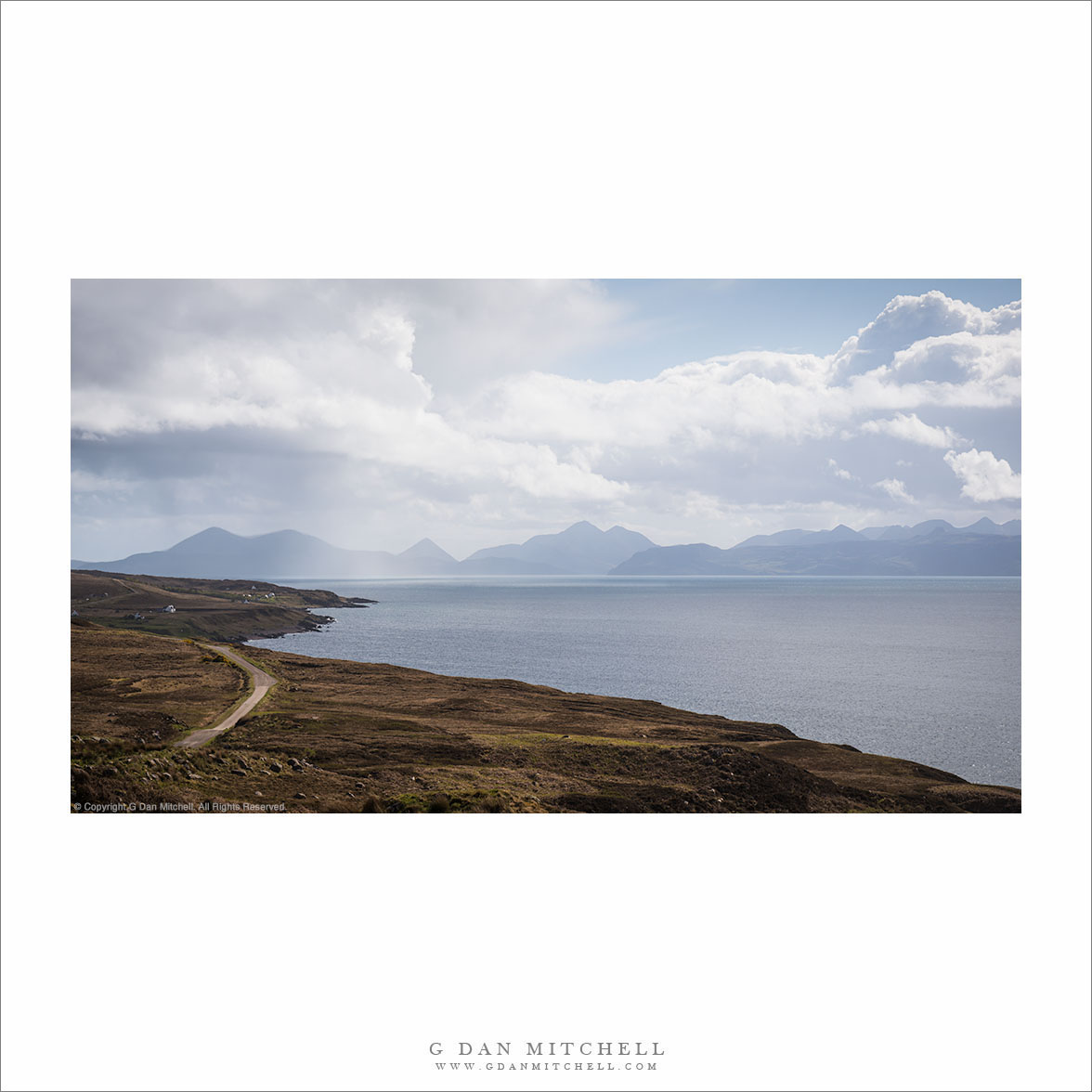
“Skye, Rain Over the Inner Sound” — Rain falls on the Inner Sound, with Isle of Skye.
It was a magical day on the far west cost of Scotland just above the Isle of Skye. We were on a long drive from Ullapool, and had just turned south along the shoreline towards the village of Applecross, which was going to be the far point of the day’s adventure. In a bit of a change from earlier weather, the sun was trying to make an appearance — and mostly succeeding, though there was an offshore rain shower between us and Skye.
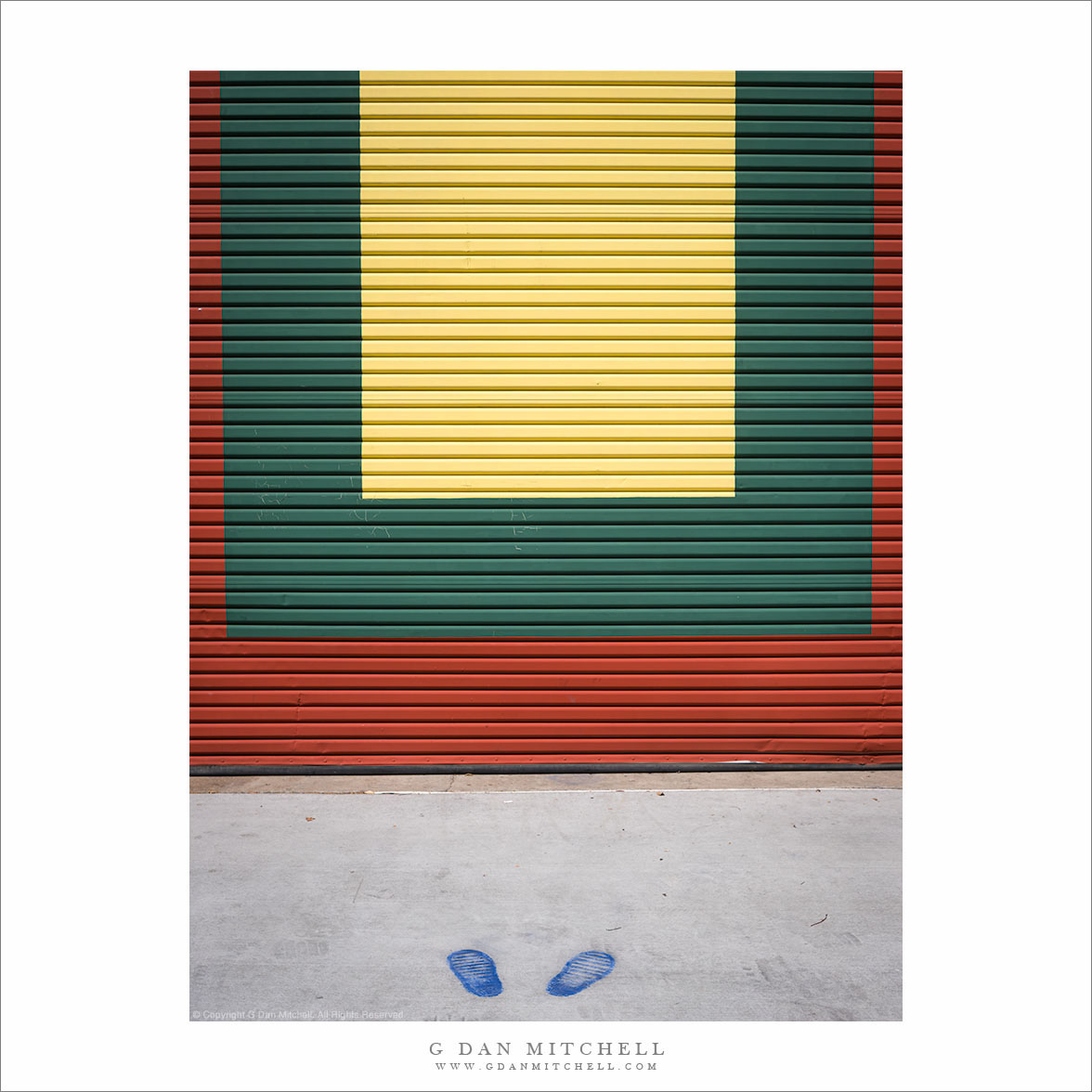
“Blue Feet” — Blue footprints in front of a colorful roll-up door.
I photographed this subject back in July on a long walk that took me to an area that is being redeveloped — or at least that is the story. The city (of San Jose) granted some extraordinary benefits to a very large corporation that promised to build a new campus in a somewhat blighted area. Hopes were high for renewal, but then the pandemic arrived, plans were delayed, and now no one knows when (or if) the plans will move forward. So, in the meantime, it seems that this corporation has decided to apply new paint to old buildings.
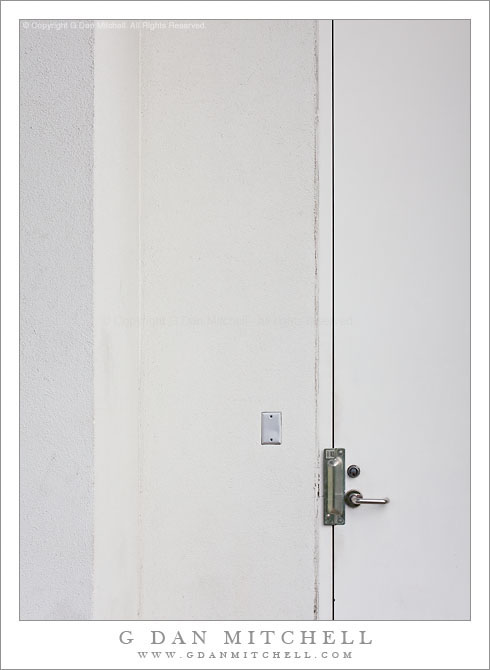
White door and stucco on a building in San Francisco, California.
As I photograph the various usual subjects that appear here, I always have a few background subjects that I’m always looking out for. One of my projects might be described as “urban minimalism,” featuring subjects from the urban environment that are very simple. This is probably about as minimalist as I can get with such images. (Though, now that I’ve written that, I’m starting to think of some even “more minimalist” possibilities. Funny.)
This one gets perilously close to the infamous “Polar Bear in Snowstorm” photo that people imagine from time to time. It is a white door in a white door frame against a white wall. Believe it or not, I had to go back and forth for a while to decide whether to print it in color or black and white – and, no, I’m not joking. Much of the image changes little when I switch between the two interpretations. However, there is a slight coloration to the “white” wall (that is almost certainly not displayed accurately on your monitor) and there is some real color on the metal security cover over the lock. But still… it is almost all shades of white in the end.
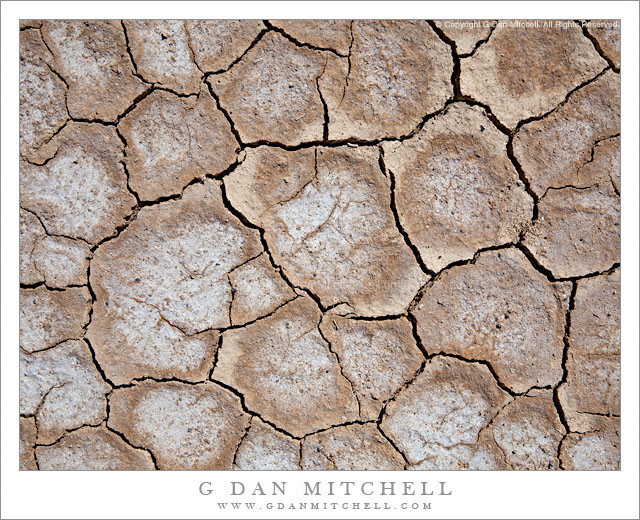
Cracked and dry surface of the playa in Panament Valley, Death Valley National Park.
This micro-scene could be found in many locations in Death Valley and, for that matter, in many places in the USA and around the rest of the planet. But my little rectangle of the patterns of drying and cracked mud comes from the surface of the Playa (sometimes called “Panamint Lake?”) in upper Panamint Valley in Death Valley National Park. I wrote previously that it was the last day of my late-March photographic visit to Death Valley – I had finished my photography in the main Valley and had started the long drive back to the Bay Area. After crossing Towne Pass the road descends into Panamint Valley to a junction where I most often go south towards Trona and Ridgecrest and beyond.
Just before this junction the road crosses the playa, an extraordinarily flat surface formed when silt washed down from the surrounding mountains occasionally pools and gradually dries, forming what may be the flattest surfaces on the planet. As the moisture evaporates the mud cracks and splits into these interesting semi-geometrical patterns.
For no particular reason other than that this is a spot where I often make one final stop before leaving the park, I pulled over and wandered out onto the playa. I enjoy walking on these often-immense flat surfaces, but there is something very odd about the experience, too. Perhaps it is the slightly odd feeling of walking on such a large floor-flat surface in the natural world, or it might be the deep silence and stillness. In any case, as I wandered around not too far from the road I started looking a bit more closely at the patterns of cracks and soon decided that my photography was not quite finished yet – so I went back to the car to get my camera and made a small series of hand-held photographs with the camera pointing straight down. (The “straight down” shooting raises a question: How should the photograph be oriented? The horizontal orientation shown here is what I saw as I made the photograph… but I also wonder about rotating it 90″ clockwise.)
Photographer and visual opportunist. Daily photos since 2005, plus articles, reviews, news, and ideas.
Manage Consent
To provide the best experiences, we use technologies like cookies to store and/or access device information. Consenting to these technologies will allow us to process data such as browsing behavior or unique IDs on this site. Not consenting or withdrawing consent, may adversely affect certain features and functions.
Functional
Always active
The technical storage or access is strictly necessary for the legitimate purpose of enabling the use of a specific service explicitly requested by the subscriber or user, or for the sole purpose of carrying out the transmission of a communication over an electronic communications network.
Preferences
The technical storage or access is necessary for the legitimate purpose of storing preferences that are not requested by the subscriber or user.
Statistics
The technical storage or access that is used exclusively for statistical purposes.The technical storage or access that is used exclusively for anonymous statistical purposes. Without a subpoena, voluntary compliance on the part of your Internet Service Provider, or additional records from a third party, information stored or retrieved for this purpose alone cannot usually be used to identify you.
Marketing
The technical storage or access is required to create user profiles to send advertising, or to track the user on a website or across several websites for similar marketing purposes.