
All posts by G Dan Mitchell

G Dan Mitchell, photographer and visual opportunist focusing on the Pacific coast, the Sierra Nevada, redwood forests, California oak/grasslands, California deserts, urban landscapes, night photography and more. Posting daily photographs since 2005, along with articles, reviews, news, and ideas.

Why Your 21MP File “Looks Softer” Than Your 12MP File at 100% Magnification

(Note: 21MP cameras were state-of-the-art when I wrote this. While that is no longer the case, the explanation of the concept still applies to comparisons between more recent higher MP cameras cameras with differing sensor resolutions. And, years later, camera reviewers are still making the mistake that I address here.)

A frequent photography discussion forum meme is that “this old camera with fewer photosites produces sharper images than this newer camera with more photosites. In fact, I have carefully inspected 100% crops from both and the evidence is clear!”

Not so fast.
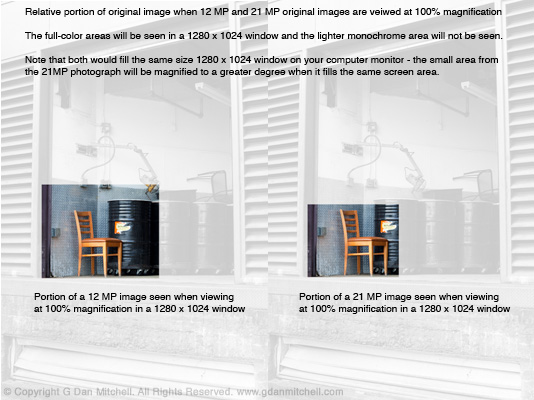
Let’s imagine that the comparison is being made between the full-frame 12MP Canon 5D and the full-frame 21MP Canon 5D2, both of which I own and use. If you put the same lens on both cameras, set the lens to the same aperture, and point both cameras at the same subject, the lens will project exactly the same image onto the sensors of both. Let’s say that you do this under controlled conditions, and you decide to compare the two captures to see if the 21MP camera is really sharper than the 12MP camera.

You want to compare closely, so you display both images as “100% magnification crops” – portions of the image that show each individual pixel from the original photograph as an individual pixel on your computer monitor. You display the two images side by side and, squinting closely and looking back and forth between the two, you notice that the 21MP original is certainly no sharper than the 12MP original and that the 21MP image actually looks a bit less sharp! You decide that a) higher MP cameras are less sharp than lower MP cameras (you have the evidence!), and/or b) the camera companies are pulling a fast one on us.

You are actually wrong. Dead wrong.

When gazing too long and too intently at a computer screen, it is easy to forget that the real world is not always represented accurately on the screen. In this case, the error is a result of viewing on a computer screen rather than making more realistic comparisons, for example between two prints of equal size. With the screen image comparison, you might overlook a fact that explains why the sharper (or at least equally sharp) camera appears to be less sharp. A look at the above  illustration will help.

The image includes two copies of a full-frame photograph. Think of the one on the left as representing the photograph made on a 12 MP camera (like the 5D) and the one on the right as representing a 21MP camera (like the 5D2). The original 5D image would be 2912 pixels wide, while the original 5D2 image would be 3744 pixels wide. The full-color area of each image represents the part of the original image that would fill the screen of a 1280 x 1024 monitor when the originals are viewed at 100% magnification.

The critical point illustrated here is that the 1280 x 1024 “slice” of the 21MP image shows a considerably smaller portion of the overall image, and in order to fill the same size screen it will have to be magnified more than the image from the 12MP camera. If the two images are equally sharp to begin with, the one that has to be magnified more to fill the screen will lose more of its original resolution because you are looking more closely at a smaller portion of the image.

In the end, if you were to make two prints of the same dimension from the two original full images, the higher MP original would look at least as sharp as the lower MP original, and if you use good lenses and good technique (and print large enough that it makes a difference) the higher MP version has the potential to resolve more detail.

Some related points

A few related notions about sharpness and megapixel resolution also come up from time to time, and those who believe in them can be quite stubborn about their misunderstandings. Here are a couple:

  • Claim: When you move to a higher MP sensor your photos will be more susceptible to motion blur.False. This is not the case at all. If you make otherwise identical photographs with a low MP full frame (or other format) digital camera and a higher MP camera using the same format, prints of the same size from both sources will have exactly the same amount of motion blur. (Technically, the higher MP camera will provide a more accurate image of the blur, but that doesn’t change how much blur there is.) In both cases the blur covers the same percentage of frame width. And, if you are tempted to check 100% magnification crops to prove me wrong, don’t forget what we saw above about looking more closely at a smaller area with the higher MP example. (The good news for the higher MP sensor is that when there is less motion blur it has the potential to produce an even higher resolution image of the subject.)
  • Claim: Because the diffraction-limited aperture is larger when you work with higher resolution sensors, you’ll have more blur at smaller apertures with the higher MP system.False. You’ll have exactly the same amount of diffraction at every aperture. Diffraction is an optical phenomenon that is not affected by the sensor. Once again, if you make prints at some size from otherwise identical frames from a higher and lower resolution system, at every aperture diffraction will affect both the same way. And, again, while the higher MP system is never worse, if you use a very good lens and open up a bit you may get an even sharper image from the higher MP system.

In every case, either the two systems perform the same or the higher MP system is better. There is no situation in which the lower MP system will produce a sharper print at a given size, and there are some in which the higher MP system will make a sharper print… or allow one to make a larger print with the same resolution.

(See related post: “Myth: Diffraction and Motion Blur Worsen With More Megapixels”)


G Dan Mitchell is a California photographer and visual opportunist. His book, “California’s Fall Color: A Photographer’s Guide to Autumn in the Sierra” is available from Heyday Books and Amazon.
Blog | About | Flickr | Twitter | Facebook | Google+ | 500px.com | LinkedIn | Email


All media © Copyright G Dan Mitchell and others as indicated. Any use requires advance permission from G Dan Mitchell.
Golden Eagle Hotel

Golden Eagle Hotel
Golden Eagle Hotel

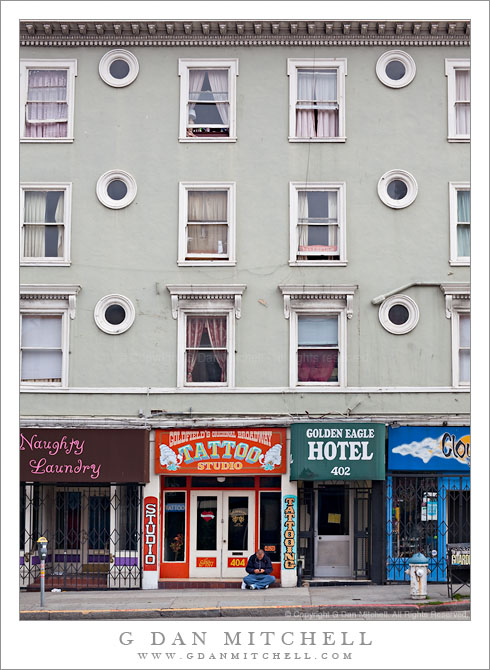
Golden Eagle Hotel. San Francisco, California. July 12, 2010. © Copyright G Dan Mitchell – all rights reserved.

Man sitting on steps in front of tattoo parlor below the Golden Eagle Hotel, San Francisco.

Last summer, on one of my “walking shoots” in San Francisco, I wandered into a less-than-lovely area of The City – though it has its points of visual interest, for sure. I named this photograph after the Golden Eagle Hotel at least partly because I assume that the dilapidated green apartment building above the colorful (in many senses) shops at street level comprise the “hotel.” Another reason is that I wasn’t sure I wanted to title a photograph “Tattoo” or “Naughty Laundry!” (I don’t know what the “Naughty Laundry” place is, and I probably am better of keeping it that way! :-)

In a sense, every photograph I make is “about” something, though often they are simply about the qualities of the subject or subjects themselves. You could certainly look at this image that way. I was certainly intrigued by the juxtaposition of the very colorful and closely packed shops and the very drab apartments above. The building itself, which may have seen better days, is interesting to me architecturally. What is with the little round windows, with their thick frames, between the conventional rectangular windows? And despite having some interesting San Francisco qualities, the building is terribly run down. A close look reveals peeling paint, wires running here and there, painted over spots of what might have been graffiti, and so forth.

Then there is that guy sitting on the step of “Goldfield’s Original Broadway Tattoo Studio.” There are no other people in the scene, and my recollection is that there really weren’t many people around. He sits, face downward and headphones on, apparently completely engrossed in whatever technology he holds in his hand, and apparently also completely disassociated from his environment. You can find a lot of people like this today.

G Dan Mitchell Photography | Flickr | Twitter (follow me) | Facebook (“Like” my page) | LinkedIn | Email
Text, photographs, and other media are © Copyright G Dan Mitchell (or others when indicated) and are not in the public domain and may not be used on websites, blogs, or in other media without advance permission from G Dan Mitchell.
G Dan Mitchell Photographs at Stovepipe Wells

G Dan Mitchell Photographs, Stovepipe Wells Lodge

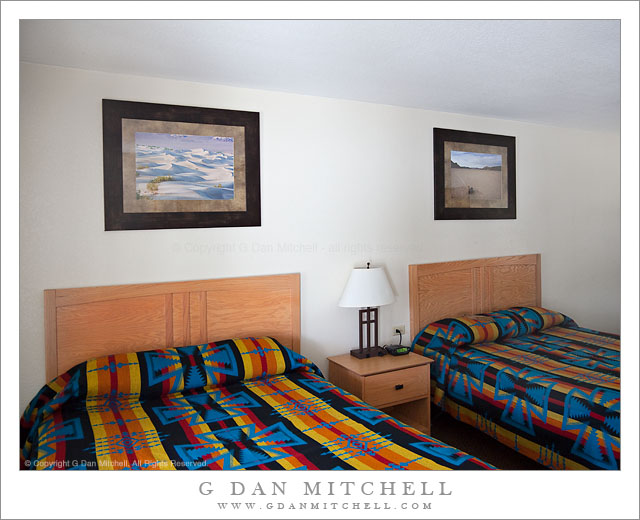
Stovepipe Wells Lodge – G Dan Mitchell photographs. Death Valley National Park, California. © Copyright G Dan Mitchell – all rights reserved.

Since several people have asked, I thought I would share an update on installation of my photographs at the historic Stovepipe Wells Lodge in Death Valley National Park. Late last year Ortega Family Enterprises (who also sell some of my photographs at Muir Woods National Monument) contacted me. They were about to take over the management of the facility from the previous concessionaire and were interested in selling some of my Death Valley photographs in the gift shop at Stovepipe Wells.

It turns out that they were also planning some significant upgrades to the lodging facilities at Stovepipe and they asked if I could provide a large number of 16″ x 24″ prints for the guest rooms. To make a long story short, they selected a half dozen of my Death Valley photographs and I went to work making nearly 170 prints of the six photographs, which were then shipped off to their framer for final preparation.

I finally got a chance to see the results when I visited Death Vally in early April. I stopped by and found out that they had begun the process of hanging the prints in guest rooms, and with the help of an employee I was able to get in long enough to snap a shot of one of the rooms. (Hanging in this room are “Transverse Dunes, Death Valley“ and “Crossing Tracks, Racetrack Playa.”) It was also good to see some work being done to upgrade and update the lodge!

It is gratifying to have my photographs installed here for several reasons. Several of the photographs were made virtually within walking distance of Stovepipe Wells, where I often camp when I visit the Valley. I also know that among the many people who visit Stovepipe will be a good number of my fellow photographers – and knowing that they will see my prints here is both a bit intimidating and a quite exciting! Finally, before Ortega took over the facility I often stopped to look at some of the photographs and paintings that had been there previously. (I was glad to see that one wonderful black and white photograph was still hanging in the hotel office.) With that in mind, it seems like there is a good chance that these photographs of mine may be hanging in this historic facility for some time to come!

G Dan Mitchell Photography | Flickr | Twitter (follow me) | Facebook (“Like” my page) | LinkedIn | Email
Text, photographs, and other media are © Copyright G Dan Mitchell (or others when indicated) and are not in the public domain and may not be used on websites, blogs, or in other media without advance permission from G Dan Mitchell.
Power Plant Wall, Night

Power Plant Wall, Night

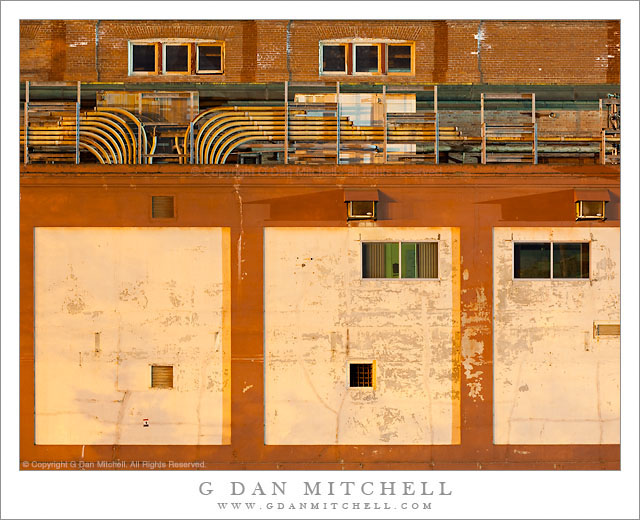
Power Plant Wall, Night. Mare Island Naval Ship Yard, Vallejo, California. April 16, 2011. © Copyright G Dan Mitchell – all rights reserved.

Night photograph of the exterior wall of the power plant at Mare Island Naval Ship Yard.

I have wandered past this building on many previous night photography sessions at Mare Island and have photographed quite a bit nearby, but this is the first time I have photographed it, at least from this perspective. (The iconic power plant smokestack above this building has been a subject of mine in the past.) The first thing that caught my interest about this building is that wonderful bundle of pipes that emerges near the upper left area and then heads off to who-knows-where in both directions. As I looked at the side of the building and imagined what it would look like in a long exposure under this artificial light, the rectangular shapes of the painted sections of the concrete wall seemed like they might also be interesting. And only after I made the photograph and looked at it in post did I realize that there was enough light in the scene – and perhaps inside the building – to faintly light some parts of the interior seen through the windows. The many shadows coming from different directions are produced by multiple overlapping light sources nearby.

To give you an idea of how dark it was on the scene, there was not enough light to focus. Usually I can get just enough by using the live view feature on my camera and finding an edge or a reflection somewhere that provides a line that has enough light, but not here. I finally ended up using one of the standard night photography tricks: I took a very small pocket LED light, walked over and set it against the wall, walked back to my camera to focus on this point of light, returned to the wall to retrieve the light, walked back to the camera and made my exposure.

G Dan Mitchell Photography | Flickr | Twitter (follow me) | Facebook (“Like” my page) | LinkedIn | Email
Text, photographs, and other media are © Copyright G Dan Mitchell (or others when indicated) and are not in the public domain and may not be used on websites, blogs, or in other media without advance permission from G Dan Mitchell.