
All posts by G Dan Mitchell

G Dan Mitchell, photographer and visual opportunist focusing on the Pacific coast, the Sierra Nevada, redwood forests, California oak/grasslands, California deserts, urban landscapes, night photography and more. Posting daily photographs since 2005, along with articles, reviews, news, and ideas.

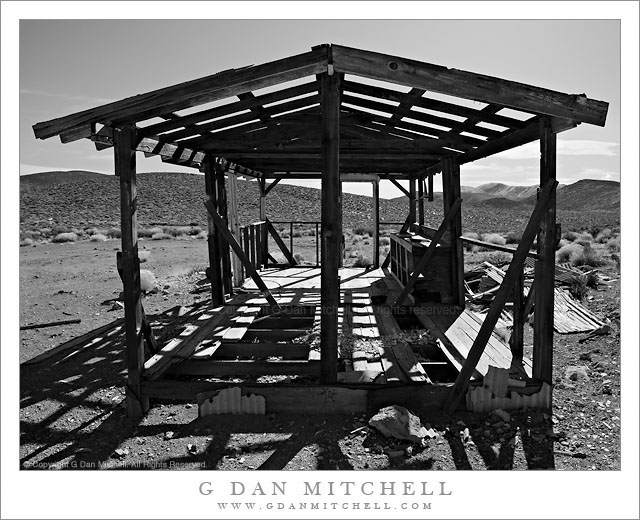
Abandoned Mining Cabin Ruins, Panamint Range

Abandoned Mining Cabin Ruins, Panamint Range

Abandoned Mining Cabin Ruins, Panamint Range. Death Valley National Park, California. March 29, 2011. © Copyright G Dan Mitchell – all rights reserved.

Black and white photograph of the ruins of an abandoned mining cabin high in the Panamint Mountain Range of Death Valley National Park.

There are a number of things that make Death Valley National Park, to the best of my knowledge, rather unique. One is the extensive history of human habitation inside the park boundaries, quite a bit of which is visible –  though some takes a bit more effort and attention to spot. The history of mining in the park is well-known, and many of the icons of the park have connections to this history. If you visit Furnace Creek, for example, you cannot miss the displays of old wagons and so forth used to move ore out of the Valley. It doesn’t take a lot of careful study to figure out that many park roads originated in an era of prospecting and mining. There are several well-known examples of structures left over from that era in and around the park, too.

It is largely because of this history that many areas of this national park are (or have been – some are now reverting to wilderness status) accessible by gravel road or four-wheel-drive routes. I would argue that you can’t really get to know this park if you just stick to the paved roads and the points of interest that they access. If you drive any of these other routes and keep your eyes open you will often be surprised by the left overs from relatively recent mining and prospecting, much of which isn’t really written about or described in the usual guides to the park. (And I’m not going to offer specific details about where to find such places here, since I don’t want to be even a little bit responsible for damage to them. If you do visit, treat them with care and respect.)

As I drove along a gravel road in one of the many mountain ranges of the park, returning from a site that is somewhat well-known, I began to notice evidence of fairly recent mining and prospecting. Faint tracks depart from the main “road” and cross valleys and hills, here and there tailing piles and mine entrances are visible, and sometimes you come across old structures such as cabins, storage bunkers, or wooden towers above mine entrances. I spotted the ruins of this old cabin above the road at one point and decided to walk up and investigate.

I’m almost always surprised at how “modern” many of the traces found at these places seem to be. I guess I am expecting something from the 1800s, but quite a few of these places look like they were build and occupied much later than that. I find modern things like linoleum flooring or modern-looking nails or electrical wire in many of them. There obviously isn’t much left of this cabin now, but from the detritus lying around near it and the form and materials found here, it must have been a reasonably comfortable place to live. As I walk around such places I often try to imagine what it must have been like to wake up every morning in this silent desert and head out for another day of physical labor.

G Dan Mitchell Photography | Flickr | Twitter (follow me) | Facebook (“Like” my page) | LinkedIn | Email
Text, photographs, and other media are © Copyright G Dan Mitchell (or others when indicated) and are not in the public domain and may not be used on websites, blogs, or in other media without advance permission from G Dan Mitchell.
“My Photos Are Soft!”

So, you have a camera or lens that you think is not as sharp as it should be. If you are already expert at these things, what follows is not for you – you already know how to analyze the problem, you can anticipate possible causes, and you know some of the pitfalls of looking at the issue in unrealistic ways. But if you aren’t certain about how to deal with the issue, perhaps the following might help… so feel free to read on.

Perhaps you just got a new lens or a new camera and you don’t think it is performing as you expected. Or perhaps you have long suspected a problem with your equipment. On the other hand, maybe some gear that you have used with confidence for a while seems to not work as well as you recall it working in the past. It can be tempting to blame the equipment – and in some cases you may be correct – but it is a very good idea to first try to analyze and understand the problem and look for other possible causes… and solutions.

It is critical that you try to control the variables that might give rise to the issue, and then to try to a) determine if the problem is real, and b) figure out specifically what might be the cause. The range of possible causes is larger than you might imagine: problems with the camera’s autofocus (AF) system, an out of adjustment or “weak” lens, less than optimal choice of lens settings, issues with camera stability, insufficient care with the use of AF, using the wrong AF settings, aperture choices, shutter speed choices, subject motion, and more. While a real equipment problem is a possibility, it is probably at least as likely that the problem lies elsewhere. Fortunately there are ways to wade through this minefield and develop some rational understanding of what is going on.

What follows is a sort of ad hoc description of how I might approach this. It is not meant to be the only way to deal with such issues, it leaves out some possibilities, and the sequence could be changed around in some ways. Continue reading “My Photos Are Soft!” →

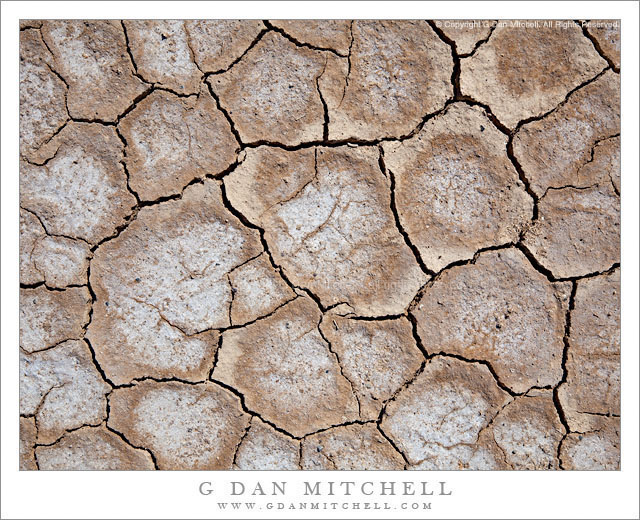
Playa Surface, Panamint Valley

Playa Surface, Panamint Valley

Playa Surface, Panamint Valley. Death Valley National Park, California. March 31, 2011. © Copyright G Dan Mitchell – all rights reserved.

Cracked and dry surface of the playa in Panament Valley, Death Valley National Park.

This micro-scene could be found in many locations in Death Valley and, for that matter, in many places in the USA and around the rest of the planet. But my little rectangle of the patterns of drying and cracked mud comes from the surface of the Playa (sometimes called “Panamint Lake?”) in upper Panamint Valley in Death Valley National Park. I wrote previously that it was the last day of my late-March photographic visit to Death Valley – I had finished my photography in the main Valley and had started the long drive back to the Bay Area. After crossing Towne Pass the road descends into Panamint Valley to a junction where I most often go south towards Trona and Ridgecrest and beyond.

Just before this junction the road crosses the playa, an extraordinarily flat surface formed when silt washed down from the surrounding mountains occasionally pools and gradually dries, forming what may be the flattest surfaces on the planet. As the moisture evaporates the mud cracks and splits into these interesting semi-geometrical patterns.

For no particular reason other than that this is a spot where I often make one final stop before leaving the park, I pulled over and wandered out onto the playa. I enjoy walking on these often-immense flat surfaces, but there is something very odd about the experience, too. Perhaps it is the slightly odd feeling of walking on such a large floor-flat surface in the natural world, or it might be the deep silence and stillness. In any case, as I wandered around not too far from the road I started looking a bit more closely at the patterns of cracks and soon decided that my photography was not quite finished yet – so I went back to the car to get my camera and made a small series of hand-held photographs with the camera pointing straight down. (The “straight down” shooting raises a question: How should the photograph be oriented? The horizontal orientation shown here is what I saw as I made the photograph… but I also wonder about rotating it 90″ clockwise.)

G Dan Mitchell Photography | Flickr | Twitter (follow me) | Facebook (“Like” my page) | LinkedIn | Email
Text, photographs, and other media are © Copyright G Dan Mitchell (or others when indicated) and are not in the public domain and may not be used on websites, blogs, or in other media without advance permission from G Dan Mitchell.

Backpacking and Photography – a Quick Link

I often field questions about doing photography while backpacking – what equipment to take, what to not take, how to carry it all, and so forth. I’ve been a Sierra Nevada backpacker for a long (really long!) time, and I do a fair amount of my photography while on the trail for periods ranging from a single day up to a couple of weeks.

This is time of year when many of us find our thoughts turning to the coming back-country season… and how to incorporate photography into that experience. I’m not going to go into all of the details in this short post… but I have previously posted about my own backpacking photo gear, and I’m sharing that link again for those who might be interested.

G Dan Mitchell Photography | Flickr | Twitter (follow me) | Facebook (“Like” my page) | LinkedIn | Email
Text, photographs, and other media are © Copyright G Dan Mitchell (or others when indicated) and are not in the public domain and may not be used on websites, blogs, or in other media without advance permission from G Dan Mitchell.