A reminder that site-sponsor B&H Photo closes in a few days for Passover, and orders placed after noon EDT on Sunday, March 24th may not ship until they reopen. Here is their statement:
“Upcoming Passover Closing
“B&H will be closed from Monday, March 25th in the observance of Passover and will reopen on Wednesday, April 3rd at 9:00AM EDT. Place your order by 12:00PM Noon EDT on Sunday, March 24th in order to ship before the Holiday. Orders placed after this time will ship when we reopen. We apologize for the inconvenience and appreciate your patronage.”
You might want to consider this if you plan to order something in the next week or two or if you have been waiting to take advantage of some of the promotions and bundles that expire at the end of March, including several from companies like Canon, Nikon, Sony, Fujifilm, and more. (See the Deals page for links to some of these specials.)
G Dan Mitchell is a California photographer whose subjects include the Pacific coast, redwood forests, central California oak/grasslands, the Sierra Nevada, California deserts, urban landscapes, night photography, and more. Blog | About | Flickr | Twitter | Facebook | Google+ | 500px.com | LinkedIn | Email
UPDATE: As of 2020 I am no longer posting annual updates concerning this subject — and I am editing older posts on the subject in light of the need to be more responsible about not encouraging the onslaught. I also no longer recommend going to the Valley to see it. Unfortunately, too much exposure (yes, I played a part in it, unfortunately) has led to absurd crowds, traffic jams, littering, destruction of areas in the Valley where too many people go to see it… and the park has increasingly — and appropriately — cracked down. Parking options have been eliminated, at least one viewing location has been closed. Good news! The rest of Yosemite Valley is still there and often exceptionally beautiful at this time of year.
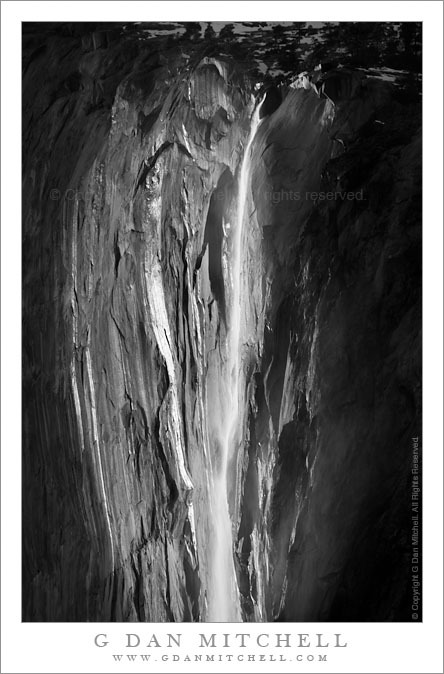
The silver strand of Horsetail Fall and water reflecting on surrounding cliffs in late afternoon light, Yosemite Valley, California.
Although it seems like it would be extremely difficult to make a truly original photograph of Horsetail Fall at this point, I won’t completely rule out the possibility, and recently I have seen a few interesting and imaginative photographs of the phenomenon.
The necessary conditions are fairly specific, and even when the basics are in place there is no guarantee that the show will occur on a given evening. To be honest, the odds are distinctly against you, and you are more likely to see something that doesn’t match your expectations.
There must be flowing water in the creek near the east end of the face of El Capitan that feeds the fall. This is not a sure thing in mid-winter. There must be sufficient snow above El Capitan and the temperatures must be warm enough to melt it, or there must have been a recent warm storm that brought some rain to higher elevations.
The setting sun must align just right with a gap in the mountains to the west of El Capitan so that the setting sun (miraculously) casts its last beams right on the face of El Capitan where the fall is located. Roughly speaking this occurs during the second half of February, right around February 20 or so.
You must be in a position such that the fall is back-lit by the sunset light beam. In addition, your position must provide a clear view of the fall – not necessarily a simple thing given the forest cover in the Valley. These areas are now subject to terrible crowding that has damaged areas of the park, and the park service is wisely reducing or eliminating access.
Although photographs make it seem like a huge, overpowering spectacle, it is actually very small. It takes place high on a distant cliff face, and to photograph it you’ll need a very long lens.
Finally, the skies to the west of Yosemite must be clear so that the golden hour sunset light is not blocked. Many tell stories of clouds that made it obvious that the show would not happen or, even more frustrating, developing light that was killed at the last minute when the sun dropped behind clouds to the west, which are quite common.
Any post about the February Horsetail Fall occurrence must include a few other important points:
The event has become so popular in recent years that the experience has been significantly compromised. You will not have an experience of relative solitude such as Galen Rowell likely had when he made the iconic photograph of the subject decades ago. Instead you will likely find yourself among hundreds or thousands (you read that right) of other photographers lined up with lenses pointed the same direction.
This, of course, implies that parking and finding “your spot” may both be challenges. As a result of traffic jams, illegal parking, overwhelming crowds, gross littering, and damage to meadow, forest, and river… the park service is wisely putting several access limits in place, even closing one of the favorite areas as of 2020.
If Horsetail isn’t an option, you are are still in one of the most beautiful and compelling places on the face of the planet for making photographs! Speaking of which, while the crowds are focused on Horsetail, you might consider photographing other things away from the crowds…
The annual Yosemite Renaissance art show typically opens at about this time each February and features the work of photographers and other artists working in Yosemite. The show is in the Yosemite Museum Gallery and the 2013 edition runs from February 22 through May 5, with the opening reception at 5:30-7:30 on February 22. (You can view my work in the show this year.) In addition, there is always something interesting to see at the nearby Ansel Adams Gallery – this year an exhibit of Michael Frye’s photographs opens on February 16.
NOTE: The 2017 edition of the exhibit, Yosemite Renaissance 32, opens with a free public reception at 5:30 PM on Friday, February 24. One of my photographs is in the exhibit again this year. See you there!
G Dan Mitchell is a California photographer and visual opportunist whose subjects include the Pacific coast, redwood forests, central California oak/grasslands, the Sierra Nevada, California deserts, urban landscapes, night photography, and more.
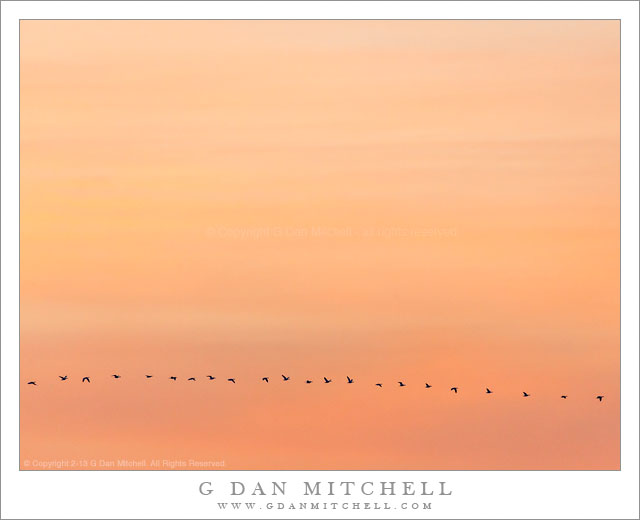
A row of Ross’s geese stretches into a line as they fly in front of dusk sky on a winter evening above California’s San Joaquin Valley.
The post-sunset twilight period is one of the most special of the day in these Central Valley wildlife refuges. There is a transformation at this point that fascinates me, even after seeing it a number of times. During the day, it often seems that not much is going on. The larger flocks of birds are mostly settled in somewhere, with only small numbers flying from place to place, albeit with an occasional momentary eruption of geese. As sunset approaches, the geese become more active, taking flight and moving from location to location. On this evening, the process was mostly one of leaving rather than arriving, as the flock nearest to us gradually left the pond where they had been settled and then flew off to more distant points. As the sun sets the wildlife seems like it is going to settle down. But then, as darkness comes on, special things happen. In this particular location, just as things quiet, the cranes return. Unlike the geese, who flap and squawk, the cranes have a distinctive and less raucous cry and then float in with much less flapping of wings. And at close to this same time, I often begin to notice that geese are flying in smaller groups all throughout the sky. At this San Joaquin Valley location, it can seem that they stretch all the way to the Diablo Range to the west. Simultaneous with this, if there are clouds in the sky, they take on the rich post-sunset colors that can perhaps be seen better by the camera than the eye.
The idea of this photograph was simple. I wanted to find and photograph a line of geese in front of a colorful section of the dusk sky. To make this work, I have to become aware of cloud patterns and where the most colorful portions of the sky are, and both clouds and colors are in a constant state of change. As groups of birds fly into view I try to guess which of them might follow a path across these areas of the sky, at which point I pick up a group in the viewfinder and follow it as it crosses into the scene. I am probably less attentive to the birds than to the non-bird portions of the scene that slide across my viewfinder, and I wait until the birds appear against a particular pattern or color of sky and clouds to make exposures. Obviously, little of this is in my control beyond the timing of my attempts to take advantage of whatever the sky and the birds happen to provide to me! In some ways, it still amazes me that it is possible to capture a simple scene like this one. Both technique and equipment play an important role here. In order to work with birds that may be a good distance away and in order to constrain my field of view to small sections of the sky, I work with a 400mm focal length. I must hand hold the camera rather than using the tripod, adding an additional challenge. By this time the light is so low that I find myself shooting at ISO 3200, something that would have been darned near impossible even a few years ago. And somehow, in light that is rapidly fading toward darkness, it is possible to photograph a moving flock of birds against a dusk sky.
G Dan Mitchell is a California photographer and visual opportunist. His book, “California’s Fall Color: A Photographer’s Guide to Autumn in the Sierra” (Heyday Books) is available directly from him.
First, why the heck do I post a new photograph every day?! I have been doing this now for more than five years, believe it or not. (I don’t know for certain when I started, but by dividing the number of photographs in my online gallery by 365, it looks like it may have been almost seven years now!) I have no illusions that it is possible for me to post something close to an incredible photograph 365 times each year, so for this purpose I’ll settle for merely credible! One impetus for this project probably comes from my background in music, where practice is regarded as central to developing and maintaining the ability to function artistically – and a goal is to do the thing so regularly and so often that the doing becomes almost intuitive and the technical stuff becomes less and less daunting – though it never quite disappears. So my daily photographs are essentially the part of my “practice” that I’ve chosen to make public.
Since I’m almost continually producing new photographs – continuing down familiar paths and trying to improve the results or trying things that are new to me – I generate a lot of photographs. My primary goal is to line them up for posting at the blog on that new-photo-per-day basis. I often have at least some photographs ready to go and queued up for posting well ahead of time.
Typically, I might have a week’s worth or so in the pipeline, though there is some variation. On a few occasions I have had nothing ready and I actually had to go out and make a photograph for posting on the day it was posted! On other occasions I’ve had a much bigger line-up of photos ready to go. (Right now my “problem” is that I have too many in the pipeline! I’ve already selected and lined up photographs through the end of March! This makes it hard to post work that I’m doing right now that I would like to share. For example, I have more work from a recent shoot at Point Lobos, some long-exposure work from early January, and there are still photographs from my extensive photography in Utah last fall. (I’m also working on a long term project to photograph musicians, and noneof that work has appeared here yet.)
When a new photograph is ready, it becomes part of a “sharing workflow” that accomplishes the following:
I queue the photograph up at my blog, scheduling its appearance there weeks or even months in advance. I write the descriptive text at the time I put the image in the queue.
Out of habit, I also post the image to my old Flickr account as part of the process to queue it at my blog. (Hint: you can often see my photographs at Flickr before they show up elsewhere, since I have no way to delay the posting there.)
On the day when the photo finally shows up at my blog, I do a quick bit of copying and pasting to create the daily posts at Facebook and Google Plus. The Facebook posts are rather minimal, usually containing little more than the image and the title and basic description, along with a link to the blog. I incorporate more information with the Google Plus posts, including an excerpt from the full post at my blog along with a link back to the blog post. A blog plugin also automatically shares a message on Twitter and a very brief one at Facebook.
From time to time I may also share some photographs at 500px or Pinterest, though that is not a regular part of my workflow.
There are a few variations on this process. At times I’m in places where I simply cannot go online and post – perhaps I’m backpacking or just too busy. When this happens, Facebook may only show the tiny thumbnail image that is automatically posted from the blog, and I may have to forego the usual larger image. I can use a Chrome browser plugin to pre-schedule new Google Plus posts on those days.
Sometimes people wonder how it is possible to find time to do all of this and whether it is worthwhile. The first question is easier to answer. At this point, I have the whole process simplified to the point that it actually takes me very little time. The second question is a bit trickier, but on balance it is worthwhile – though there are days when I think about how it might be a bit easier to simply not post every day… but then I do it anyway! :-)
G Dan Mitchell is a California photographer and visual opportunist whose subjects include the Pacific coast, redwood forests, central California oak/grasslands, the Sierra Nevada, California deserts, urban landscapes, night photography, and more. Blog | About | Flickr | Twitter | Facebook | Google+ | 500px.com | LinkedIn | Email
Photographer and visual opportunist. Daily photos since 2005, plus articles, reviews, news, and ideas.
Manage Consent
To provide the best experiences, we use technologies like cookies to store and/or access device information. Consenting to these technologies will allow us to process data such as browsing behavior or unique IDs on this site. Not consenting or withdrawing consent, may adversely affect certain features and functions.
Functional
Always active
The technical storage or access is strictly necessary for the legitimate purpose of enabling the use of a specific service explicitly requested by the subscriber or user, or for the sole purpose of carrying out the transmission of a communication over an electronic communications network.
Preferences
The technical storage or access is necessary for the legitimate purpose of storing preferences that are not requested by the subscriber or user.
Statistics
The technical storage or access that is used exclusively for statistical purposes.The technical storage or access that is used exclusively for anonymous statistical purposes. Without a subpoena, voluntary compliance on the part of your Internet Service Provider, or additional records from a third party, information stored or retrieved for this purpose alone cannot usually be used to identify you.
Marketing
The technical storage or access is required to create user profiles to send advertising, or to track the user on a website or across several websites for similar marketing purposes.

 G Dan Mitchell is a California photographer whose subjects include the Pacific coast, redwood forests, central California oak/grasslands, the Sierra Nevada, California deserts, urban landscapes, night photography, and more.