
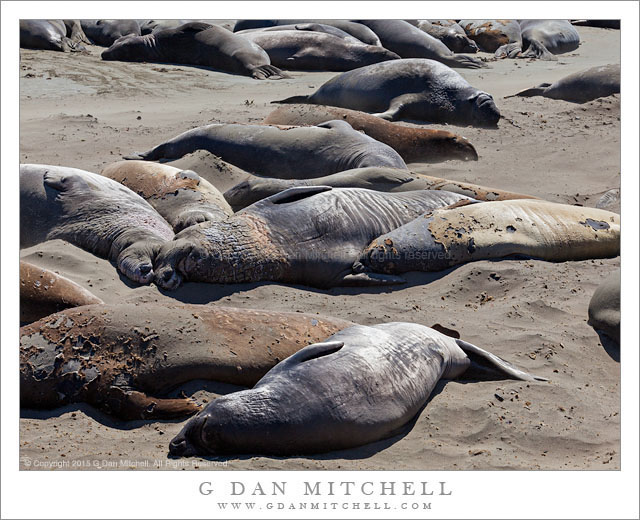
Napping Elephant Seals

Napping Elephant Seals

Napping Elephant Seals. Point Piedras Blancas, California. July 24, 2014. © Copyright 2014 G Dan Mitchell – all rights reserved.

A crowd of elephant seals napping on the beach near Point Piedras Blancas

This is (yet another!) photograph of elephant seals lolling about on the beach near Point Piedras Blancas just south of the Big Sur coastline. This location is well-known for providing easy access to viewing of these remarkable animals. They are found in many other locations along the coast now that their numbers have recovered, but in most places access is much more difficult. Here there is an “elephant seal nursery” mere feet for the Pacific Coast Highway, with short observation trails that give good views of the action and which protect both the seals and the human visitors.

I visited a bit earlier in this season when the pups were still rather small. This visit was almost an afterthought — after a morning of photographing landscapes and seascapes along the Big Sur coast I found myself at the southern end of this area with a few hours to kill in midday light, so I decided to drive a bit further and visit the seals. There were not nearly as many there at this later point in the season, but there were still plenty for me to make photographs. Images of the animals lying almost motionless on the sand not only evoke our own pleasant thoughts of doing the same thing (!) but they can also create a false impression that the lives of these creatures are lives of ease. In fact, the reality seems quite a bit different. In contrast to what seems like a life as a big chunk of sleeping blubber, these animals become quite sleek and graceful once in the water — where I understand that they have to be on the lookout in order to avoid become a snack for a great white shark!

G Dan Mitchell is a California photographer and visual opportunist whose subjects include the Pacific coast, redwood forests, central California oak/grasslands, the Sierra Nevada, California deserts, urban landscapes, night photography, and more.
Blog | About | Flickr | Twitter | FacebookGoogle+ | 500px.com | LinkedIn | Email

Text, photographs, and other media are © Copyright G Dan Mitchell (or others when indicated) and are not in the public domain and may not be used on websites, blogs, or in other media without advance permission from G Dan Mitchell.
Making Aperture Selection Easy (Morning Musing for 8/22/14)

From time to time I see questions from photographers trying to figure out exactly which aperture is the “right” one for a particular photograph. Some will go so far as to consult depth of field calculators (or “DOF calculators”) to help them decide whether the should open up a third of a stop from f/11.

There may be times where that sort of precision aperture selection is useful, but in many cases you can make things a lot simpler*, basically selecting from one of three general options:

  1. If depth of field isn’t a big issue — let’s say you are shooting a relatively flat subject — simply use a “middle of the road” aperture that will be sharp on your lens/camera combination. The old rule of thumb about using f/8 is a decent one to follow here, although cropped sensor shooters might go for something more like f/5.6.
  2. If you need very deep depth of field, go straight to the smallest aperture you feel comfortable using. On a full frame camera this is likely to be about f/16, while on a cropped sensor camera it might be a bit larger, perhaps in the f/11 or so range. If your need for extra deep depth of field is strong enough that you are willing to give up a small degree of overall image sharpness — which will be invisible in small images anyway —  you might even go one stop smaller on some occasions to f/22 on full frame and f/16 on crop.
  3. If you need to limit depth of field to throw background elements out of focus, simply try the largest aperture that your lens has — but consider stopping down just a bit if you need just a bit more depth of field.

Basically, for most photographs, especially if you have good light and/or are using a tripod, you could probably get away with considering only three apertures in most cases — the “normal” one, the really small one, and the really big one.

  • Yes, this is a bit of a simplification, though it really does work in the vast majority of the photographs that most people are making. Clearly things can get a bit more complicated if you are, for example, shooting in very low light or need to deal with moving subjects. In the interest of keeping this “Easy” description easy, I’ll simply acknowledge those possibilities here without elaborating.

G Dan Mitchell is a California photographer and visual opportunist whose subjects include the Pacific coast, redwood forests, central California oak/grasslands, the Sierra Nevada, California deserts, urban landscapes, night photography, and more.
Blog | About | Flickr | Twitter | FacebookGoogle+ | 500px.com | LinkedIn | Email

Text, photographs, and other media are © Copyright G Dan Mitchell (or others when indicated) and are not in the public domain and may not be used on websites, blogs, or in other media without advance permission from G Dan Mitchell.

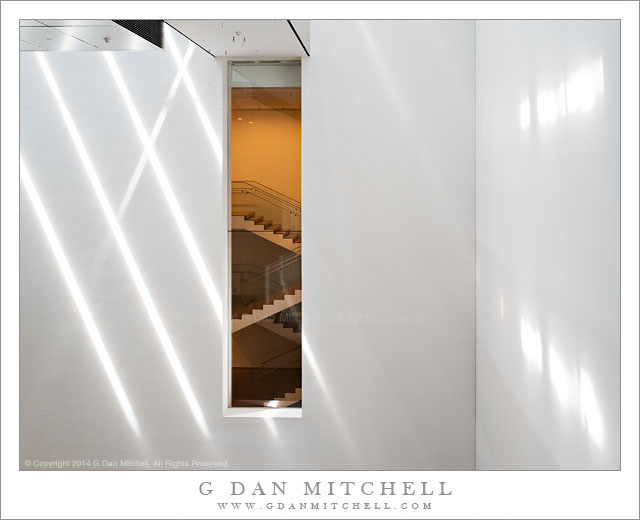
Museum Atrium

Museum Atrium
Museum Atrium

Museum Atrium. New York City. August 11, 2014. © Copyright 2014 G Dan Mitchell – all rights reserved.

Light patterns on the atrium wall at the New York Museum of Modern Art

I think I end up visiting the Museum of Modern Art (MOMA) every time I visit New York City. It may be partly out of habit, but it is also because there are always things there to see. MOMA always features photography — though the work on display this time was not quite my cup of tea. There are special exhibits, and we were especially surprised and please by the Lygia Clark show. It is always hard to resist — we inevitably fail — visiting the regular collection of famous work in the main galleries.

For me, the space itself is an interesting photographic subject. To some extent it is a good place to photograph people, and I did a bit of that in one particular gallery displaying work that did not particularly impress me — though I noticed one particular museum attendant keeping a very close eye on me. She never said a word, but it seemed like she was always watching me, to the extent that she shows up in perhaps half of the photos I made in that exhibit! The building itself is fascinating, in terms of its own architectural details, how people inhabit the space, and how light plays on its shapes and surfaces. This photograph features the central atrium, which I have photographed in the past, crisscrossed by light patterns stretching down from the roof.

G Dan Mitchell is a California photographer and visual opportunist whose subjects include the Pacific coast, redwood forests, central California oak/grasslands, the Sierra Nevada, California deserts, urban landscapes, night photography, and more.
Blog | About | Flickr | Twitter | FacebookGoogle+ | 500px.com | LinkedIn | Email

Text, photographs, and other media are © Copyright G Dan Mitchell (or others when indicated) and are not in the public domain and may not be used on websites, blogs, or in other media without advance permission from G Dan Mitchell.

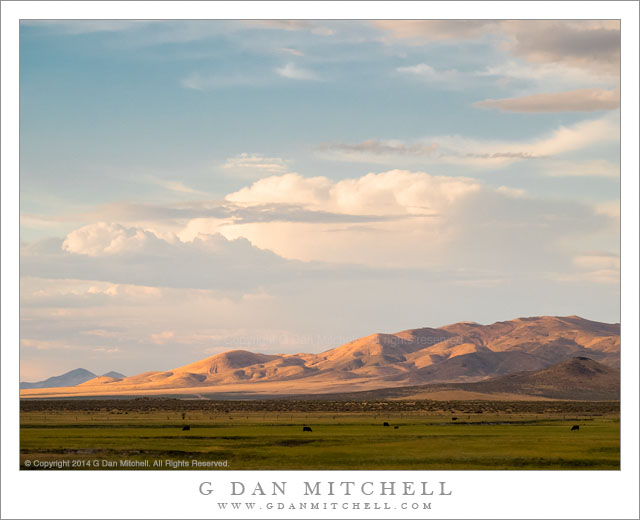
Basin and Range, Monsoon Clouds

Basin and Range, Monsoon Clouds

Basin and Range, Monsoon Clouds. Between Winnemucca and Elko, Nevada. July 30, 2014. © Copyright 2014 G Dan Mitchell – all rights reserved.

Evening monsoon thunderstorms dissipate above the basin and range terrain of Nevada

This simple photograph necessarily leads to a long story. It starts many, many years ago when I was a child. My family moved to California from Minnesota when I was four years old, and every few years we took a long trip back to the Midwest to visit my mother’s family in Sioux Falls, South Dakota. (Although I have not been there for some years now, I still have fond feelings for the place.) Sometimes we drove, with my parents figuring out routes that would take us through national parks and monuments — Yellowstone, Rocky Mountain, etc — along the way. Several times we took the train, which in those days was the famous California Zephyr. We would get on the train in Fremont, California and travel all the way to Omaha, Nebraska, arriving very early in the morning and then getting to South Dakota by (usually) rental car or (occasionally) a plane. To a young kid, the California Zephyr was an amazing thing — somehow we got “Pullman” sleeper cars, ate in the dining car, and — if my memory is correct — passed hours in the vista dome car watching the terrain roll by.

Jump forward to the new millennium. Patty’s brother and sister-in-law, and two of our sons and their girlfriends live in Brooklyn, so we find excuses to go to New York City every year or so. This time we went not only to visit family, but also so that Patty could attend the International Double Reed Society conference at NYU. We’ve flown plenty of times, so this time we decided to give the train a try. (We did fly back home at the end of the trip — a good choice in my view.) So on this last day of July we went up to Emeryville, where the Zephyr’s trip starts these days, and embarked on our adventure, nostalgic for me and brand new for Patty. There is much more to say about train travel than I have space for here, but I’ll share just a bit about the first day. The route begins along the shores of the San Francisco Bay and then up the delta to Sacramento, the historic end point of the continental railroad. From there the train crosses the Sierra above Truckee Lake, an absolutely beautiful route that often reveals perspectives on this part of the Sierra that are quite different from what we know from driving Interstate 80. As we crossed the crest, the clouds thickened and we rolled through a hail storm as we descended to Truckee. Not long after that we stopped briefly in Reno, Nevada, and then continued on to the northeast across Nevada. After we passed through Winnemucca (from which I departed some years ago on a grand bike trip across the Black Rock Desert and into Northern California) the train continued on through the Humboldt Basin as evening came on and beautiful light fell on the rangeland and the monsoon clouds overhead as the day came to an end.

G Dan Mitchell is a California photographer and visual opportunist whose subjects include the Pacific coast, redwood forests, central California oak/grasslands, the Sierra Nevada, California deserts, urban landscapes, night photography, and more.
Blog | About | Flickr | Twitter | FacebookGoogle+ | 500px.com | LinkedIn | Email

Text, photographs, and other media are © Copyright G Dan Mitchell (or others when indicated) and are not in the public domain and may not be used on websites, blogs, or in other media without advance permission from G Dan Mitchell.

Photographer and visual opportunist. Daily photos since 2005, plus articles, reviews, news, and ideas.