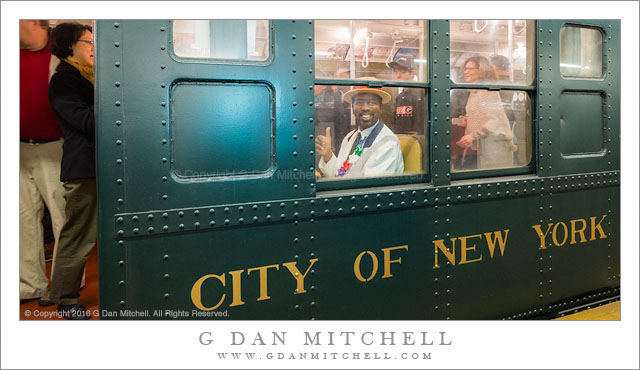
A man in a hat inside an antique subway car, Manhattan
I had been hearing about the “nostalgia” train days in New York for some time, mostly from my sons, who now live there and who are big fans of the infrastructure (and more) of New York. This year the timing of our visit allowed us to go to the nostalgia event, a day when lots of the old trains are out and running on the subway lines, and open to riders who want to get a feeling for what the system was like in the past.
People seem to show up for all kinds of reasons. Some seem like your standard railroad fans. Others seem to come mostly for the history. A few other, somewhat like me perhaps, simply go because we heard that it was going on. But some folks do all sorts of fun and idiosyncratic things. In one car I ran into a crowd of photographers, many of whom were using really old and impressive film gear. Others dress up in period clothing. As I photographed this car I was taken by the image of this smiling man in a color accented bright white shirt. As I photographed, furtively at first, I could tell that he wanted me to photograph him and he encouraged me to make more than one photograph.
I’ve used the subway system in New York as much as any out-of-town visitor, enjoying the fact that I can get to so many places all over the city on the subway plus a little bit of walking. But I don’t give the system all that much thought beyond trying to get on the right time at the right time at the right place. But when you stop to think about what it is and what it does it is quite an amazing thing. Hidden away beneath the surface of the extraordinary busy city is an entire transportation system and only rarely comes to the surface, and then mostly as it leaves Manhattan or heads out into more distant areas.
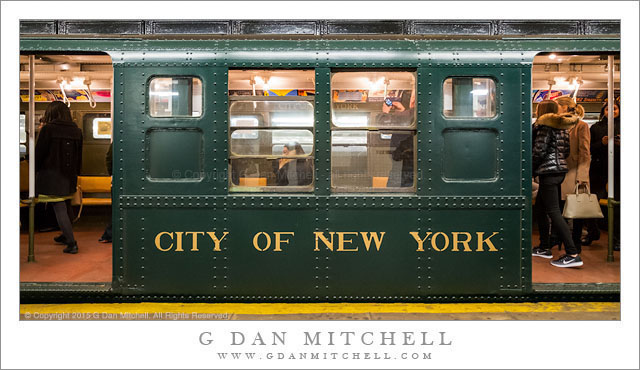
On our recent visit to New York we managed to go visit the subway museum in Brooklyn. (Hard to avoid this, since it was literally walking distance from where we stayed this time.) The museum holds many things, but perhaps most intriguing is the collection of historic rolling stock, going way back to the beginning of the system. A visit got me to take the system a bit less for granted. We saw this car at the museum, but then again a few days later on one of the “nostalgia” train days, when the old trains run once again and subway fans turn out by the thousands. By framing this photograph so tightly and from a direct point if view, I hoped to “see” the train a bit more for what it is as a shape, and a bit of an odd one at that.
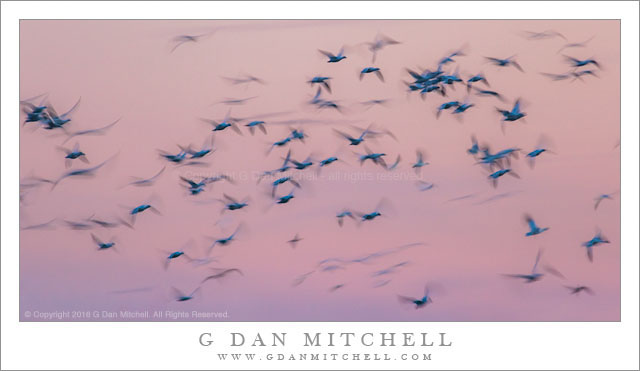
A flock of geese against twilight sky above the Central Valley
February was mostly a very good month for photographing migratory birds in the Central Valley this winter. This was a relief, quite honestly, after the past four years of drought and increasingly dire conditions in the Valley and throughout the state. In normal times, the wildlife refuges where I often photograph can be filled with water and life in the winter — flowing creeks and flooded fields where thousands of birds collect. But much of this water comes from sources that are not local, and as they dried up the refuges also began to shrink the acreage that was under water. It was sad to see locations that I’ve thought of as ponds become plain, dry fields. And at times the birds seemed to suffer a bit, too, or at least change their habits. Back in the late fall, before the course of the winter season became clear and Northern and Central California received rain again, we were concerned about what would happen this year.
But in most of California the rains came, at times heavy, and water flows once again. The birds returned, and sometimes it seemed that there numbers were exploding with the return of water. By February it wasn’t uncommon to find many thousands of birds in the refuges, and by late in the month the scene was downright wild, with all kinds of geese, huge numbers of cranes, and much more. In the evening things become active, and as the light fails I often continue to photograph, but at longer shutter speeds that allow me to work with the moving poetry of blurred birds in flight against dusk sky.
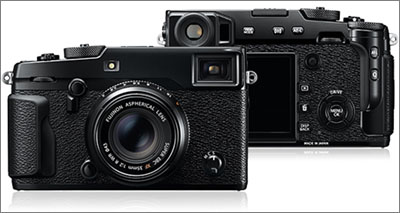
Fujifilm just released their newest camera, the X-Pro2. Since I have been relying on an earlier Fujifilm camera (the original X-E1) for over three years — and liking the results a whole lot — it seemed like time to move up to the newer, more refined body. My new X-Pro2 arrived a few days ago, and so far I’m quite impressed. (My time with the camera has been limited thus far, and I’ll share a much more detailed report once I have had a chance to use it extensively.)
Fujifilm X-Pro2 with the new XF 35mm f/2 WR lens
The Fujifilm “x-trans” sensor cameras are appealing for a number of reasons:
Small, light mirrorless designs offer an alternative to larger DSLR systems.
The x-trans sensor produces excellent image quality and uses a photo site layout that is designed to minimize aliasing without using anti-aliasing filters.
The Fujifilm lenses are truly top-notch, from primes to zooms, and there is a complete and diverse selection of available lenses.
Until now all of these cameras have use 16 megapixel (MP) 1.5x cropped sensor designs. 16MP is plenty for almost all photographers, and I make beautiful 18″ x 24″ prints from the files. One of the main updates on the X-Pro2 is the addition of an optimized 24MP sensor. If anything, this sensor improves the low light performance and dynamic range of the 16MP versions, and it provides a bit more resolution.
The X-Pro2 also improves on many of the ideas behind the original (and now a bit long in the tooth, though quite inexpensive) X-Pro1. Both cameras use a hybrid viewfinder that incorporates both an optical viewfinder (OVF) and an electronic viewfinder (EVF), both of which have advantages in various situations. The OVF works beautifully with many primes, eliminates shutter blackout, and allows the photographer to see what is going on just outside the borders of the image. The design overlays an electronic display on top of the optical image. These features are very useful to those doing street photography and similar things.
The EVF works well with all lenses, from ultra wide to telephoto and especially with zoom lenses. It can be advantageous in very low light, such as night street photography. It also shows the precise frame edge lines and can display even more image data than the OVF.
The camera feels light but also solid and well-constructed, and it recalls classic rangefinder cameras.
I got mine with the new XF 35mm f/2 WR lens, one of five newer lenses that are optimized to autofocus more quickly on the X-Pro2 (and, presumably, future X-series cameras). It is also weather resistant. I can report that it focuses quickly and accurately in a wide range of situations. Since I also have my older XF 35mm f/1.4 lens, I haven’t yet decided whether I will end up valuing the extra stop of the f/1.4 lens enough to give up the faster AF and smaller size of the new f/2 lens.
That’s all I’ll say for now, but expect more in the not-too-distant future as I gain more experience with the camera. For now, I don’t see any reason to not recommend it.
Fujifilm X-Pro2 digital camera body — $1699 at B&H or Adorama
Fujinon XF 35mm f/2 WR lens — $399 / $299* with X-Pro2 at B&H or Adorama (*limited time offer)
(If you find this website and posts like this useful and you are going to get one of these products, consider making your purchase through links on this site. Your price will be the same, but the purchases help support the operation of the site. Thanks!)

 G Dan Mitchell is a California photographer and visual opportunist. His book, “California’s Fall Color: A Photographer’s Guide to Autumn in the Sierra” is available from Heyday Books and Amazon.