Photographer Louis Mendes

Photographer Louis Mendes
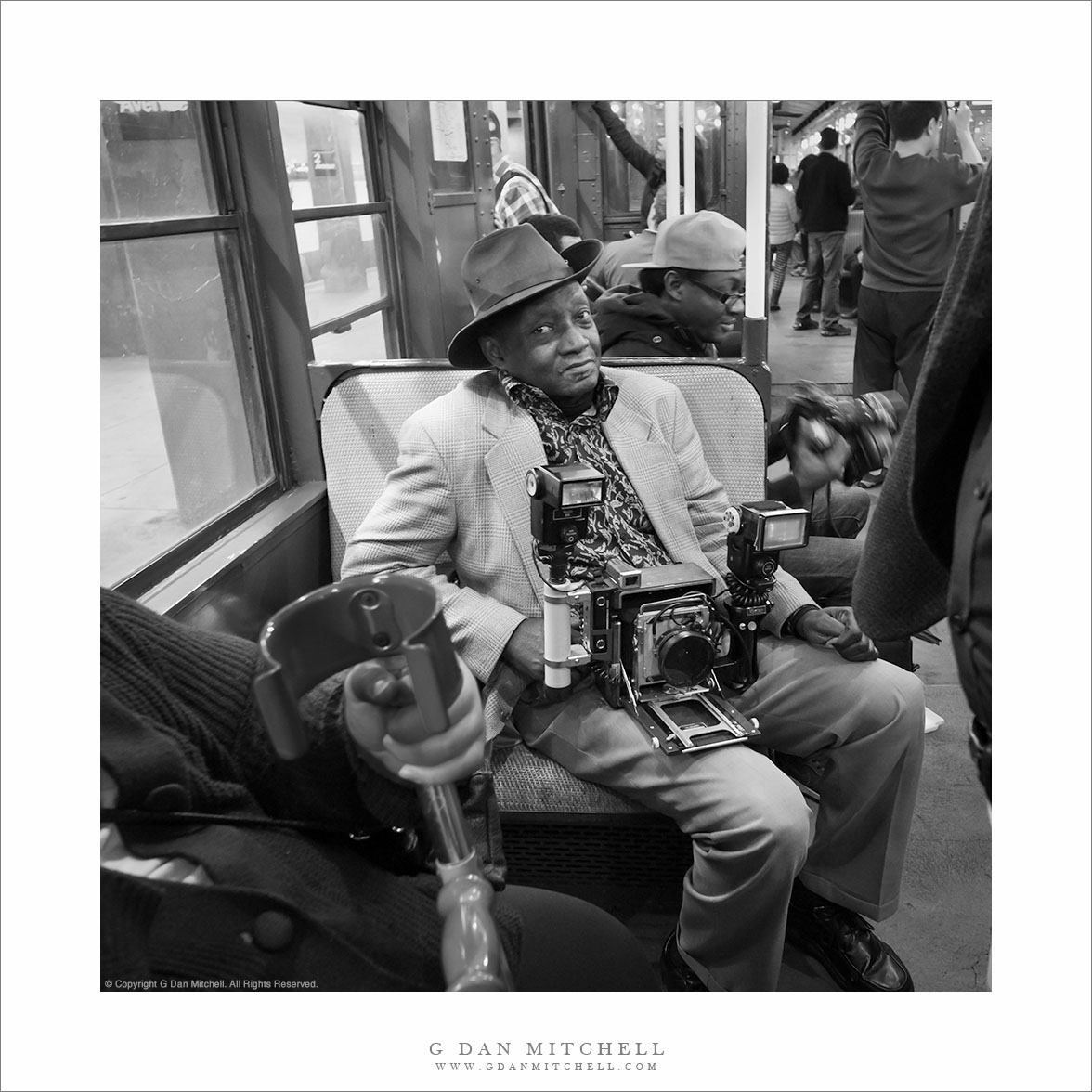
“Photographer Louis Mendes” — Photographer Louis Mendes rides a historic New York subway car

The timing of our December 2015 visit to New York City coincided with a special event on the New York Subway system — a day when historic subway trains run along one Manhattan route. Our sons had told us about this before, and we all met up at the south end of the line to catch the first train. It is made up of a variety of cars — some from just before the vintage of the current trains and others from much further in the past. It is a big event, and by the time the second run began there were big crowds. (One fun thing was watching the looks of the faces of folks at stations who didn’t know about this… as ancient subway trains rolled in and stopped to take on passengers.)

As I walked through one of the cars there was a big group of photographers, many holding vintage film cameras, some rigged up to work with modern electronic flash units. This fellow immediately caught my eye, and for a bunch of reasons. Many years ago my father had a camera almost exactly like his, and I thought it was the coolest thing back then. I also was taken by the contrast between his rig, with his giant camera and multiple flash units, and what I use to photograph in circumstance these days… a very small mirrorless system that works so well in low light than I never use flash. And I was pretty sure I recognized him, and thought that I had read about him somewhere. It was too crowded and noisy to talk, but I later figured out that he is street photographer Louis Mendes, who is well-known for photographing with this eclectic equipment in Manhattan. (I later ran into him again in front of the B&H store, and I recently read an interview in which he said that is his “third favorite” location for photographing.)

There is an article in The New Yorker about Mendex” New York City’s Most Classic Street Photographer. (2016)


Leave a comment or question using the form. (Click the title to see the full article and to comment if you are viewing it on the home page.)

G Dan Mitchell is a California photographer and visual opportunist. His book, “California’s Fall Color: A Photographer’s Guide to Autumn in the Sierra” (Heyday Books) is available directly from him. Blog | Bluesky | Mastodon | Substack Notes | Flickr | Email

All media © Copyright G Dan Mitchell and others.
Snowy Egret

Snowy Egret
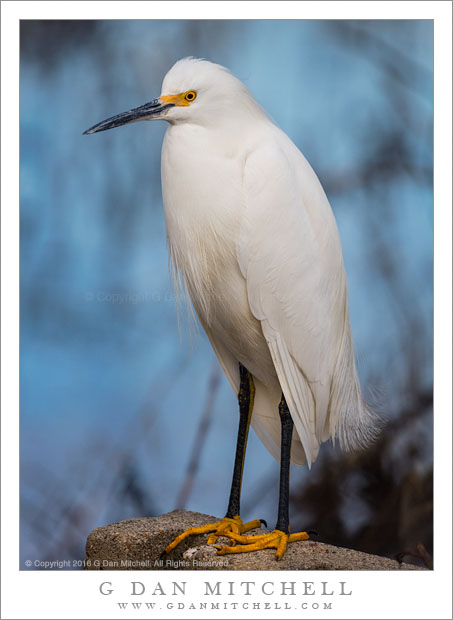
Snowy egret stands at rest

Snowy Egret. Sacrament Valley, California. January 8, 2016. © Copyright 2016 G Dan Mitchell – all rights reserved.

Snowy egret stands at rest

I recently posted a photograph of a great egret, probably the most striking are recognizable of the egrets found in the parts of California where I photograph. That bird is found in field, creek beds, along lakes and rivers, and even in Pacific Ocean kelp beds. But it isn’t the only kind of egret found in the state. Two others are the snowy egret (seen here) and the small cattle egret. All of them often are found alone, though occasionally in small groups, and all may fly off with the least provocation if you get too close.

This snowy egret seemed to be in a rather inactive mood as I came upon it while driving around the perimeter of a wildlife refuge. Those who aren’t familiar with the California refuges and their regulations might wonder why one would drive rather than walk, but it turns out that this is the rule in most areas of the refuges. One is supposed to stay mostly inside a vehicle and make photographs from the “mobile blind” of the vehicle, supposedly since this is less stressful for the birds. So I stopped the vehicle and then very slowly moved forward a bit at a time, first to get close enough for an initial photograph and then to work my way closer for an even better image. Much to my surprise, this specimen didn’t budge at all, and I was able to stop quite close and make frame-filling photographs.


G Dan Mitchell is a California photographer and visual opportunist. His book, “California’s Fall Color: A Photographer’s Guide to Autumn in the Sierra” is available from Heyday Books and Amazon.
Blog | About | Flickr | Twitter | FacebookGoogle+ | 500px.com | LinkedIn | Email


All media © Copyright G Dan Mitchell and others as indicated. Any use requires advance permission from G Dan Mitchell.

Black and White Photography

Black and White Photography
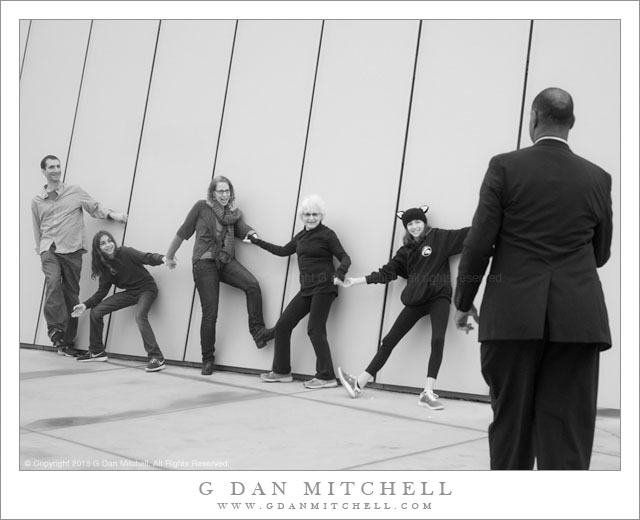
A museum employee photographs a family.

Black and White Photography. New York City. December 27, 2015. © Copyright 2015 G Dan Mitchell – all rights reserved.

A Whitney Museum employee photographs a family.

During our December 2015 visit to New York I had my first opportunity to visit the new Whitney Museum in Chelsea, at the south end of the High Line Park. I hadn’t been to the old Whitney, so I was especially interested in the new museum — not only would I see work that I hadn’t looked at before, but I would have a chance to visit a brand new piece of architecture. In fact, I thought the building was fascinating, especially outdoor terraces on each of the floors that I visited. (I started at the top and got through the collections on the 6th, 7th, and 8th floors.) The highest levels thrust out into space, providing dizzying and spectacular New York views, and the visual appearance looking up from the lower terraces is quite something, too.

I like photographing at and around museums. Often the architecture itself is interesting, but even more, the people at museums are fascinating subjects. Perhaps it is just because there are often so many of them packed so tightly together. Maybe it is something about a change in appearance and demeanor among people who are looking at and thinking about art. I spent a lot of time out on those terraces making quick photographs, and when I saw this family lining up against the wall of the museum, asking a museum employee (who was quite cooperative) to take the camera and record their antics, I quickly clicked of a sequence of photographs.


G Dan Mitchell is a California photographer and visual opportunist. His book, “California’s Fall Color: A Photographer’s Guide to Autumn in the Sierra” is available from Heyday Books and Amazon.
Blog | About | Flickr | Twitter | FacebookGoogle+ | 500px.com | LinkedIn | Email


All media © Copyright G Dan Mitchell and others as indicated. Any use requires advance permission from G Dan Mitchell.

Reader Question: Sony Versus Fujifilm

6/28/16: Slightly updated on 6/28/16 to reflect my acquisition of the Fujifilm X-Pro2  (B&H | Adorama) and a few other things.


Today I am sharing  another reader question and my response. This one came from “Greg” in a response to a post on my Facebook page:

Hi Dan, have heard good things about the Fuji cameras. Have also heard good things about the SONY cameras. Both are mirrorless, but the SONY is a full-frame while the Fuji is APC/1.5X. Is there a reason you would choose the Fuji over the SONY – you indicated in the article you have been using the  X-Pro1 and will be moving up to the  X-Pro2… Illuminate me on the subject

That is a great subject to consider, Greg. Both Sony and Fujifilm are making some very fine mirrorless cameras these days, but for my purposes the Fujifilm is a better fit than, say, the Sony a7R II full frame mirrorless camera that Greg is thinking of. (Small correction: I have not been using the X-Pro1. I have used the X-E1 for the past three years and I now use the X-Pro2.)

Before I explain, I must acknowledge that the Sony is an excellent body, and another photographer may well find it to be the best choice for his/her needs. The Sony a7R II is, as you point out, a full frame body and the current version has a 42MP sensor rather than a 24MP sensor. The sensor is known for its low noise and excellent dynamic range. Sony has some native lenses, but lots of folks are using their Sony cameras with a range of third party lenses, including those from their Canon and (now) Nikon DSLRs.

So, with all of those positives, why Fujifilm?

Continue reading Reader Question: Sony Versus Fujifilm

Photographer and visual opportunist. Daily photos since 2005, plus articles, reviews, news, and ideas.