A boulder in the midst of early autumn aspen color in the Eastern Sierra Nevada
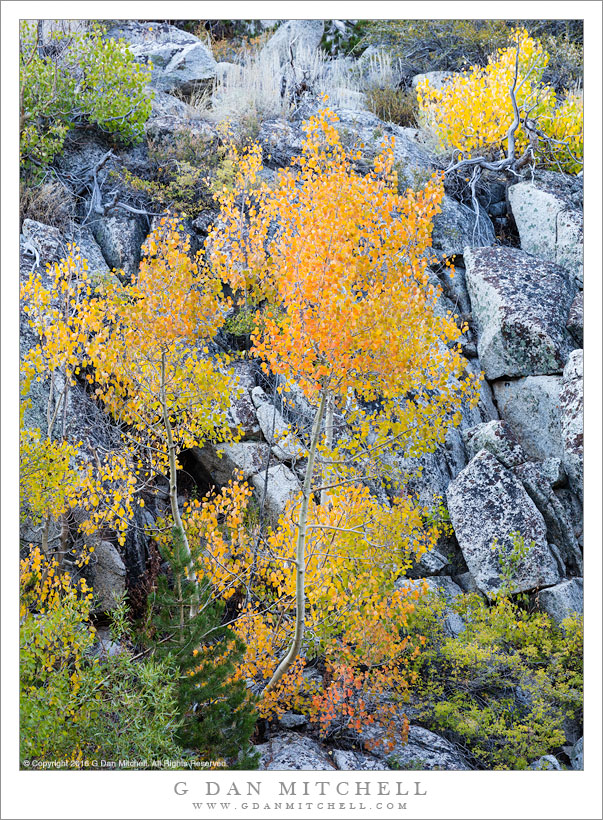
Besides being an example of relatively bright color, this little aspen scene may reveal a few other things to close viewers. The colors range almost across the entire spectrum of aspen color, from the green or trees that have not yet turned, through the typical brilliant golden-yellow, and in between some orange and even a bit of red. These are rather small trees, growing on very rocky soil, the environment where the trees frequently begin to turn first.
The slope is perhaps not remarkable among many other similar slopes that are also covered with aspens. But for some reason — it may be an accidental turn I took near here years ago — this little section of an east side valley seems special to me, so much so that I have to make a sort of ritual passage past and through it when I’m in the area. This photograph was made close to the middle of September, which seems early for Eastern Sierra aspen color. But after several drought years the trees are not behaving according to the familiar plan. Yet, there is still a lot of green, too, which promises several weeks of developing color to come.
Even though the calendar reports that a few days of summer still remain, and the thermometer here in the San Francisco Bay Area still reads hot enough for summer, the annual autumn color show is now underway in the Sierra Nevada. I’m just back from four days “over there,” and I’d like to share a bit of what I saw, along with a few hunches about where things might go over the next few weeks. (Disclaimer: Predicting fall color is very much an inaccurate science — kind of like predicting the outcome of the playoff games before they begin. Over the years I’ve been surprised many times, and we really won’t know how this year’s color plays out until it happens.)
Early fall color from aspens on rocky slopes in the Eastern Sierra Nevada
Between September 16 and 19 I visited the Yosemite around Tuolumne Meadows, a few spots well east of the Sierra with views back toward the range, the Mono Basin, US 395 between Conway Summit (just north of Mono Lake) and Bishop Canyon, and Bishop Canyon itself.
Acknowledging the risk of pronouncing this to be an “Early Aspen Season This Year!”, I’m going out on a limb and saying that it did seem like some of the color is progressing on an early than usual schedule. I usually wouldn’t both seriously hunting for aspen color in the Sierra this early, but I found a number of places with color worthy of photographing. In fact, I had the joy of photographing alone in some locations that will be overrun by photographers in a few weeks! (To be clear, and as I’ll clarify below, there are still lots of very green trees!)
For example, the photograph above was made up in Bishop Canyon at between 8000′ and 9000′ in a place that I visit every year. While these particular trees are often among the earliest in the area to change colors, seeing almost an entire slope of yellow/gold this soon is not what I would expect.
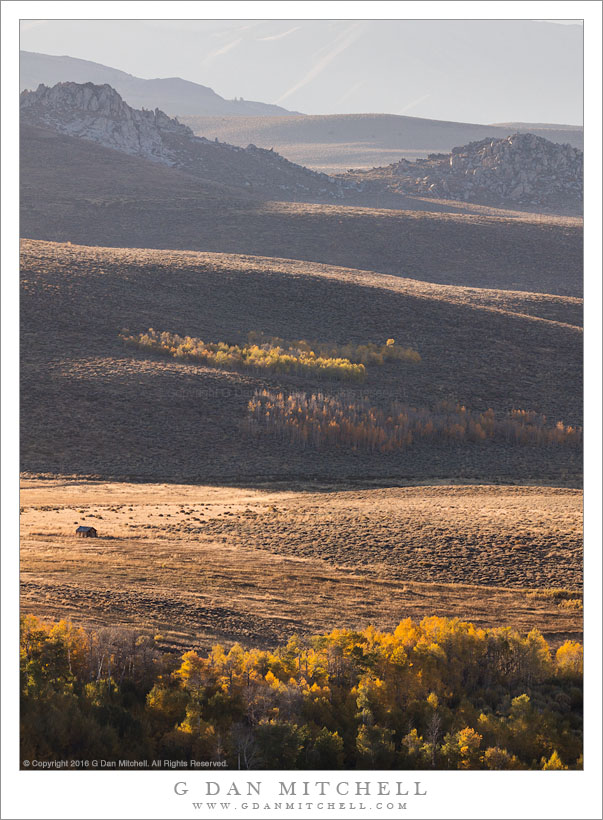
Most of the early color comes from small aspens, growing at relatively higher elevations, and often on what seems to be margins terrain — in very rocky areas, along talus slopes, and it areas that are typically dry. There is some extensive color in some areas east of the Sierra, areas that are drier and tend to support the smaller “scrub” aspen trees.
Would I recommend going up there right now to see the color? Not exactly, though if you do go you’ll be able to find some nice color if you poke around a bit in the usual places, emphasizing the higher and rockier locations. That said, there are still a lot of very green trees, and the vast majority of the bigger and taller trees are essentially still completely green. This is especially true in the low elevation canyons, where the trees often grow larger and are sheltered more from the elements.
When will the rest of the trees change? Good question! I don’t know, but I have some hunches. Typically they would get their color after the start of October, and some years ago I would look for the best color beginning a few days into October and continuing through the second week and possibly a bit later as the final good color comes to large, low elevation aspens. My thinking this year is that last year’s (2015) pattern may be a guide to this year as well. Color last year also started a bit early. Last year it also looked like some trees were stressed by the prolonged drought. But in 2015 many of the bigger trees in areas perhaps less affected by drought seemed to change on almost their typical previous schedule. This meant that at any given moment it might have been a bit harder to find the “perfect grove,” but that the season actually lasted longer due to the early start.
Speaking for myself, if I had a choice between going early in the usual time frame (starting near the beginning of October) and going later (say at the end of the second week of the month) I would be more inclined to gamble on the early time rather than the later this year. In round numbers, perhaps aiming of the first week of October would be a good bet — though I’m also confident that, barring weather surprises, there will still be color at lower elevations and among the largest trees later on, too.
Intensely colorful red and orange autumn aspen leaves in the eastern Sierra Nevada.
It is the first day of September. What happened to summer? Actually, I know what happened to my summer — we were traveling internationally for the past five weeks, and thus I missed my usual August time in the Sierra. And, yes, I do know that it still is summer for a few more weeks, and that in my (San Francisco Bay Area) neck of the woods it will remain mostly warm and sunny for at least another six weeks of so.
However, the arrival of September does signal the coming end of summer and the inevitable arrival of autumn and then winter. And I’m fine with that! Truth be told, summer is my least favorite season in many ways. Yes, it is warm and sunny, we have an abundance of fresh produce, and I often have more opportunities to travel. But from a photographic perspective, especially when it comes to my wildlife and landscape photography, the other three seasons offer more compelling opportunities. I especially love fall!
Next up is autumn. Although I haven’t been in the Sierra since late July, I have seen the first signs that fall is coming. A week ago in the Chianti region of Italy I photographed (badly, with an iPhone!) the first autumn leaves on an apple tree where we were staying. Yesterday as I walked in my neighborhood the temperatures were cooler, a strong wind came up, and some brown leaves were blown about with their characteristic dry and crackly autumn sound.
And even though I won’t get up there for a few more days, I know that the earliest signs of autumn are already appearing in the Sierra. Creeks are diminishing and drying up. Meadows are turning golden-brown. Corn Lily plants are shifting to brown and yellow, and here and there a few golden leaves may appear. And next up will be the annual spectacular display of aspen color.
If you are also an aspen color chaser like me, you may be interested in some of the California fall color resources on this website. To get started see my Sierra Fall Color page for basic information and links to other articles I’ve written on the subject. As I get up to the Sierra and as I hear updates from various sources I will share them on this page, too.
There is also information there about my book, California’s Fall Color: A Photographer’s Guide to Autumn in the Sierra. This book offers some ideas about where and when to look for aspen and other color in the Sierra, and it includes some photographic basics that can help you once you get there.
California’s Fall Color: A Photographer’s Guide to Autumn in the Sierra, my book on photographing fall foliage in California’s Sierra Nevada, is available from Heyday Books and from Amazon.)
The book shares a lot of what I have learned about finding and photographing Sierra Nevada fall color, along with a large collection of my autumn photography. Watch this page for updates and news on the book and for continuing information about photographing Sierra Nevada fall color.
I have had my eye on these trees for several years now. In fact, I have photographed them a few times, though I wasn’t quite happy with the results. They stand near a spot that I frequently visit during the late fall through winter months, when migratory birds live in the nearby wetlands and fields. In fact, that is why I was there on this December day. After a couple of hours of bird photography I looked over in the direction of the trees and thought that the light might be right for a photograph.
The light in this part of the Central Valley is astonishingly variable, especially in the winter and near-winter months. There can be high thin clouds, a Pacific weather front, general haze, or fog so thick that you can’t see 100 feet… unless you look up to see the stars and the moon! This day was quite variable, and that was part of the fun of photographing it. Fog was forming when we arrived before dawn. It stuck around a while, thinned and morphed into a sort of general atmospheric haziness. Above the fog there were high clouds that also muted the light a bit. Here and there, actual fog banks formed. This photograph has a little of all of these things: the light on the trees is muted, fog banks stand in the distance with high clouds overhead.
Photographer and visual opportunist. Daily photos since 2005, plus articles, reviews, news, and ideas.
Manage Consent
To provide the best experiences, we use technologies like cookies to store and/or access device information. Consenting to these technologies will allow us to process data such as browsing behavior or unique IDs on this site. Not consenting or withdrawing consent, may adversely affect certain features and functions.
Functional
Always active
The technical storage or access is strictly necessary for the legitimate purpose of enabling the use of a specific service explicitly requested by the subscriber or user, or for the sole purpose of carrying out the transmission of a communication over an electronic communications network.
Preferences
The technical storage or access is necessary for the legitimate purpose of storing preferences that are not requested by the subscriber or user.
Statistics
The technical storage or access that is used exclusively for statistical purposes.The technical storage or access that is used exclusively for anonymous statistical purposes. Without a subpoena, voluntary compliance on the part of your Internet Service Provider, or additional records from a third party, information stored or retrieved for this purpose alone cannot usually be used to identify you.
Marketing
The technical storage or access is required to create user profiles to send advertising, or to track the user on a website or across several websites for similar marketing purposes.