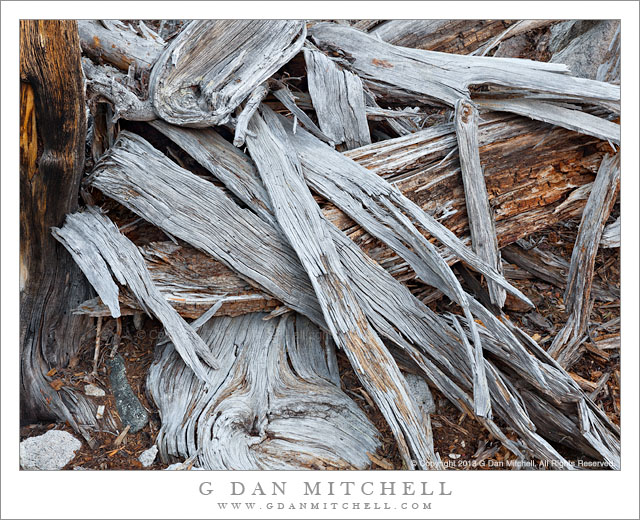
The decaying stump of an ancient sub-alpine Sierra Nevada tree
I came upon this jumble of the remains of a very old and large tree while walking about on our first full morning camped at the spot where we would remain for six nights in the Kings Canyon National Park high-country. From our camp at about the 11,000′ level I walked uphill, intending to investigate a dome on the ridge behind us and to see if I could find anything to photograph around a small lake that I could see on our maps.
As I walked up the hill I passed through small meadows and by dried-up tarns with their barren rocks and the branches of various fallen trees. As I approached the location of the lake I had to find a route between rocks and various small but thick groves of trees. As I passed one of these spots I noticed this old tree in the (long) process of disintegrating. The boundary between these ancient and rugged living thing and rock has sometimes seemed fuzzy to me. While I understand that the rocks are far, far older than any tree, these trees grow so slowly, are often so twisted and gnarled, wind so intimately among the rocks and boulders, and are of a color that looks more like rock than wood.
G Dan Mitchell is a California photographer and visual opportunist whose subjects include the Pacific coast, redwood forests, central California oak/grasslands, the Sierra Nevada, California deserts, urban landscapes, night photography, and more. Blog | About | Flickr | Twitter | Facebook | Google+ | 500px.com | LinkedIn | Email
Hazy morning light filters across the burned hillsides in the area of the Rim Fire, California
In photographic terms this is perhaps not the most spectacular photograph, and the location is not quite a scenic icon – though it is a place that many stop and take a look on their way to Yosemite, the “Rim of the World” overlook along highway 120 between Groveland and the northern park entrance. However, this view is loaded with implications and connected to many stories.
Late this past summer, the state of California was tremendously dry after a second drought season. It wasn’t a question of whether there would be big wildfires, but more of where, when, and how many. Perhaps the biggest one of all started very near the Rim of the World overlook, and in the hot and dry conditions it quickly – some might say explosively – spread to the north, east, and south. While many think of it as “the Yosemite fire” – and it did burn a lot of terrain inside the park – it really was more of a “Yosemite area” fire. Because of the conditions – the long-term conditions of drought and the immediate conditions of heat and wind – the fire apparently did very serious damage to the forests in the are.
Shortly after the fire was contained, I thought that I might drive through the park on Tioga Pass Road to get to and from the eastern Sierra in early October. In fact, the roads had opened up again by that time, but snow closed Tioga Pass on my trip to the west and we ended up coming back over Sonora Pass. So the post-fire conditions of this area, which is very familiar to me after years of visits, were still an unknown when I drove to The Valley on October 30 for a few days of autumn photography. Passing into the first fringes of the burned areas along highway 120 things didn’t look all that different than they do after any wildfire – some areas badly burned, some singed, and others that mostly escaped the fire. I decided to stop at the Rim of the World overlook, which was pretty much the only place where stopping was allowed, and get out and take a look. I was floored by the scale of the fire. It had come from behind my position, burned down and across the deep canyon of the Tuolumne River, up the canyon walls on the far side, and then across a vast series of receding ridges. Some smoke and haze still seemed to be coming from the area, and early morning light glanced across the ridges, with their dead trees. In the far distance there is a low peak with a bit of early season snow.
I have seen quite a few fires in the park over the past few decades. One not far from here destroyed a large area of forest a few decades ago – and on this trip, ironically, I was noting that new evergreen trees are finally taking hold there. Later several very bad fires blew up from near Foresta, doing terrible damage to the section of Crane Flat Road descending towards The Valley. There have been others. In most of these cases – though I wondered in the case of the most recent Foresta fire, too – it seemed that I could watch the forest recover and return to something resembling what I remember. However, given the intensity and scale of this fire, I wonder if I’ll have that opportunity where the Rim Fire burned?
To end on a cheerier note, a couple of other observations. Even near badly burned areas, I did see sections where this fire only burned some of the vegetation and a few that seemed to have been completely spared. And when I got to a spot inside the park along highway 120 where I often stop to photography dogwood trees in the spring and fall, a spot that seemed like it might have been within the burn zone on the maps, I found my little spot completely intact, with the dogwoods turning to fall colors.
G Dan Mitchell is a California photographer and visual opportunist whose subjects include the Pacific coast, redwood forests, central California oak/grasslands, the Sierra Nevada, California deserts, urban landscapes, night photography, and more. Blog | About | Flickr | Twitter | Facebook | Google+ | 500px.com | LinkedIn | Email
An October storm brings snow to the Parker Canyon area of the eastern Sierra Nevada
This is yet another photograph from our early October “aspen chasing” trip to photograph fall color in the eastern Sierra. We were on the “east side” for five days, in conditions that began with a full day of snow, then turned mostly sunny for a few more days, and returned to more winter-like weather on our final day. On that last day of the visit we tracked far to the east of the Sierra, out into high desert ranges where we saw many interesting things including a number of stands of aspens in surprising and less-visited places.
We looped back from the east and passed by the south shore of Mono Lake, and coming over the rise between there and highway 395 we were not surprised to see a substantial chunk of the Sierra crest laid out before us… but we were a bit surprised to see that it appeared to still be snowing along the crest. We had awakened to light snow in Mammoth Lakes that morning, but assumed that it was just a passing squall. This seemed to be the case, as we did not see much more in the way of precipitation as we headed east. But these were apparently the sort of conditions in which storm clouds form right over the crest, and the result was this very dramatic scene. Low in the frame, the foreground hills pick up a bit of sunlight, and as they ascend toward higher peaks, aspen trees in full autumn color are visible. A forest filled valley, lined by an old lateral glacial moraine, ascends across the frame from right to left, leading to the entrance to steep Parker Canyon. High above, light snow falls and the peaks around Parker Pass slip in and out of the clouds.
G Dan Mitchell is a California photographer and visual opportunist whose subjects include the Pacific coast, redwood forests, central California oak/grasslands, the Sierra Nevada, California deserts, urban landscapes, night photography, and more. Blog | About | Flickr | Twitter | Facebook | Google+ | 500px.com | LinkedIn | Email
“Fallen Snag, Dry Tarn” — The bleached remains of an old dead tree lie on the rocks of a dry subalpine tarn, Kings Canyon National Park
This year was the second of two very dry years in the Sierra Nevada and much of the west. The snowfall this past winter (2012-13) was far below normal and set records in some places. Last October and November it seemed like we might be starting a very wet season, which would have been welcome after the previous winter’s low levels of precipitation, but then the tap was shut off near the end of the year and there was hardly any more precipitation at all during the rest of the season, the portion when the majority of the Sierra’s precipitation falls. Consequently, this has been a strange summer in the Sierra. Although there may have been more monsoonal rain the usual, the effects of the depleted snow pack are obvious. The spring run-off occurred early and was anemic. By July much of the Sierra looked more like August, and I was already seeing signs of fall by early August.
With all of this in mind, it was no surprise to use to find some unusually dry conditions in the Kings Canyon back-country when we visited for more than a week in mid-September. (Though, in some ways, things were less horrendous than I might have expected. Perhaps this was a combination of going at a time when things tend to be dry anyway and, as a local pointed out to me, some recent summer rains.) On our first day at the location where we stayed to photograph for nearly a week I wandered up some nearby meadows towards a lake that I though I might want to photograph. Very close to my campsite I found several completely dry tarns. (A “tarn” is a seasonal pond fed by snowmelt, and many of them dry up each season.) This very old, sun bleached snag lay across the exposed rocks of this one, creating a stark images.
G Dan Mitchell is a California photographer and visual opportunist. His book, “California’s Fall Color: A Photographer’s Guide to Autumn in the Sierra” from Heyday Books, is available directly from G Dan Mitchell.
Photographer and visual opportunist. Daily photos since 2005, plus articles, reviews, news, and ideas.
Manage Consent
To provide the best experiences, we use technologies like cookies to store and/or access device information. Consenting to these technologies will allow us to process data such as browsing behavior or unique IDs on this site. Not consenting or withdrawing consent, may adversely affect certain features and functions.
Functional
Always active
The technical storage or access is strictly necessary for the legitimate purpose of enabling the use of a specific service explicitly requested by the subscriber or user, or for the sole purpose of carrying out the transmission of a communication over an electronic communications network.
Preferences
The technical storage or access is necessary for the legitimate purpose of storing preferences that are not requested by the subscriber or user.
Statistics
The technical storage or access that is used exclusively for statistical purposes.The technical storage or access that is used exclusively for anonymous statistical purposes. Without a subpoena, voluntary compliance on the part of your Internet Service Provider, or additional records from a third party, information stored or retrieved for this purpose alone cannot usually be used to identify you.
Marketing
The technical storage or access is required to create user profiles to send advertising, or to track the user on a website or across several websites for similar marketing purposes.