Looking into Panamint Valley and toward the Panamint Mountain Range
When most people think of Death Valley they probably think of incredibly hot desert conditions. Those conditions are real, and are among the reasons that I do not visit the place during the warmer times of the year. But the conditions are quite a bit more varied than that reputation would suggest. I have been snowed on in Death Valley — on one memorable occasion photographic desert wildflowers in a snow storm! — and I have encountered temperatures ranging from over 100 degrees to below freezing. The variations are related to seasons (there are some very cold places here in the winter!) and to elevation, which ranges from below sea level to over 11,000′.
This photograph captures a range of those conditions in one image. It was a pleasantly warm, though cloudy, day as I left the park. The winds were howling down below in Panamint Valley, where a dust storm was beginning to kick up. Winter snow was still thick on the highest peaks of the Panamint range, and an incoming storm was developing and promising more precipitation.
Dawn lenticular clouds from above the Black Mountains and Death Valley
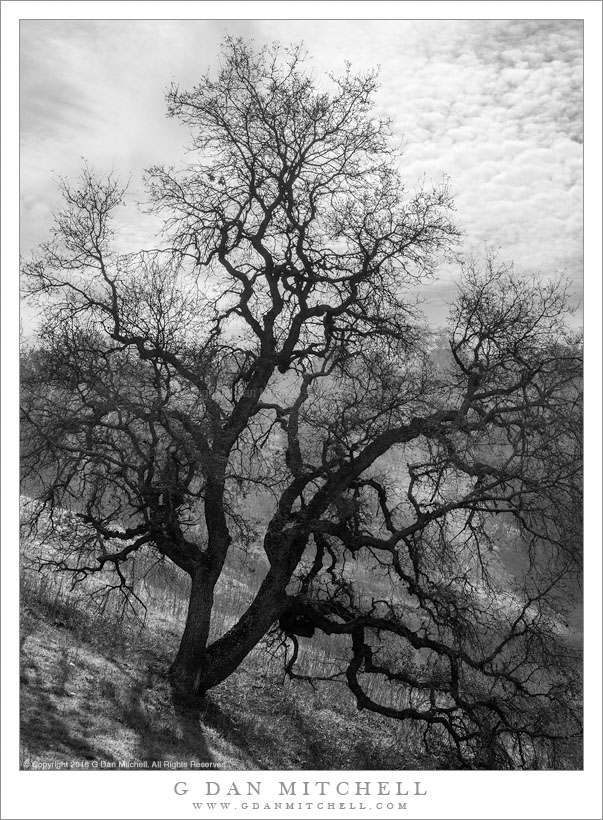
After a cold and windy final night camping in the Panamint Mountains of Death Valley National Park this spring, I woke up early and headed to an overlook along the summit ridge for the range before dawn. The most typical experience here is to watch the sun rise into clear skies above the desert landscape, but this time a weather system was approaching. It was cold, extremely windy, and the sky was filled with dark clouds. The only sunrise color I saw was along a distant band of light at the horizon, produced by clearer skies far to the southeast.
I had seen the giant lenticular cloud forming the previous afternoon. These clouds are almost a part of the landscape at times, arising in predictable locations and formed by interactions between the atmosphere and features such as mountain ridges. Unlike other clouds, the lenticular can remain almost stationary for long periods of time — but this is the first time I’ve awakened to see clouds from the previous day still there. The choice to use a monochrome interpretation allowed me greater interpretative latitude in the final image, and this let me draw attention to certain shapes mirrored by the clouds and the geology in the scene.
A wave cloud develops above Death Valley mountains at sunrise
When it comes to desert skies, it can be hard to find just-right conditions. Often the skies at Death Valley are simply clear, with few or no clouds aside from contrails from passing jets. And when there are clouds during the dawn and dusk hours when color potential is at its greatest, more distant clouds can block the light that would create the bright colors. This is especially true in the evening in Death Valley, where it is not uncommon for there to be thicker clouds in the moister regions to the west at sunset.
The latter situation was in play on this morning. In fact, I had originally planned to photograph south of this location. I had driven there and started to set up in the near darkness, only to realize that a fairly thick cloud deck was not going to clear and that it was going to block the morning light. I had a backup plan, and when I arrived at this spot a good distance to the north there was a break in the clouds. This color comes quickly and doesn’t last long — you more or less have to be ready for it before it is visible, though you may get a hint of developing color from clouds far off and near the horizon. Here a wave cloud is forming over Tucki Mountain, with a few more lenticular clouds out over the Cottonwood Range and beyond.
Lenticular clouds build over the Black Mountains before dawn, Death Valley National Park
Death Valley can be a tough place in general and a tough place for photography in particular. My recent trip in April of this year might be a case in point. The photography was not easy, and I faced different sorts of challenges almost every day. During the morning and evening hours when I typically look for “golden light” subjects, I had rather thick clouds on almost each day. Wind is often a challenge in the park, and this trip was no exception. And with the wind comes dust — yes, I dealt with dust storms on multiple days. On one morning I arrived at what I thought was my location in pre-dawn murky light, loaded up a pack, and wandered out into the landscape… only to realize once the light came that I was in the wrong place! While this sort of thing can make the photography edge a bit more difficult, I know that it comes with the territory, so I’m philosophical about it. If you are out there enough to encounter astonishing conditions, it is not a surprise when you find yourself at the opposite end of the bell curve on occasion. And when this does happen, if I just open myself to the terrain and look more carefully I can almost always find something.
On my second-to-last day of photography in the park I packed up my camp and left one of the popular campgrounds, with a plan of putting myself in a more isolated location, one of several that I had in mind. However, as I drove up the Valley a storm wind began to rise from the south, and soon clouds of dust and sand were filling the air and blowing north towards the places I thought I would visit. I wasn’t in the mood for camping in a dust storm so I switched gears and decided to head up into the Panamint Range where I thought the terrain might give me some protection. I arrived and set up my “camp” (which, in this case, was mostly my vehicle, in which I would roll out a sleeping bag), and almost immediately clouds filled the sky and a strong wind raced through the campsite. I hunkered down, at some dinner, and realized that this was not going to be a photography evening. The next morning, my final in the park on this trip, I was up and out of the campground at around 5:00, heading out on a gravel road to a high place with a grand panorama. As the first light appeared it became clear that the clouds had not gone away, and my hopes of a colorful sunrise were not going to be rewarded. I arrived at the destination to find that gale-force winds were raking the summit ridge. But I was there, I had my camera, I figured something might happen, so I got out and watched the sky lighten. Soon I saw this remarkable lenticular cloud formation to the southwest above the Black Mountains.
Photographer and visual opportunist. Daily photos since 2005, plus articles, reviews, news, and ideas.
Manage Consent
To provide the best experiences, we use technologies like cookies to store and/or access device information. Consenting to these technologies will allow us to process data such as browsing behavior or unique IDs on this site. Not consenting or withdrawing consent, may adversely affect certain features and functions.
Functional
Always active
The technical storage or access is strictly necessary for the legitimate purpose of enabling the use of a specific service explicitly requested by the subscriber or user, or for the sole purpose of carrying out the transmission of a communication over an electronic communications network.
Preferences
The technical storage or access is necessary for the legitimate purpose of storing preferences that are not requested by the subscriber or user.
Statistics
The technical storage or access that is used exclusively for statistical purposes.The technical storage or access that is used exclusively for anonymous statistical purposes. Without a subpoena, voluntary compliance on the part of your Internet Service Provider, or additional records from a third party, information stored or retrieved for this purpose alone cannot usually be used to identify you.
Marketing
The technical storage or access is required to create user profiles to send advertising, or to track the user on a website or across several websites for similar marketing purposes.