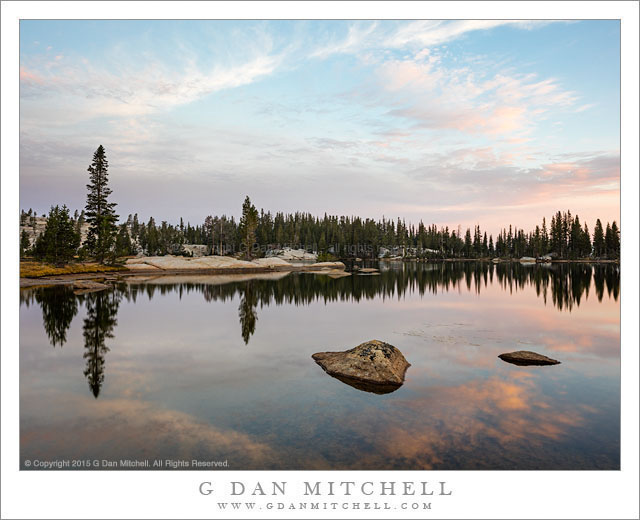
Dawn sky reflected in the surface of a Yosemite backcountry lake
Another morning from a week of such mornings at this Yosemite backcountry lake. My tent was at the end of a granite slab leading back up from the shore of the lake, so it became typical to arise each morning, crawl out of the tent, grab camera and tripod, and walk the slab and then the meadow beyond to the shoreline for morning photography. In this strange weather year in the Sierra every morning was different. One morning it might be clear, another was filled with thick wildfire smoke, and on yet another it was raining.
This was an in-between morning. There was a bit of wildfire smoke — it never went away completely during our stay — and high clouds muted the morning light on the lake itself. The air was not moving, and was September-cold. First light brought a bit of color to the clouds, reflected in the early morning stillness of the lake.
Photographer Patricia Emerson Mitchell working the dawn light near a small lake in Long Valley
On about my third week of aspen photography this fall I was accompanied back to the Sierra by my wife and fellow photographer, Patricia Emerson Mitchell. There are all sorts of advantages for me when she comes along — motel (instead of tent or back of car), real food (instead of things heated over a camp stove), and more… ;-) By this point in the aspen season I was ready for something that wasn’t aspen, so on this morning we headed east rather than west into the Sierra, traveling out across Long Valley with a plan of going even further east toward the White Mountains near the town of Benton.
We started in near darkness and arrived at a familiar spot out in the Valley before the sun rose. We parked and headed out to our destination, arriving a few minutes before the light, at which point we went to work rapidly — the photographic opportunities evolve rapidly as the first light arrives. Here she sets up close to the shoreline of the lack, photographing across the water toward mountains to our north as the first light rakes across sagebrush and the nearby hills.
The eastern escarpment of the Sierra Nevada rises from desert hills to rugged aretes lit by dawn sun
Depending on how you approach the range, the Sierra Nevada presents two quite different aspects to the visitor. For many decades, as a long time resident of the San Francisco Bay Area, I was only familiar with one of them. I always came to the range from the west, on long drives over coastal mountains and then across the Great Central Valley. As I approached the east side of the Valley I would encounter the low hills, at first almost imperceptible, that humbly mark the beginning of this might range. Because it tilts upward from the west, the western slopes are overall very gradual. Rising through these first low hills, the grass and oak covered landscape raises over a distance of many miles, and it is quite a while before the range starts to feel like “the mountains,” and many hours before the visitor arrives in the high alpine zone of rugged granite peaks. Even here, to the west of the crest there are plenty of gentle valleys and meadows.
The east side is a radically different world, as I finally began to understand two or three decades ago. The eastern base of the range is an arid near-desert place, made more so by Los Angeles’ historic draining of east side waters that once irrigated now-dry places and once filled today’s dusty playas with shallow lakes. The Sierra rises abruptly from this lower landscape, and in places you can look up nearly 10,000′ to the highest summits — you stand in desert and look at alpine peaks, and you see every zone in between. I made this photograph at dawn from one such valley location where the landscape that of sagebrush and playa and alkali lakes. From this spot I looked across low hills with the first coniferous trees toward the abrupt rise of the eastern foothills, backed by jagged and rugged slopes leading upward to high peaks.
First light on rugged, snow-dusted ridges above aspen-covered Parker Bench
This is a special place, high along the eastern escarpment of the Sierra Nevada and open to the first dawn light from the east. It is also just far enough off the beaten track and difficult enough to access that it is usually not very crowded. (Don’t worry if you can’t get to it, there are thousands of other places where you can have a similar experience in the eastern Sierra.) We recently got up early enough to drive here and arrive well before sun rise. To this day, despite seeing many sunrises, I still often am surprised at how quickly the light comes and how silently. Living in a culture in which every spectacular thing, or thing that we are supposed to regard as being spectacular, is pumped up with loud music and lots of action, the sunrise comes often comes in complete silence and with little warning — you look up and notice that the light has already struck some small element of the scene, and soon you discover it moving across the landscape and quietly lighting more and more bits and pieces. I made this photograph when this first light had hit the rugged upper slopes above this aspen-covered bench, but before it had worked its way down to the trees.
This photograph also illustrates something I finally figured out about this strange eastern Sierra fall of 2015. This year the season began oddly, with very early first color in many places. In addition, many groves simply did not have leaves — either they lost them so early that I never saw them or perhaps they did not put out leaves this year. In other groves the leaves went almost straight “from green to gone,” with little or not brilliant color phase. Where this happened, I think it was the result of the four-year drought creating tremendous stress on the trees. At the same time, other climate factors thought by some to be associated with the drought also had the effect of delaying the color change of trees that were not as stressed by the shortage of water. Instead, these trees are changing later, likely due to overall warming temperatures. So far, this has been a season not quite like any other I’ve experienced. In this photograph you can spot examples of almost all of these conditions — completely bare groves, groves that have turned and already dropped leaves, some that are going straight from green to having no leaves, and even some trees that are still very green.
Photographer and visual opportunist. Daily photos since 2005, plus articles, reviews, news, and ideas.
Manage Consent
To provide the best experiences, we use technologies like cookies to store and/or access device information. Consenting to these technologies will allow us to process data such as browsing behavior or unique IDs on this site. Not consenting or withdrawing consent, may adversely affect certain features and functions.
Functional
Always active
The technical storage or access is strictly necessary for the legitimate purpose of enabling the use of a specific service explicitly requested by the subscriber or user, or for the sole purpose of carrying out the transmission of a communication over an electronic communications network.
Preferences
The technical storage or access is necessary for the legitimate purpose of storing preferences that are not requested by the subscriber or user.
Statistics
The technical storage or access that is used exclusively for statistical purposes.The technical storage or access that is used exclusively for anonymous statistical purposes. Without a subpoena, voluntary compliance on the part of your Internet Service Provider, or additional records from a third party, information stored or retrieved for this purpose alone cannot usually be used to identify you.
Marketing
The technical storage or access is required to create user profiles to send advertising, or to track the user on a website or across several websites for similar marketing purposes.