
Tag Archives: desert

Dunes, Blowing Sand

Dunes with blowing sand in afternoon light, Death Valley National Park

Dunes, Blowing Sand. © Copyright 2018 G Dan Mitchell – all rights reserved.

Dunes with blowing sand in afternoon light, Death Valley National Park

For this photograph I returned to my file on as-yet-unfinished images from this year’s end-of-March visit to Death Valley. We were there for the better part of a week, visiting various areas of the park ranging from some quite popular spots (such as the dunes in this scene) to some that were a bit more off the beaten track and which required some effort to get to. The latter included some abandoned backcountry habitations and some dead-end roads into various canyons.

This scene is a fairly accessible one, though we came at it from a slightly different direction. We also arrived here in conditions that were a bit less than ideal, at least for walking into sand dunes, namely a lot of strong wind and blowing sand. I made the photograph when the sun was a bit lower in the sky, and its back-lit the dust-filled atmosphere and the little ribbons of blowing sand along the top ridges of the dunes.


See top of this page for Articles, Sales and Licensing, my Sierra Nevada Fall Color book, Contact Information and more.

G Dan Mitchell is a California photographer and visual opportunist. His book, “California’s Fall Color: A Photographer’s Guide to Autumn in the Sierra” is available from Heyday Books and Amazon.
Blog | About | Flickr | Twitter | Facebook | LinkedIn | Email


All media © Copyright G Dan Mitchell and others as indicated. Any use requires advance permission from G Dan Mitchell.
Dunes, Afternoon Light, Blowing Sand

Dunes, Afternoon Light, Blowing Sand
Late afternoon light and blowing dust above Death Valley sand dunes

Dunes, Afternoon Light, Blowing Sand. © Copyright 2018 G Dan Mitchell – all rights reserved.

Late afternoon light and blowing dust above Death Valley sand dunes

Wind and blowing dust on sand dunes can produce an otherworldly and spectacular scene. They are also very difficult to work in — tough on equipment and tough on photographers! (I recently read some advice about entering the dunes during serious sand storms. Basically, the recommendation was, “don’t.” For the stubborn, who would do it anyway, the text continued with a recommendation to wear protective clothing, eye protection, and some kind of mask — perhaps towels soaked in water. Fun, eh?) The conditions on this occasion were not really that bad, probably not even as challenging as they might appear to be in the photograph, but it was an afternoon of blowing wind and sand.

We were in a section of low dunes, a distance away from the popular areas where the challenge seems to be to surmount the highest dune. In these lower areas there is plenty to see and photograph, and I usually prefer them to the less accessible and higher areas. Here there are plenty of plants growing in the same, and the more intimate landscape of hills and valleys provides endless subjects. As I was working that terrain I happened to look west toward the late day sun — barely out of the frame — to see the complex patters leading away on the closer dunes, the dark shape of the more distant tall dune, and the light shining through the wind-blown sand in the distance.


G Dan Mitchell is a California photographer and visual opportunist. His book, “California’s Fall Color: A Photographer’s Guide to Autumn in the Sierra” is available from Heyday Books and Amazon.
Blog | About | Flickr | Twitter | FacebookGoogle+ | LinkedIn | Email


All media © Copyright G Dan Mitchell and others as indicated. Any use requires advance permission from G Dan Mitchell.

Kit Fox Hills, Amargosa Range

Kit Fox Hills, Amargosa Range
Amargosa Range mountains rise behind the Kit Fox Hills, Death Valley

Kit Fox Hills, Amargosa Range. © Copyright 2018 G Dan Mitchell – all rights reserved.

Amargosa Range mountains rise behind the Kit Fox Hills, Death Valley

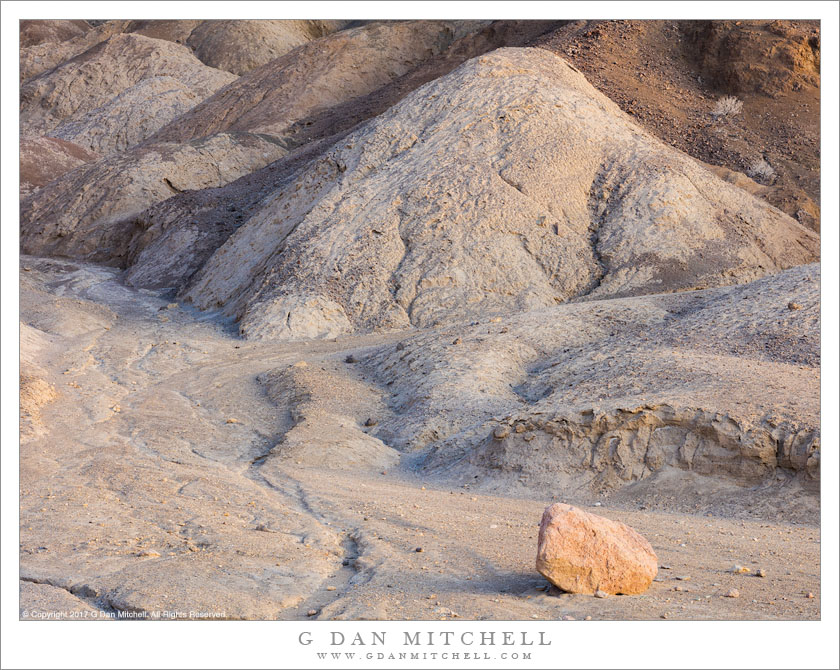
These low, deeply eroded, and colorful (in the right light) Death Valley hills lie at the western base of the Amargosa Range near the start of the road heading north toward the Scotty’s Castle area. I recently read that they may be the remnants of an old earthquake fault along the eastern side of Death Valley, marking a division between the rising mountains and the sediment-filled valley. I have walked along the base of these hills, though I still need to find the time to more extensively explore their rugged and eroded landscape.

Late in the day they intercept almost the very last sunlight to reach the valley floor before sunset. With that in mind, I have photographed them many times, often from a good distance away across the valley. That was the case on this evening, when I found a spot elevated above the valley floor and climbed to its summit to watch the late-day light. It was one of those evenings when the light was unpredictable. There were clouds to the west above the Cottonwood mountains, which can turn out to be either a good thing or a bad thing. The clouds may light up at sunset and the minutes just after… or they may simply block the sun and “turn out the lights” on sunset photography. It looked like the latter might turn out to be the case as I watched the sun descend toward a band of thicker clouds. But there was a small gap between the base of the clouds and the top of the mountains, and the sunlight shone through this gap for a few minutes, casting beautiful soft light on these hills.


G Dan Mitchell is a California photographer and visual opportunist. His book, “California’s Fall Color: A Photographer’s Guide to Autumn in the Sierra” is available from Heyday Books and Amazon.
Blog | About | Flickr | Twitter | FacebookGoogle+ | LinkedIn | Email


All media © Copyright G Dan Mitchell and others as indicated. Any use requires advance permission from G Dan Mitchell.
Mountains And Salt Flats, Morning

Death Valley, Mountains, Morning
Water seeping onto salt flats reflects morning light on Panamint Mountains

Death Valley, Mountains, Morning. © Copyright 2018 G Dan Mitchell – all rights reserved.

Mountains And Salt Flats, Morning

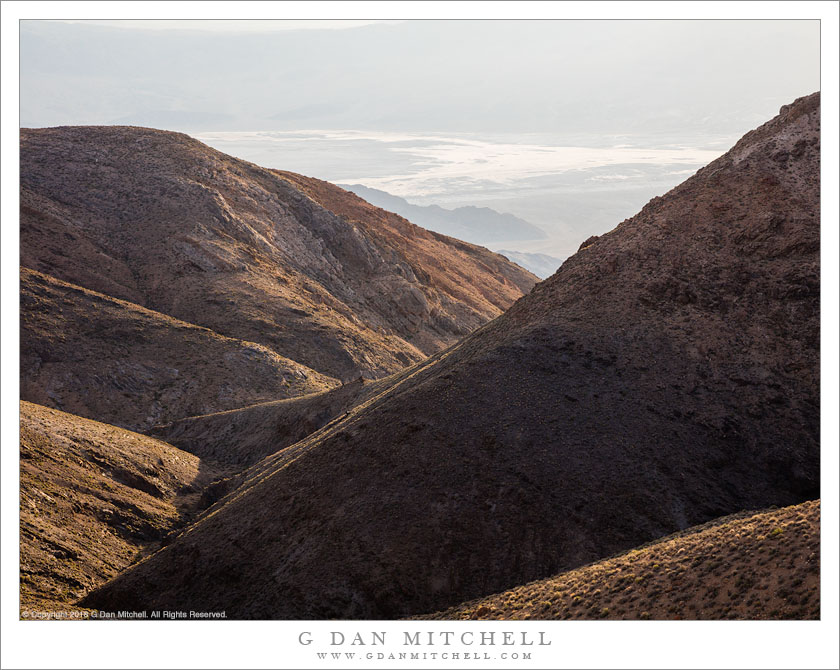
On your first visit to Death Valley and to this particular spot in the park, you might be surprised to find water here. I know I was the first time I saw the spot so many years ago. As I drove past on a road through the valley I thought I saw water on the salt flats, but I suspected that it was just a mirage. But I kept seeing it on subsequent visits and before long I stopped, got out, and walked out there to see what was going on. From the roadway one walks across a low-angle gravel fan that is one of the more desolate spots in Death Valley. At the right time during the right years, there actually can be flowers growing here for a short time, but it small numbers and widely scattered. On this recent visit, even though there were flowers around, I found spots out here where I would see literally nothing growing at all.

At the bottom of the gravel fan one enters salt weed or salt grass, an extremely hardy plant that grows in some of the most hostile locations imaginable — as long as there is some water, even if it is full of salt and chemicals. Passing through this area makes for difficult walking, between the rough but sometimes muddy ground and the sharp branches of the plant. Beyond the plants water seeps onto the salt flat, barely moving at all, then slowly travels in narrow and very shallow sheets down toward even lower portions of the valley. Surprisingly, things do live here, including insects and, on occasion, some rather exuberant birds. If you stand in just the right place, at sunrise the early morning light on the Panamint Mountain Range is reflected in these ponds.


G Dan Mitchell is a California photographer and visual opportunist. His book, “California’s Fall Color: A Photographer’s Guide to Autumn in the Sierra” is available from Heyday Books and Amazon.
Blog | About | Flickr | Twitter | FacebookGoogle+ | LinkedIn | Email


All media © Copyright G Dan Mitchell and others as indicated. Any use requires advance permission from G Dan Mitchell.