
Tag Archives: dormant

Dormant Trees and Fog

Dormant Trees and Fog
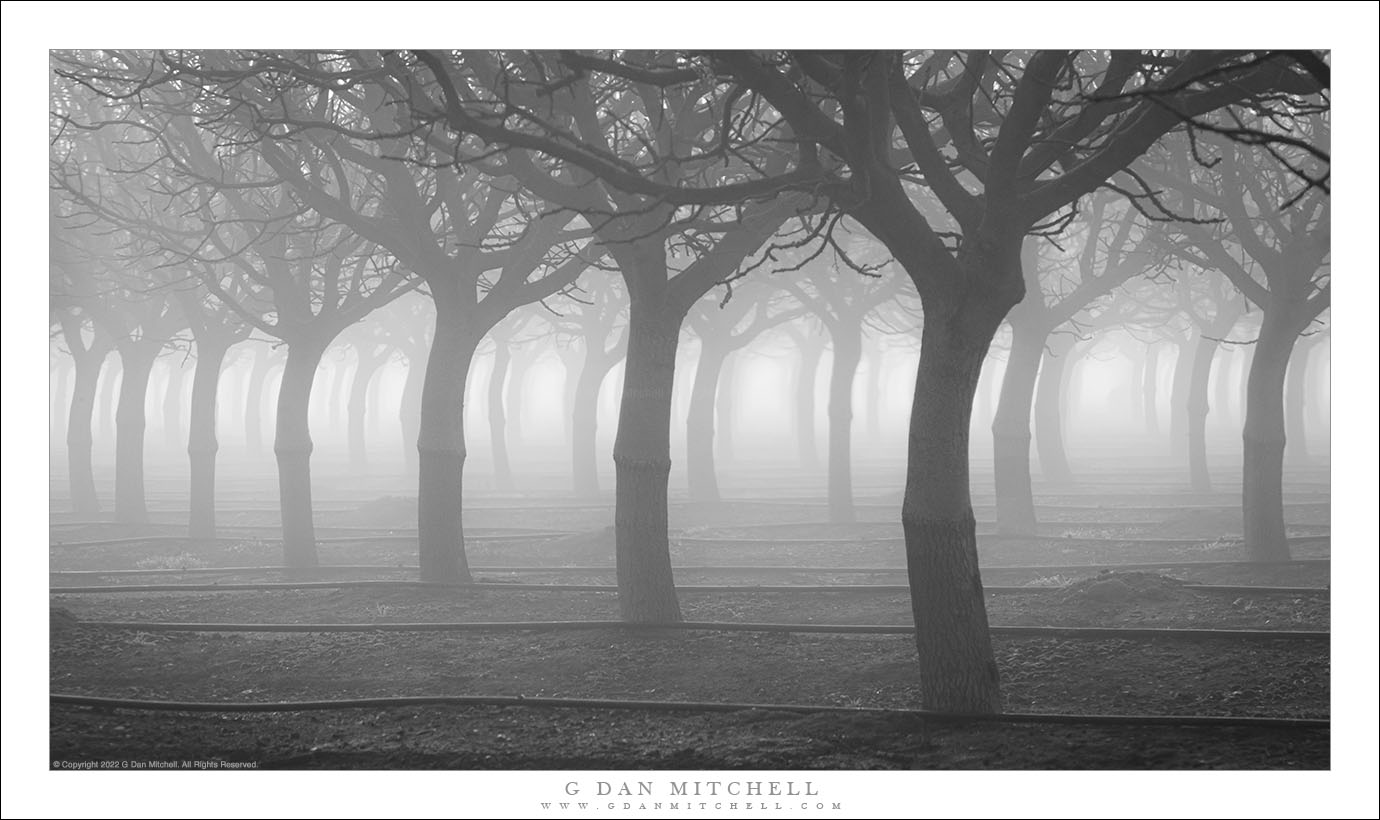
Dormant trees in Central Valley winter tule fog.

Dormant Trees and Fog. © Copyright 2022 G Dan Mitchell – all rights reserved.

Dormant trees in Central Valley winter tule fog.

This is the second in a series of photographs I made of this Central Valley orchard on a very foggy winter morning. On a typical morning with these conditions, there comes a time when the fog begins to move and thin and the light begins to come through the fog and make it glow. (This is tule fog, which forms at night when the moisture level is right, and ends up producing a thin but often very dense layer of low fog.) I had been photographing birds in thicker fog, and when the thinning process began I moved to this location where I thought the trees might be an interesting subject.

In some ways it is an easy matter to photograph a subject like this one. It is naturally mysterious and compelling, both from the fog itself and from the vaguely anthropomorphic forms of the dormant trees. However, once I begin to work with such a subject, things invariably start to become more complicated than I expected — how to create a balanced composition? What camera position gives the most interesting juxtaposition of trunks? How much to focus on trunks and how much on the upper branches How to deal with inevitable intrusions of branches into the scene. My solution is a combination of looking and thinking, relying on intuition, and trying many different approaches.


G Dan Mitchell is a California photographer and visual opportunist. His book, “California’s Fall Color: A Photographer’s Guide to Autumn in the Sierra” is available from Heyday Books, Amazon, and directly from G Dan Mitchell.

Blog | About | Flickr | FacebookEmail

Links to Articles, Sales and Licensing, my Sierra Nevada Fall Color book, Contact Information.

Scroll down to leave a comment or question. (Click this post’s title first if you are viewing on the home page.)


All media © Copyright G Dan Mitchell and others as indicated. Any use requires advance permission from G Dan Mitchell.
Dry Corn Lily Plants, Autumn

Dry Corn Lily Plants, Autumn
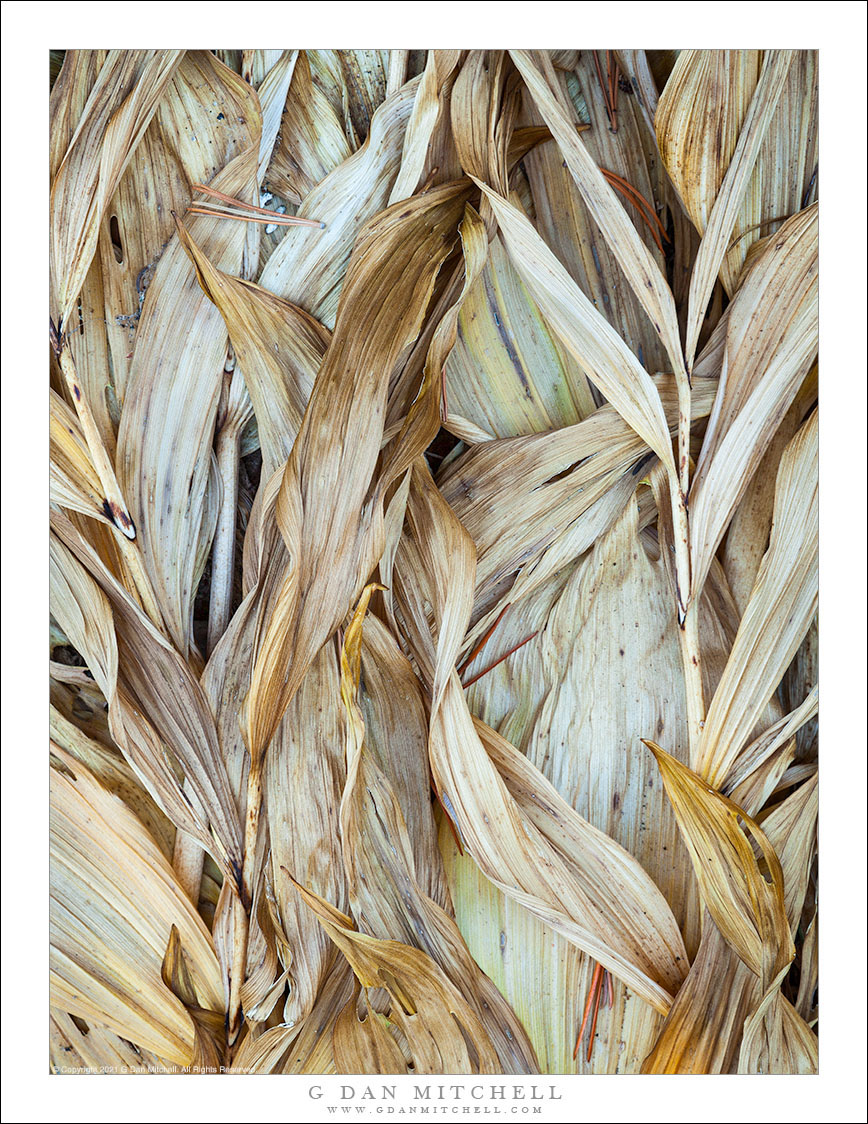
A bed of fallen and dry autumn corn lily plants, Yosemite National Park.

Dry Corn Lily Plants, Autumn. © Copyright 2021 G Dan Mitchell – all rights reserved.

A bed of fallen and dry autumn corn lily plants, Yosemite National Park.

The corn lily is one of my favorite Sierra plants. It tends to grow in meadowy, wet areas that are often particularly lush — and thus bug infested— in the early season. I think it is an attractive plant at almost any point in its annual life-cycle. It emerges as the green shoot as meadows come back to life early in the season, and before long the intense and lush bright green plants stand tall. But this state of perfection doesn’t last long, and soon blemishes appear — dark spots, holes, and eventually yellow areas as the end of the summer season draws near. (I’ve long thought of this change as the first sign of the coming Sierra autumn season.) Eventually the plants dry out, fall over, and when everything works out just right the form small carpets of brown and yellow and tan and fading green.

The corn lily is a favorite of photographers, most often photographed during that earlier lush, green stage. (It often seems like photographing such a beautiful plant would be easy, but once I start looking for the perfect conjunction of leaf shapes it inevitably becomes more difficult than I expected. )


G Dan Mitchell is a California photographer and visual opportunist. His book, “California’s Fall Color: A Photographer’s Guide to Autumn in the Sierra” is available from Heyday Books, Amazon, and directly from G Dan Mitchell.

Blog | About | Flickr | FacebookEmail

Links to Articles, Sales and Licensing, my Sierra Nevada Fall Color book, Contact Information.

Scroll down to leave a comment or question.


All media © Copyright G Dan Mitchell and others as indicated. Any use requires advance permission from G Dan Mitchell.
Dormant Plant, Fractured Rock

Dormant Plant, Fractured Rock
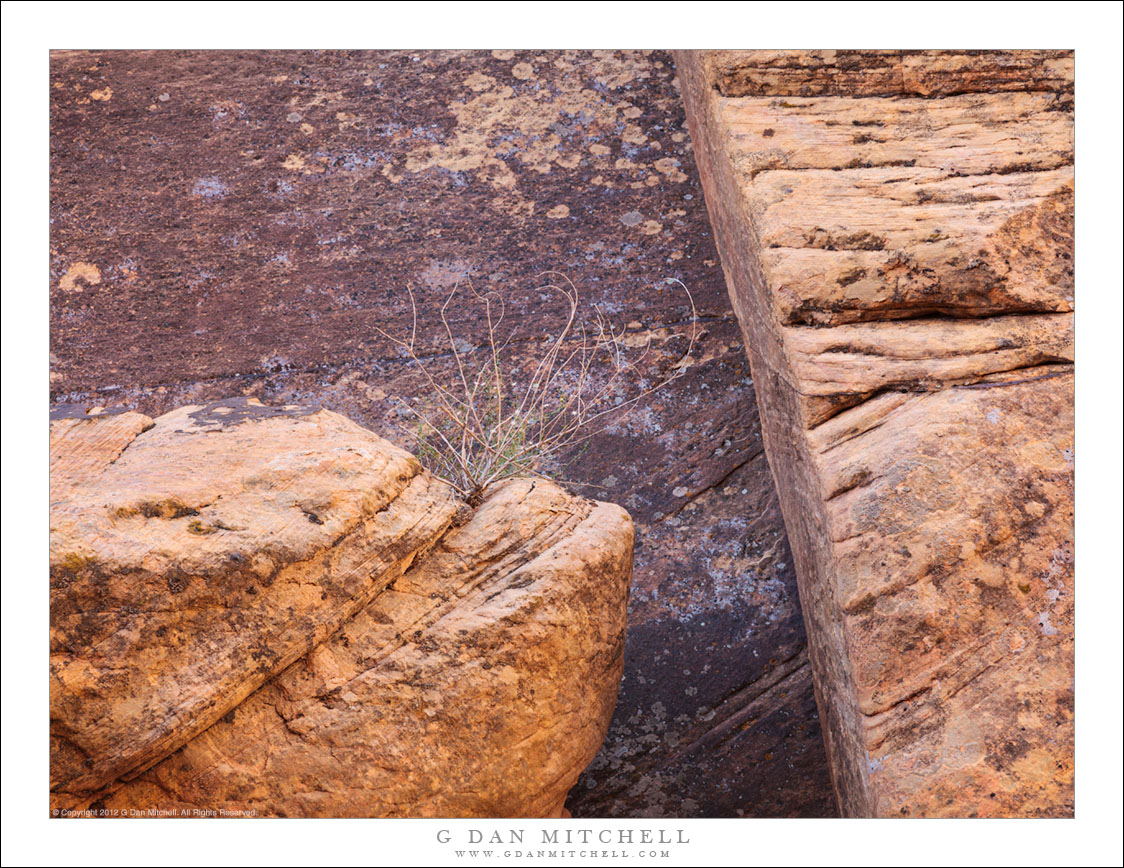
A nearly dormant plant grows on a fractured boulder against a cliff wall in a Utah slot canyon.

Dormant Plant, Fractured Rock. © Copyright 2012 G Dan Mitchell – all rights reserved.

A nearly dormant plant grows on a fractured boulder against a cliff wall in a Utah slot canyon.

To my way of thinking, slot canyons bring several primary associations. The narrow, twisting vertical walls are near the top of the list. The unusual surfaces of the wash floor are another: sand, mud, rocks. Above all (literally and figuratively) is the light entering far above and then bouncing back and forth among the canyon walls as it descends, picking up the colors of the rock and becoming softer and softer.

There are other associations, too, and although they might not be quite so immediately apparent, once you see them they are everywhere. Almost everything here is, of course, affected by water. The canyons were cut by it and the process continues. When the water periodically moves cataclysmically, rocks and boulders are redistributed downstream and mixed together with material from many different sources. As the water continues to eat into rock it undermines the higher structures, and gravity brings down rock from younger state. All the while the moving water grinds away and polishes the lower reaches of the canyon.


G Dan Mitchell is a California photographer and visual opportunist. His book, “California’s Fall Color: A Photographer’s Guide to Autumn in the Sierra” is available from Heyday Books and Amazon.

Blog | About | Flickr | FacebookEmail

Links to Articles, Sales and Licensing, my Sierra Nevada Fall Color book, Contact Information.

Scroll down to leave a comment or question.


All media © Copyright G Dan Mitchell and others as indicated. Any use requires advance permission from G Dan Mitchell.
Open Book

Open Book
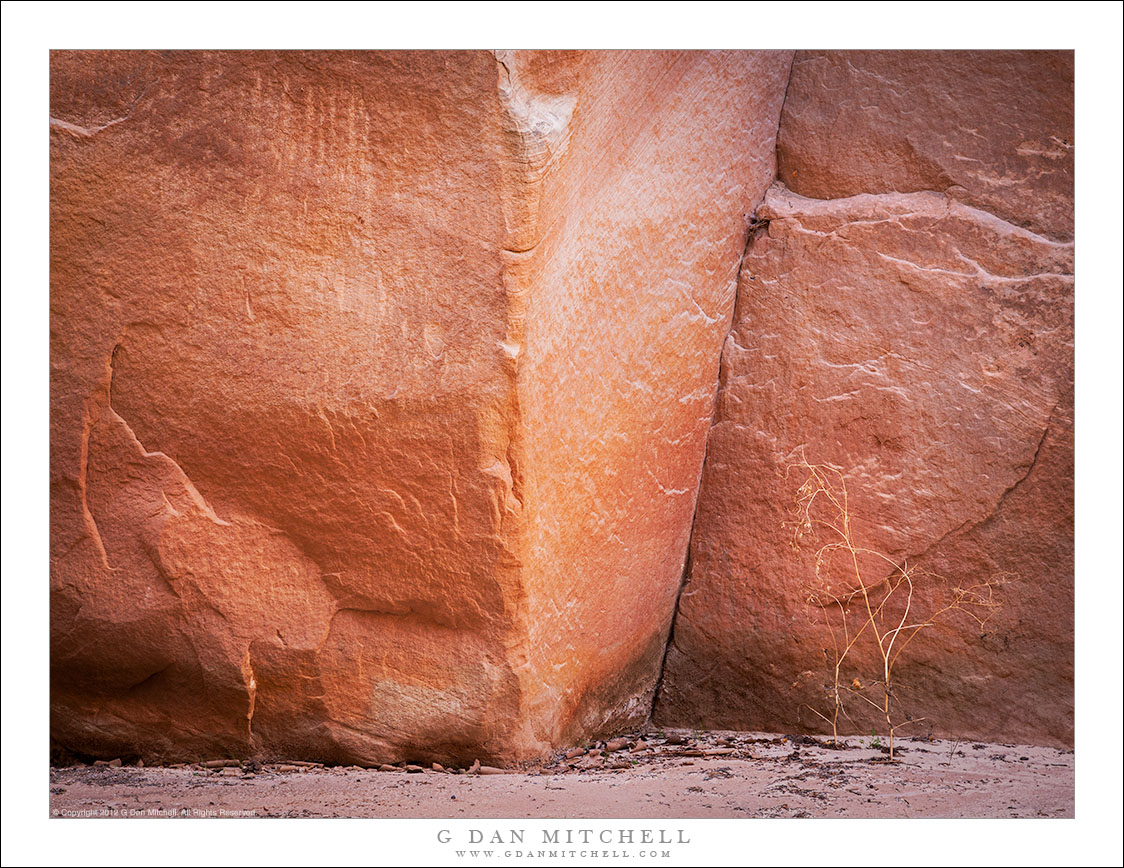
A sandstone cliff meets the bottom of a Utah red rock country wash.

Open Book. © Copyright 2012 G Dan Mitchell – all rights reserved.

A sandstone cliff meets the bottom of a Utah red rock country wash.

My virtual journey back through Utah continues. Since opportunities to go into the field are limited right now I am instead digging back though tens of thousands of raw files in my archives. I have always recognized that I leave some photographs behind as I move on to the next thing — and sometimes I’m not just not yet ready to “see” how a photograph will work. For years I’ve made these return visits to the old files, most often with an end-of-the-year traverse of that year’s images before moving on. This time I’m starting back in 2012 and working my way forward slowly.

I made this photograph in the first slot canyon that I ever visited. You might wonder how I managed to get to 2012 without visiting this kind of terrain. It is a long story, but for some reasons I’ve explained elsewhere I simply didn’t get to Utah and the Southwest until about a decade ago. Shame on me! As we walked into this canyon I really had little idea of what to expect, but I was entranced. This bit of sandstone cliff wall sat immediately next to the sandy bottom of the wash, and the color of the diffused light warmed as it bounced down from above between the canyon walls.


G Dan Mitchell is a California photographer and visual opportunist. His book, “California’s Fall Color: A Photographer’s Guide to Autumn in the Sierra” is available from Heyday Books and Amazon.

Blog | About | Flickr | FacebookEmail

Links to Articles, Sales and Licensing, my Sierra Nevada Fall Color book, Contact Information.

Scroll down to leave a comment or question.


All media © Copyright G Dan Mitchell and others as indicated. Any use requires advance permission from G Dan Mitchell.