
Tag Archives: el capitan

Hiker, Black Oaks, and Meadow

Hiker, Black Oaks, and Meadow

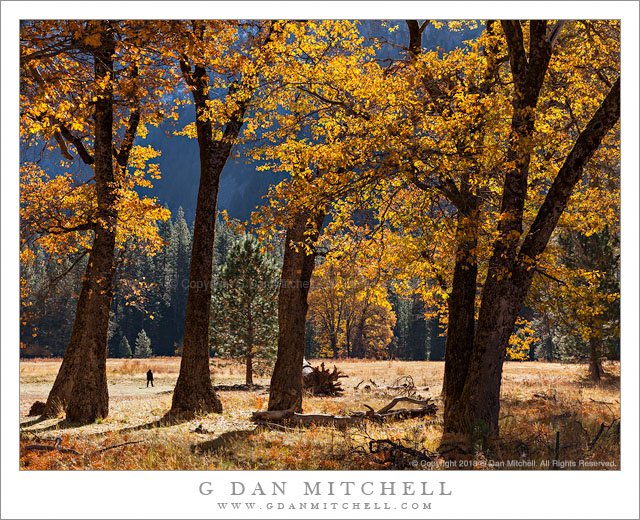
Hiker, Black Oaks, and Meadow. Yosemite Valley, California. October 30, 2013. © Copyright 2013 G Dan Mitchell – all rights reserved.

A hiker crosses a Yosemite Valley meadow beyond black oak trees with autumn foliage

Yes, yet another photograph of autumn oak trees and Yosemite Valley meadows! It is (or was) the season in late October and I’m still sorting through the photographs. When I first arrived here my plan was to photograph the black oaks as a “natural” landscape without people. So I found a composition that I thought would work and settled in to wait for the folks who were (as is inevitable in the Valley) wandering around in the meadow to finish and move out of the frame. It seemed that every time the view was about to be clear yet another person would arrive and walk into the frame. I finally decided that I might have to make two or more photographs and blend the “person-less” sections to create one image without hikers, so I made a few exposures as two or three people walked across. (I also timed some of the shots so that the people would be hidden behind the oak trees.)

As luck would have it, after I decided on this approach there was a point at which no human figures appeared in the scene, so I do have my natural landscape version of this scene. However, after thinking about it a bit more, I actually like the version with a person in it better! While most of my landscapes are “people-free,” every so often I do one that includes the figures in the frame. I’ve learned a few things about this. First, having a person in the frame isn’t always a bad thing. (Yes, file that in the “duh!” file.) The presence of a human figure can both crystallize the composition and it causes us to relate to the scene very differently – perhaps imaging ourselves being there or perhaps considering what the person in the photograph might be thinking and experiencing. Second, the figure can often be quite small and still change the effect of the image in ways that are much bigger than the small figure might suggest. As an exercise, try to just barely cover the person with your finger. Notice how the greatly the effect of this scene changes?

G Dan Mitchell is a California photographer and visual opportunist whose subjects include the Pacific coast, redwood forests, central California oak/grasslands, the Sierra Nevada, California deserts, urban landscapes, night photography, and more.
Blog | About | Flickr | Twitter | FacebookGoogle+ | 500px.com | LinkedIn | Email

Text, photographs, and other media are © Copyright G Dan Mitchell (or others when indicated) and are not in the public domain and may not be used on websites, blogs, or in other media without advance permission from G Dan Mitchell.
Meadow, Trees, Granite Wall

Meadow, Trees, Granite Wall

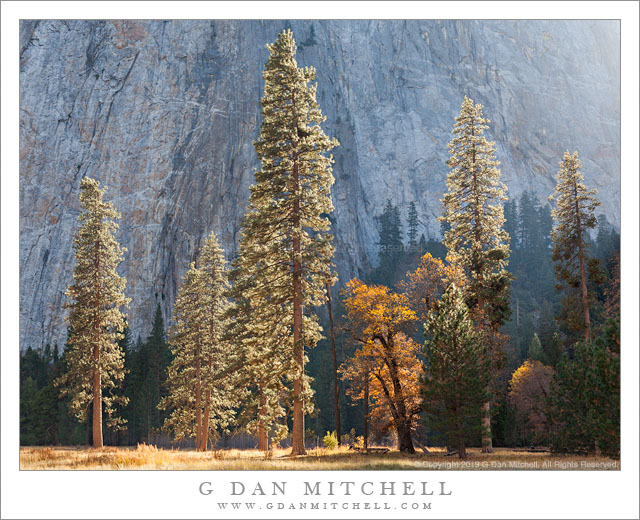
Meadow, Trees, Granite Wall. Yosemite Valley, California. October 31, 2013.© Copyright 2013 G Dan Mitchell – all rights reserved.

The immense granite face of Cathedral Rocks looms behind trees of El Capitan Meadow in autumn afternoon light

This meadow, located between two of the largest cliffs in Yosemite Valley, is both an obvious place to make photographs – everyone does it – and a place of nearly infinite variations of light, season, and atmosphere. Sometimes when I’m in the Valley I may stop here two or three times during the day. As is the case in other spots in Yosemite Valley, the place changes radically depending upon what the light is doing – soft early morning or evening light, strong light coming down the Valley in the early morning, light blocked by cliffs at midday, strong backlight in the late afternoon. And many of these changes happen very rapidly. As I made this photograph I could virtually watch the shadow move over the trees from the right.

The granite face rising beyond this meadow – one of the two I mentioned above – has always attracted me for some reason. Although not as high as the much more famous El Capitan, in some ways it seems to me to look more forbidding. It seems to lack the obvious crack systems seen on El Capitan, and unlike the larger wall, which is often bathed in sun, this one is often in shadow. In winter it casts a shadow across this portion of the Valley in the middle of the day, though a low spot may allow a beam of light to sweep across this area in the late afternoon.

G Dan Mitchell is a California photographer and visual opportunist whose subjects include the Pacific coast, redwood forests, central California oak/grasslands, the Sierra Nevada, California deserts, urban landscapes, night photography, and more.
Blog | About | Flickr | Twitter | FacebookGoogle+ | 500px.com | LinkedIn | Email

Text, photographs, and other media are © Copyright G Dan Mitchell (or others when indicated) and are not in the public domain and may not be used on websites, blogs, or in other media without advance permission from G Dan Mitchell.
Autumn Leaves, Reflection of a Monolith

Autumn Leaves, Reflection of a Monolith
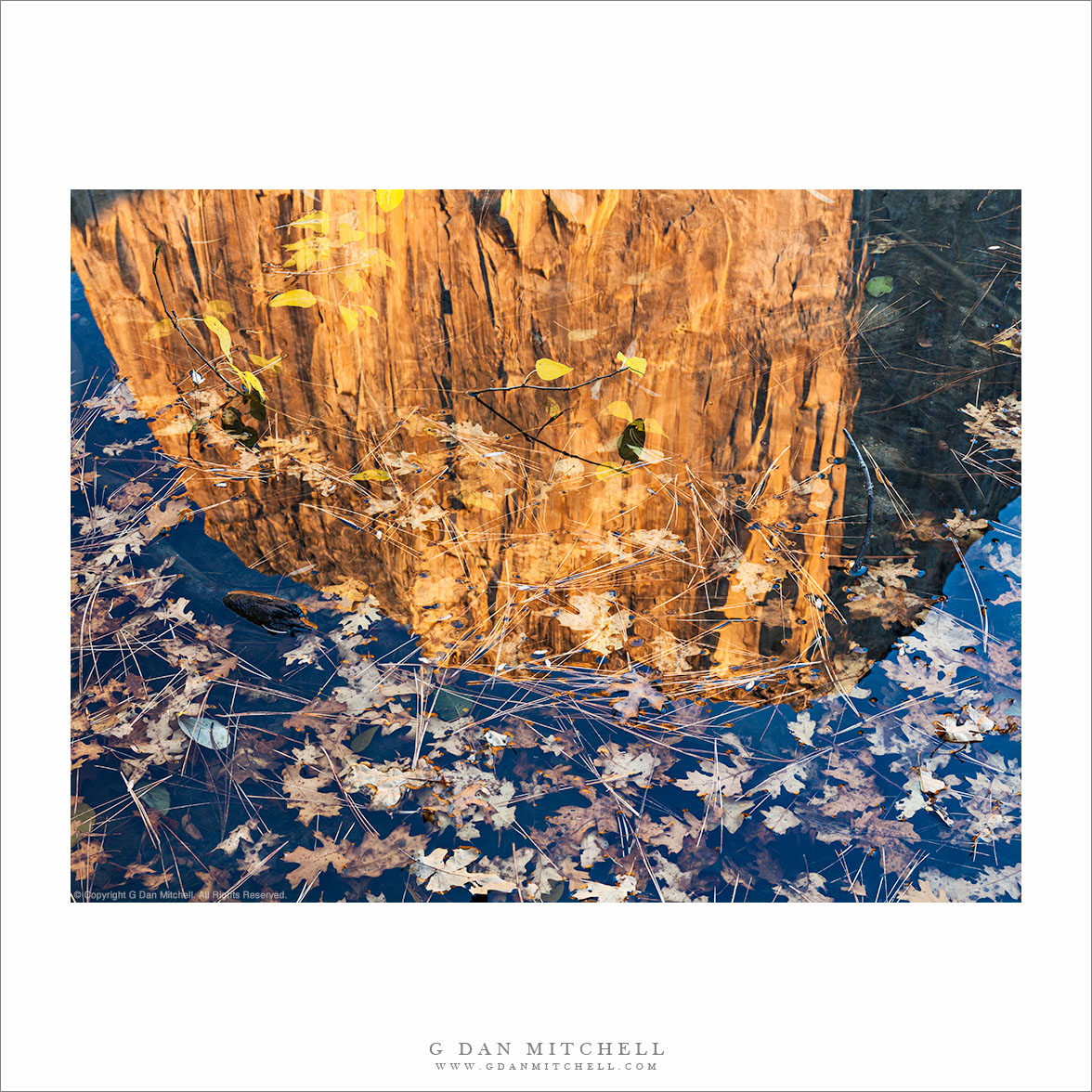
“Autumn Leaves, Reflection of a Monolith” — The face of El Capitan is reflected in the surface of a autumn leaf-filled pool along the Merced River

A book could be written about this photograph, but I promise to keep it shorter than that. The book would include chapters on the role of luck in photography, the importance of patience, knowing places well, looking at things other than the most obvious, not forgetting to look at the obvious as well, the pleasure of finding like-minded friends in such places, the importance of wandering around slowly, and more.

Every autumn, right around the end of October, I like to go to Yosemite Valley to photograph fall subjects. This mostly means the fall colors of cottonwoods, black oaks, big leaf maples, and dogwood trees – though it also includes the beautiful brown, rust, golden, and tan colors of autumn meadows. It also includes the magical fall light of the Sierra. I’ve never been able to quite put my finger on just what it is that makes this light so special, but I am certain that it is different. When the timing works out just right – as it did on this visit – the first snows of the season might have fallen, and there will be at least a dusting along the rim of the Valley. The Valley slows down in other ways at this time of year, too. The visitors to the Valley are different. There are fewer in general, and especially there are fewer of those who might seem to be checking another goal off the list, and more who genuinely know and love the place. Only the committed – or the poor and RV owners – stay in campgrounds, so you can just show up and get a camp site. Interestingly, although there are far fewer people, I’m much more likely to run into folks I know, which seems to be one of the special pleasures of this recent visit.

As I photographed during this trip, I more or less followed the light and my intuition around the Valley. I might get an idea to go shoot some subject, and along the way I would find something else worth shooting… and many other things worth remembering for a later visit. One of the things on the mental list was a single isolated dogwood tree sitting back in a dark section of forest off to the side of the roadway. I passed it several times, each time thinking about coming back and photographing it, and I finally made it there late on my final day in the Valley. I parked – and no one else at all was around – picked up my gear and walked off into the woods. This light in the shadows along the base of the Valley cliffs changes very slowly, so there was no hurry to make a photograph before light went away and I just poked about slowly, looking at the tree from various angles and considering other subjects in the area. I made a few photographs, and just as I finished a car pulled up and I saw that it belonged to a couple of friends.

I wandered back over that way and after the requisite wise cracks and good-natured insults we realized that all three of us had the same idea to photograph on the other side of the road among trees along the river bank. So, still moving at a relaxed pace and talking as we walked, we headed off towards the river through trees and brush. Along the shoreline I came to a spot where a few leaves littered the surface of the water in a tiny, still cove along the edge of the river. This familiar granite monolith stands not far away, and I found that I could, if I put tripod feet in the water, get both the leaves and its reflection in the frame. I made a few photographs and then wandered off to photograph leaves and grass and some trees and more of the river. Eventually, the light began to fail, and I climbed a small hill and started back to my car through the trees. I happened to look up – yes, sometimes I forget to look up for a moment – and saw that the intense sunset light was striking the granite… and it occurred to me that I might just barely have time to get back to that spot where I had photographed earlier and put those leaves into the reflection of this transformed scene. Fortunately, I knew exactly what lens to use, what aperture to set, and where to locate the tripod, so I could move quickly and efficiently to make the photograph before shadow rose from the bottom of the cliff.


Leave a comment or question using the form. (Click the title to see the full article and to comment if you are viewing it on the home page.)

G Dan Mitchell is a California photographer and visual opportunist. His book, “California’s Fall Color: A Photographer’s Guide to Autumn in the Sierra” (Heyday Books) is available directly from him. Blog | Bluesky | Mastodon | Substack Notes | Flickr | Email

All media © Copyright G Dan Mitchell and others.

The Annual Horsetail Fall Post

Horsetail Fall, Early Evening

UPDATE: As of 2020 I am no longer posting annual updates concerning this subject — and I am editing older posts on the subject in light of the need to be more responsible about not encouraging the onslaught. I also no longer recommend going to the Valley to see it. Unfortunately, too much exposure (yes, I played a part in it, unfortunately) has led to absurd crowds, traffic jams, littering, destruction of areas in the Valley where too many people go to see it… and the park has increasingly — and appropriately — cracked down. Parking options have been eliminated, at least one viewing location has been closed. Good news! The rest of Yosemite Valley is still there and often exceptionally beautiful at this time of year.

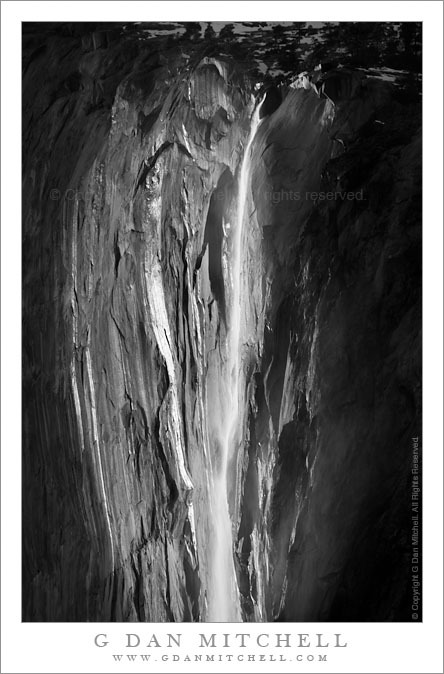
Horsetail Fall, Early Evening. Yosemite Valley, California. February 15, 2010. © Copyright G Dan Mitchell – all rights reserved.

The silver strand of Horsetail Fall and water reflecting on surrounding cliffs in late afternoon light, Yosemite Valley, California.

Although it seems like it would be extremely difficult to make a truly original photograph of Horsetail Fall at this point, I won’t completely rule out the possibility, and recently I have seen a few interesting and imaginative photographs of the phenomenon.

The necessary conditions are fairly specific, and even when the basics are in place there is no guarantee that the show will occur on a given evening. To be honest, the odds are distinctly against you, and you are more likely to see something that doesn’t match your expectations.

  • There must be flowing water in the creek near the east end of the face of El Capitan that feeds the fall. This is not a sure thing in mid-winter. There must be sufficient snow above El Capitan and the temperatures must be warm enough to melt it, or there must have been a recent warm storm that brought some rain to higher elevations.
  • The setting sun must align just right with a gap in the mountains to the west of El Capitan so that the setting sun (miraculously) casts its last beams right on the face of El Capitan where the fall is located. Roughly speaking this occurs during the second half of February, right around February 20 or so.
  • You must be in a position such that the fall is back-lit by the sunset light beam. In addition, your position must provide a clear view of the fall – not necessarily a simple thing given the forest cover in the Valley. These areas are now subject to terrible crowding that has damaged areas of the park, and the park service is wisely reducing or eliminating access.
  • Although photographs make it seem like a huge, overpowering spectacle, it is actually very small. It takes place high on a distant cliff face, and to photograph it you’ll need a very long lens.
  • Finally, the skies to the west of Yosemite must be clear so that the golden hour sunset light is not blocked. Many tell stories of clouds that made it obvious that the show would not happen or, even more frustrating, developing light that was killed at the last minute when the sun dropped behind clouds to the west, which are quite common.

Any post about the February Horsetail Fall occurrence must include a few other important points:

  • The event has become so popular in recent years that the experience has been significantly compromised. You will not have an experience of relative solitude such as Galen Rowell likely had when he made the iconic photograph of the subject decades ago. Instead you will likely find yourself among hundreds or thousands (you read that right) of other photographers lined up with lenses pointed the same direction.
  • This, of course, implies that parking and finding “your spot” may both be challenges. As a result of traffic jams, illegal parking, overwhelming crowds, gross littering, and damage to meadow, forest, and river… the park service is wisely putting several access limits in place, even closing one of the favorite areas as of 2020.
  • If Horsetail isn’t an option, you are are still in one of the most beautiful and compelling places on the face of the planet for making photographs! Speaking of which, while the crowds are focused on Horsetail, you might consider photographing other things away from the crowds…

The annual Yosemite Renaissance art show typically opens at about this time each February and features the work of photographers and other artists working in Yosemite. The show is in the Yosemite Museum Gallery and the 2013 edition runs from February 22 through May 5, with the opening reception at 5:30-7:30 on February 22.  (You can view my work in the show this year.) In addition, there is always something interesting to see at the nearby Ansel Adams Gallery – this year an exhibit of Michael Frye’s photographs opens on February 16.

NOTE: The 2017 edition of the exhibit, Yosemite Renaissance 32, opens with a free public reception at 5:30 PM on Friday, February 24. One of my photographs is in the exhibit again this year. See you there!

G Dan Mitchell is a California photographer and visual opportunist whose subjects include the Pacific coast, redwood forests, central California oak/grasslands, the Sierra Nevada, California deserts, urban landscapes, night photography, and more.

Blog | About | Flickr | Twitter | FacebookGoogle+ | 500px.com | LinkedIn | Email

Text, photographs, and other media are © Copyright G Dan Mitchell (or others when indicated) and are not in the public domain and may not be used on websites, blogs, or in other media without advance permission from G Dan Mitchell.