
Tag Archives: erosion

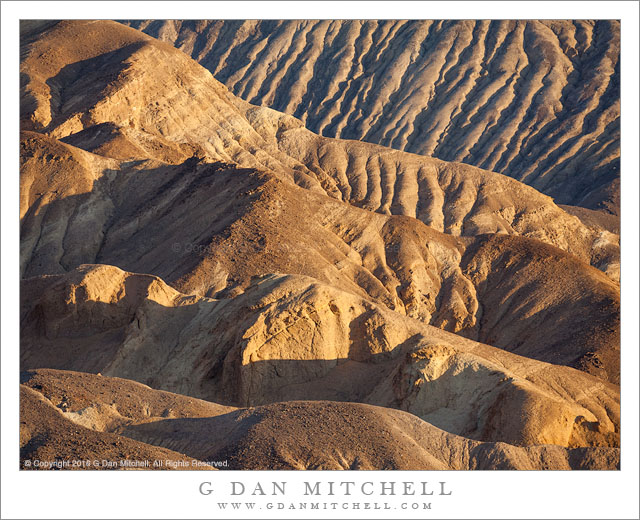
Badlands, Evening

Badlands, Evening
Evening light on deeply eroded terrain, Death Valley National Park

Badlands, Evening. Death Valley National Park, California. March 30, 2015. © Copyright 2015 G Dan Mitchell – all rights reserved.

Evening light on deeply eroded terrain, Death Valley National Park

Early each spring I head back to Death Valley for several days of exploration and photography. In March of 2015 I began my trip with a visit to Los Angeles, from which I departed and drove to the park to set up my camp. My typical ritual is to arrive in the early afternoon, find a campsite, get set up and settled in, wait for early evening, and then head out for my first photography in this vast landscape.

I began by heading to an area of the Valley with expansive views across to the Panamint Mountains, backlit by the early evening sun. I photographed them through a moody haze from an elevated spot that I often go to. Before long the light on these mountains faded as the sun dropped behind them, and my attention turned to nearer formations on my side of the valley, which were now being illuminated by the warm evening light. The low angle delineated the complex structures of these badlands during the last few minutes of light.


G Dan Mitchell is a California photographer and visual opportunist. His book, “California’s Fall Color: A Photographer’s Guide to Autumn in the Sierra” is available from Heyday Books and Amazon.
Blog | About | Flickr | Twitter | FacebookGoogle+ | LinkedIn | Email


All media © Copyright G Dan Mitchell and others as indicated. Any use requires advance permission from G Dan Mitchell.
Waterpocket Fold Terrain

Waterpocket Fold Terrain
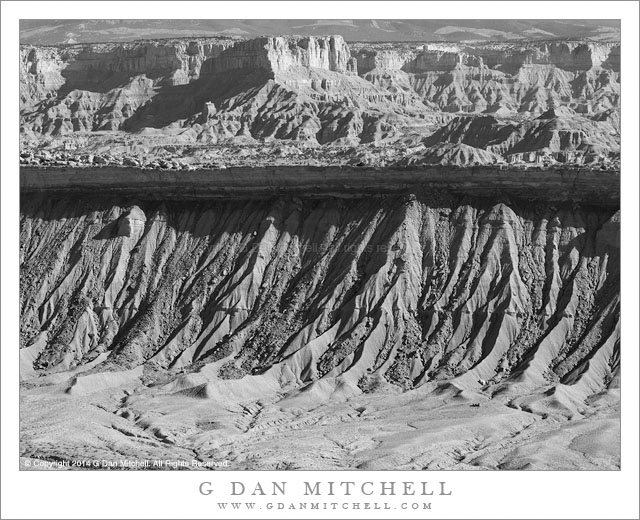
Deep erosion gullies below an uplifted rock band empty into the valley below, with rugged terrain extending into the distance

Waterpocket Fold Terrain. Capitol Reef National Park, Utah. October 22, 2014. © Copyright 2014 G Dan Mitchell – all rights reserved.

Deep erosion gullies below an uplifted rock band empty into the valley below, with rugged terrain extending into the distance

Until a few years ago, although I had heard the term “waterpocket fold” before, I was almost completely unaware of what this geological feature is. Since that time I have visited it several times. On the first occasion I visited the area, but I still did not understand the geology. I “got it” that there was some sort of uplift — the land rising to the west of Capitol Reef was a pretty good clue — but I did not understand or really see any of the connections. I recall stopping at one road side pullout and seeing a sign about it, registering that it is something important, but not really understanding.

On more recent visits the reality of this huge and striking feature has finally sunk in. I began to see it a few years ago on a trip that took we away from main roads and way up on a rocky ridge from which I could look down into the eastern valley and clearly see some of the larger patterns — sinuous lines of angled rock, the valley twisting gently into the distance in the south. On the most recent visit it began to make a lot more sense, as I noticed features like the shadowed cliff band across the center of this photograph, which more or less represents the remaining underside of a layer that long ago continued on up into what today would be the sky. Its edge overhangs the softer material below, though it still erodes into the bottom of the valley. Further to the east in this photograph the impossibly rugged terrain of arid strata continues, eventually rising to a mountain range in the far distance.


G Dan Mitchell is a California photographer and visual opportunist. Blog | About | Flickr | Twitter | FacebookGoogle+ | 500px.com | LinkedIn | Email


All media © Copyright G Dan Mitchell and others as indicated. Any use requires advance permission from G Dan Mitchell.
Eroded Ridge and Valley

Eroded Ridge and Valley
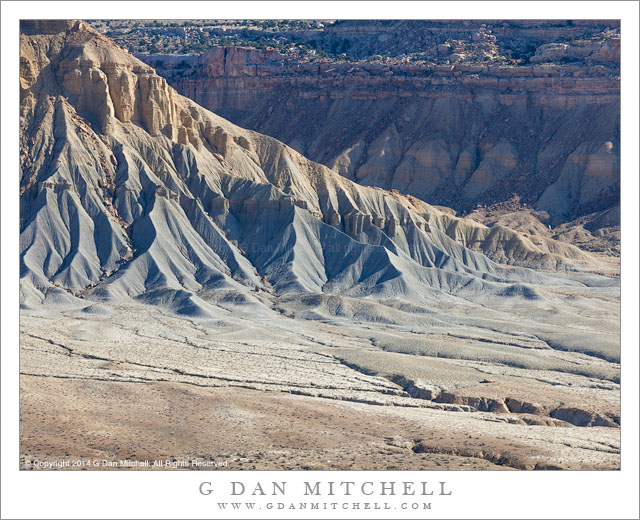
Eroded ridge and valley in the Waterpocket Fold area, Utah

Eroded Ridge and Valley. Capitol Reef National Park, Utah. October 22, 2014. © Copyright 2014 G Dan Mitchell – all rights reserved.

Eroded ridge and valley in the Waterpocket Fold area, Utah

This landscape could hardly be more different from the landscape in yesterday’s photograph. The earlier photograph was of Drake’s Estero, at the Point Reyes National Seashore, made on a day that was almost entirely foggy until a brief interval of filtered sun illuminated the blue waters of the estuary, a bit of green on a peninsula, and distant sky and water. None of those things are found in this photograph.

This landscape from Capitol Reef National Park is austere, arid, and quite rugged. It has a special beauty, but it is not a beauty with soft edges, misty skies, and water. Here the land is laid bare, seeming from a distance to be devoid of plant life. (Once inside this landscape, it turns out to be a bit more alive than it might seem.) Geology and the effects of time are visible in these places with their colored layers of rock, deeply cut valleys, and rugged erosion forms. Here gullies lie below rocky ridges, and two valleys come together in a flat area laced by stream beds.


G Dan Mitchell is a California photographer and visual opportunist. Blog | About | Flickr | Twitter | FacebookGoogle+ | 500px.com | LinkedIn | Email


All media © Copyright G Dan Mitchell and others as indicated. Any use requires advance permission from G Dan Mitchell.
Flow Lines, Morning Light

Flow Lines, Morning Light

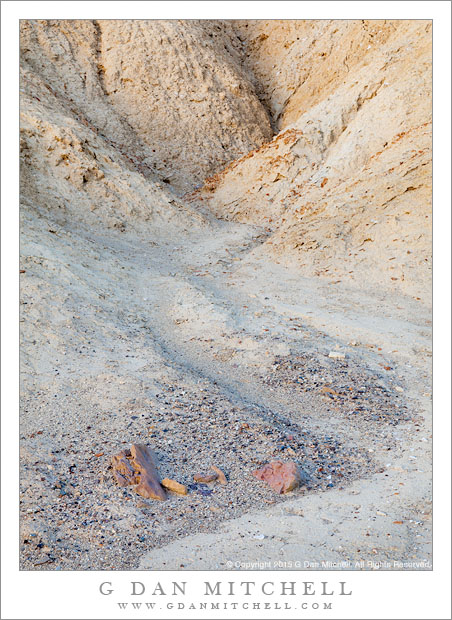
Flow Lines, Morning Light. Death Valley National Park, California. April 3, 2015. © Copyright 2015 G Dan Mitchell – all rights reserved.

Soft early morning light illuminates curving erosion patterns of a desert gully, Death Valley National Park

Today I’m back from my annual spring photography visit to Death Valley National Park. I first visited this place a bit more than 15 years ago, though photography was not the purpose of that first trip. My first view of the Valley was magical. We had arrived the night before and set up camp in the dark at the first camping area we found, a tiny campground near below Towne Pass at the turnoff to Wildrose Canyon. I had little idea where I was nor what my surroundings looked like, as I had literally never been in this place before. Early the next morning I stepped out of my tent and was greeted by an astounding and unexpected view down into the huge and rugged landscape of this Valley, a first sight I will not forget.

Since then I have returned many times — much of that landscape has become familiar to me as I’ve pushed the boundaries of my knowledge of the place outwards in all directions. I’ve been into areas that I didn’t imagine existed on that first visit, and I’ve learned to see past the geology and geography of the place and see the human history of the park and the sometimes-hidden beauties of wildflowers and more. Today when I visit I still look for that astonishing and grand landscape, but I also slow down and stop and look for more subtle things that I surely missed nearly completely on that first visit. This little miniature landscape of curving erosion and stones and first light is one that I would have missed completely on that first visit, but which I now know can be found almost everywhere in this park once I slow down to the pace of the desert and take the time to really look.


G Dan Mitchell is a California photographer and visual opportunist whose subjects include the Pacific coast, redwood forests, central California oak/grasslands, the Sierra Nevada, California deserts, urban landscapes, night photography, and more.
Blog | About | Flickr | Twitter | FacebookGoogle+ | 500px.com | LinkedIn | Email

Text, photographs, and other media are © Copyright G Dan Mitchell (or others when indicated) and are not in the public domain and may not be used on websites, blogs, or in other media without advance permission from G Dan Mitchell.