
Tag Archives: first

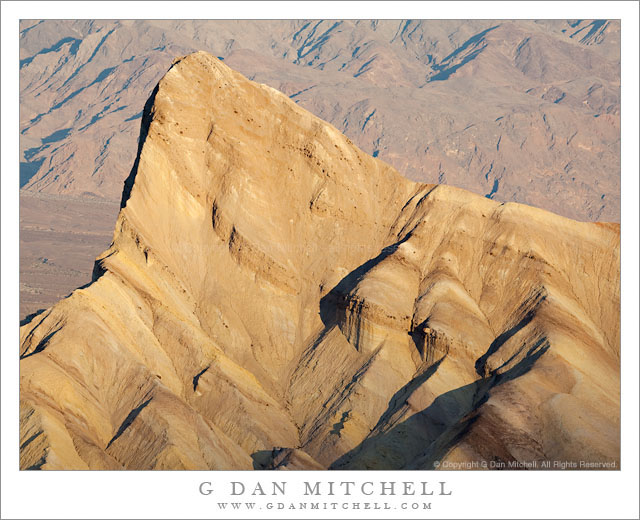
Manly Beacon, First Light

Manly Beacon, First Light

Manly Beacon, First Light. Death Valley National Park, California. March 30, 2011. © Copyright G Dan Mitchell – all rights reserved.

The first morning light strikes Manly Beacon at Zabriskie Point, Death Valley National Park.

Icon alert!

I had more or less promised myself that I would not photograph at Zabriskie Point on this trip – been there, done that – unless the conditions were really special. But I miscalculated my morning start on this day and discovered that I wasn’t going to make it to my intended destination in time. As I passed Zabriskie on my way to the “other place,” telling myself that I still had a half hour before I needed to be in place for the early light… I noticed that clouds above this area were already starting to pick up the pink color of dawn light. I hesitated for a moment – I really wanted to photograph that other subject – but quickly realized that it would make a lot more sense to the shoot the subject that was here in the light that was developing than to drive further and miss out entirely on the first light.

So I turned into that familiar parking lot with its familiar fleet of photographers’ cars and quickly loaded up my gear. I was a bit surprised that I saw so few people up above at the official overlook, but it was quite windy and I figured that perhaps they had just dropped down on the other side of the wall below this spot. In any case, I had a different spot in mind, one further to the right, so I headed over that way and quickly discovered that the wind was blowing almost too strongly to make photographs. I made a couple of shots from a small gap there and then headed up toward the overlook. At the top of the little trail from the parking lot I dropped onto the small use trail to the side of the wall and was again surprised to see almost no other photographers. I walked a few feet farther and discovered that the “usual crowd” was huddled in a small area in the lee of the wall, trying desperately to find protection from the wind.

These days, my main project when I stop at Zabriskie is to find and photograph small, isolated elements of the landscape with a long lens. For the most part – unless truly magical conditions are present, and they weren’t on this morning – I don’t really spend much time on the classic views of Gower Gulch, the Valley, and the Panamint Range. However, since I’m there and know the progression of the light fairly well at this point, I’m not about to pass up the opportunity to get a better image of one of these iconic subjects. So as the first light was about to hit the summit of Manly Beacon I turned my rig that direction and spent a couple of minutes photographing it as the line between shadow and morning light traveled down its face.

G Dan Mitchell Photography | Flickr | Twitter (follow me) | Facebook (“Like” my page) | LinkedIn | Email
Text, photographs, and other media are © Copyright G Dan Mitchell (or others when indicated) and are not in the public domain and may not be used on websites, blogs, or in other media without advance permission from G Dan Mitchell.

Mesquite Dunes and Cottonwood Mountains, Morning

Mesquite Dunes and Cottonwood Mountains, Morning

Mesquite Dunes and Cottonwood Mountains, Morning. Death Valley National Park, California. March 31, 2011. © Copyright G Dan Mitchell – all rights reserved.

Early morning light on Mesquite Dunes and the Cottonwood Mountains, Death Valley National Park.

This is one of the images I had in mind on the most recent late-March trip to Death Valley. When I visited earlier this year in February I started thinking about photographing the dawn light on the lower slopes of the Cottonwood Mountains along the west side of upper Death Valley. I had (and still have!) in mind several locations from which to explore this interesting terrain and light, but among them were a few that placed the Mesquite Dunes (a.k.a. “Death Valley Dunes”) in the foreground. (Why didn’t I shoot this subject back in February, you ask? The weather did not cooperate! There was rarely good light in the morning and, in fact, I had to deal with rain and snow on that visit!)

Besides finding a location from which to line up the elements of the shot, the other keys are having a long enough lens and, well, being there at the right time! And, as I was reminded in February, a bit of luck with the weather doesn’t hurt either. Although it had snowed and rained right before my arrival on this visit, this time the weather ended up being clear for the most part and was even turning downright hot by the time I left later on the day that this photograph was made.

G Dan Mitchell Photography | Flickr | Twitter | Facebook | Email
Text, photographs, and other media are © Copyright G Dan Mitchell (or others when indicated) and are not in the public domain and may not be used on websites, blogs, or in other media without advance permission from G Dan Mitchell.
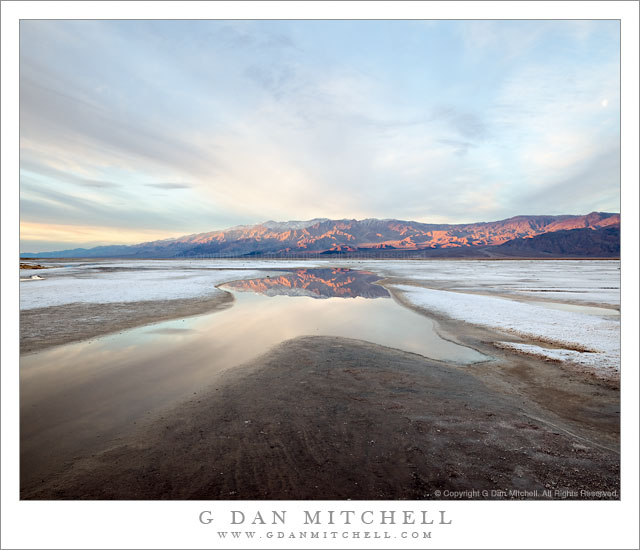
Dawn Light, Panamint Range and Salt Flats

Dawn Light, Panamint Range and Salt Flats

Dawn Light, Panamint Range and Salt Flats. Death Valley National Park, California. February 21, 2011. © Copyright G Dan Mitchell – all rights reserved.

The first dawn light on the snow-dusted Panamint Range is reflected in shallow winter pools on the salt flats of Death Valley National Park.

This is yet another story of serendipity, I think, though it also does involve some advance work – which should please those who become uncomfortable with the idea that not every landscape photograph results from a slow and deliberate and well-planned process! ;-)

The general location of this scene is along a section of salt flat just below the Salt Creek turnoff from the main highway – it is the first area of obvious salt flats that you come to as you head south towards the Furnace Creek area. One one of my first photographic visits to Death Valley I recall stopping near this location along the road and trying to make a photograph pointing down the length of the Valley. It was not successful, but I’ve always been a bit intrigued by this location where the road has to curve around to the east to avoid this salt flat. A day or two earlier on this trip I had stopped along the road at almost this exact location during the “boring light” part of the day after shooting somewhere else. I had wandered – without any camera gear – down across the wash to a patch of brown salt grass and beyond to the edge of the salt flat. I had noticed a lot of things: the very alien nature of this landscape consisting of mud and caked salt and not much else, the surprising presence of some worms and larvae in this tremendously salty water, the fact that the water seemed to seep from beneath the wash, and the interesting shapes that the water created as it slowly spread along the edge of the salt flat.

Move ahead to this morning, the final one of this trip to Death Valley, and I was up well before first light. I had several ideas about what I might photograph, but had not made a firm decision yet since the weather was something of an unknown. I had a vague idea about heading north up the valley and photographing the first light on the hills along its western edge. I was keeping open the possibility that spectacular light might make it worth while to photograph Zabriskie. But I really didn’t know.

I drove to the Furnace Creek/Scotty’s Castle junction and pulled over to watch the light begin to grow. There were lots of clouds! It looked like a lighter area might evolve straight to my east, but I couldn’t quite see photographic potential in it. To the north things looked pretty bleak. There was some possibility that light could happen way to the south, but I wasn’t convinced. I decided to drive a bit south and see what might happen, and very soon I came back to this place where I had stopped earlier. The light wasn’t very promising – clouds to the east seemed likely to block the sunrise light even though there were some interesting cloud patterns overhead that were starting to become more transparent as the sky began to lighten.

Then I caught just a bit of light on some of the higher clouds above the middle level clouds and I started to wonder if the light just might make it through. I went to the back of the car and grabbed my camera with one lens already attached and mounted it on the tripod. I wasn’t sure if I’d want wide or tele for some of the possible subjects, so I grabbed two additional lenses and stuck them in a shoulder bag and headed down the wash, not really looking up too much, just heading straight towards these little areas of water that I remembered from earlier. As I got close to the edge of the flats I saw that, indeed, a band of sunrise light was coming in below the cloud deck to the east (something I have learned to watch for) and starting to light up the highest peaks of the Panamints. I knew that if this light survived long enough to make it down across the range that it was going to happen fast, so I quickly headed out onto the edge of the flats, more or less ignoring the larger scene and simply looking for an interesting reflecting pool. As I set up – working very quickly now – the first sun lit up the face of the panamints and revealed radiating cloud shapes above. I had perhaps two minutes of this light… and then the small gap along the eastern horizon must have closed up as the light disappeared and went back to gray.

G Dan Mitchell Photography | Flickr | Twitter | Facebook | Email
Text, photographs, and other media are © Copyright G Dan Mitchell (or others when indicated) and are not in the public domain and may not be used on websites, blogs, or in other media without advance permission from G Dan Mitchell.

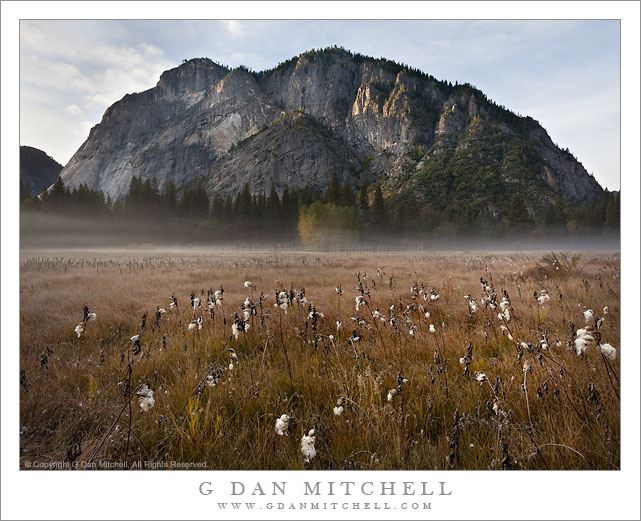
Glacier Point and Ground Fog in Ahwahnee Meadow, Autumn

Glacier Point and Ground Fog in Ahwahnee Meadow, Autumn

Glacier Point and Ground Fog in Ahwahnee Meadow, Autumn. Yosemite Valley, California. October 31, 2010. © Copyright G Dan Mitchell – all rights reserved.

Thin morning ground fog floats above the dry autumn grasses of Ahwahnee Meadow below the granite cliffs of Glacier Point, Yosemite Valley.

During the cooler and wetter months of the year, ground fog often forms in the meadows of Yosemite Valley. Ahwahnee Meadow is one of the places I like to photograph these conditions, and since this was the morning after a damp and rainy day, I arrived here very early in anticipation of conditions that might produce the fog. It was very cold when I arrived, certainly below freezing by at least a few degrees. At first the fog was much denser and a bit deeper. I have photographs from this earlier pre-dawn period when a herd of deer passed through the meadow. Eventually, as the sun rose high enough that the light beams began to clear the mountains to the east of the Valley, the first light began to strike the upper slopes and walls of Glacier Point. As this happened and the air began to move and the temperature stopped dropping, the fog began to thin. This photograph was made shortly before the fog actually dissipated completely, and thin streamers of mist are broken up by clearer areas.

I have to admit that I do not know what the foreground plant is. (Hint: I won’t mind even a tiny bit if someone wants to write and tell me! :-) Cottony tufts are found at the top of long stems, growing out of odd shaped pods. I shot this with a very wide angle lens so that I could include some of this foreground foliage and the fill width of Glacier Point.

On a technical note, this image incorporates a blend of two exposures. Portions of the sky at the left side of the frame were very bright, while much of the rest of the scene was in shade and a lot darker. Almost the entire frame is from the 1/15 second exposure, but I have manually blended in a bit of the 1/40 second exposure in the area of cloudy sky at upper left in order to retain a bit of detail there. Also, though it should be obvious, this was shot with an ultra-wide angle lens – a 17mm focal length on a full frame DSLR. If you are at all familiar with this location in the Valley you will recognize that this is a bit of an unusual view.

This photograph is not in the public domain and may not be used on websites, blogs, or in other media without advance permission from G Dan Mitchell.

G Dan Mitchell Photography | Twitter | Friendfeed | Facebook | Facebook Fan Page | Email