Tag Archives: formation

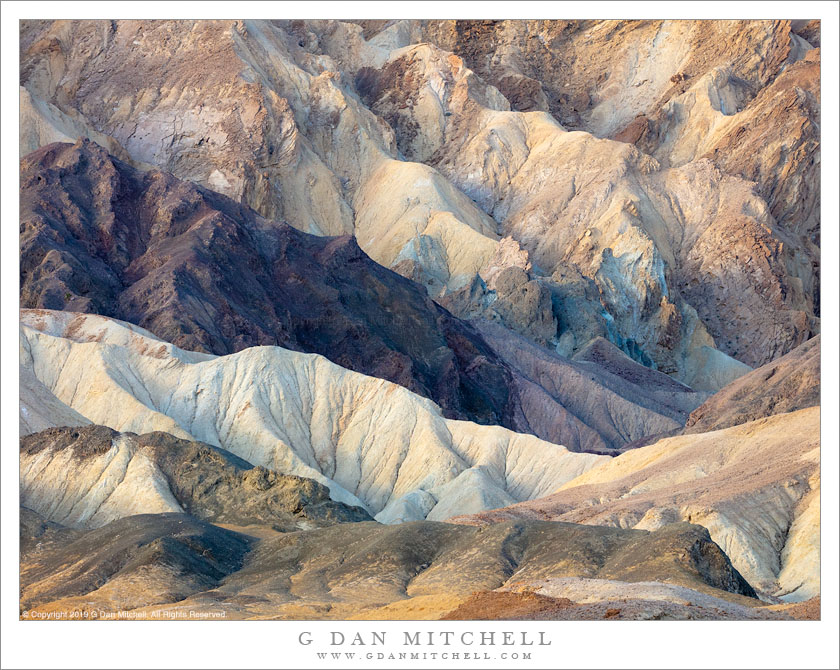
Bandlands, Morning Light

Bandlands, Morning Light
Soft early-morning light on rugged and colorful badlands formations

Bandlands, Morning Light. © Copyright 2019 G Dan Mitchell – all rights reserved.

Soft early-morning light on rugged and colorful badlands formations.

On the final full day of our early-April 2019 photography visit to Death Valley we decided to head for a familiar location where I enjoy photographing in the morning. After being closed earlier in the season this area had finally reopened — flooding of washes in the area had interfered with access, and repairs had be recently completed.

The photographic opportunities in this area — and, to be honest, in many places — depend a lot on the specific qualities of the light during a visit. I’ve been here where clouds turned everything gray and when intense light made some portions of this landscape a bit too stark for my preferences. This morning was close to ideal. When we arrived, before dawn, there was a high overcast and the light was not all that spectacular. However, the clouds were thin, and as the sun rose the light made it thought the dissipating clouds — and this sort of high, thin clouds provide some of the most subtle and beautiful light.


G Dan Mitchell is a California photographer and visual opportunist. His book, “California’s Fall Color: A Photographer’s Guide to Autumn in the Sierra” is available from Heyday Books and Amazon.

Blog | About | Flickr | Facebook | Email

Links to Articles, Sales and Licensing, my Sierra Nevada Fall Color book, Contact Information.


All media © Copyright G Dan Mitchell and others as indicated. Any use requires advance permission from G Dan Mitchell.

Dark Hills, Death Valley

Dark Hills, Death Valley

Dark Hills, Death Valley. Death Valley National Park, California. April 1, 2015. © Copyright 2015 G Dan Mitchell – all rights reserved.

Dark hills contrast with surrounding salt flats and alluvial fans

I know that “dark hills” is not a very poetic description for this landscape… but it does seem, at least, to be accurate! These formations have intrigued me for a few years, and I’ve been surprised to be able to photograph them all alone — despite visiting them regularly, I have never encountered another person there. I’m not sure why, except that there are some better known icons nearby, and perhaps they attract all of the others in the area.

In the past I tried to find out more about the source of the formations and my recollection (which I was unable to re-verify this time) is that they are the result of some kind of ancient tufa-like deposits formed on the bottom of the lake that once filled the basin that is now Death Valley. Their darker color contrasts strikingly with the surrounding terrain, and the material of the mounts has a finely layered quality. This example sits on a small playa where pooling water seems to have left salt deposits behind, though similar forms can also be found in slightly higher terrain nearby. In the evening the low light from the west angles across these mounds and makes their textures and curves a bit more visible.


G Dan Mitchell is a California photographer and visual opportunist whose subjects include the Pacific coast, redwood forests, central California oak/grasslands, the Sierra Nevada, California deserts, urban landscapes, night photography, and more.
Blog | About | Flickr | Twitter | Facebook | Google+ | 500px.com | LinkedIn | Email

Text, photographs, and other media are © Copyright G Dan Mitchell (or others when indicated) and are not in the public domain and may not be used on websites, blogs, or in other media without advance permission from G Dan Mitchell.

Strata and Columns

Strata and Columns, Red Rock State Park
“Strata and Columns” — Red rock strata and vertical columns

For years I have passed by California’s Red Rock Canyon State Park on my way to or from other places, most often Death Valley National Park. My winter route between the San Francisco Bay Area and Death Valley almost inevitably takes me south over Tehachapi Pass and then north, where the highway cuts through this state park. Every time I have passed through I have marveled at the beautiful rock formations rising from the desert and thought about stopping… but kept driving, anxious either to get to DEVA or to get home after a long time on the road.

This time we made a plan to stop, booking a motel in a nearby town for the night to more or less force a stop. We made a fairly brief visit, but we did go this time. This visit, although brief, may have finally cracked the door open a bit to the idea of returning and photographing here again. Being unfamiliar with the park I cannot be sure, but I would guess that this formation may be one of its “icons.” It stands in an easily visited location and presents a striking appearance. It also seems to me to tell a bit of a story. One of the first things that got my attention is the way that its thick band of red rock tilts the opposite direction from the similar rock in the sculpted cliffs that stand behind it. It seems to me that this piece must have dropped off the face (probably with a big bang and lots of dust!), landed in the softer material at the base of the cliff, and momentarily leaned toward falling over to the right, but then managed to just keep its balance enough to be locked into this off-kilter tilted position.


G Dan Mitchell is a California photographer and visual opportunist. His book, “California’s Fall Color: A Photographer’s Guide to Autumn in the Sierra” (Heyday Books) is available directly from him.

G Dan Mitchell: Blog | Bluesky | Mastodon | Substack Notes | Flickr | Email


All media © Copyright G Dan Mitchell and others as indicated. Any use requires advance permission from G Dan Mitchell.

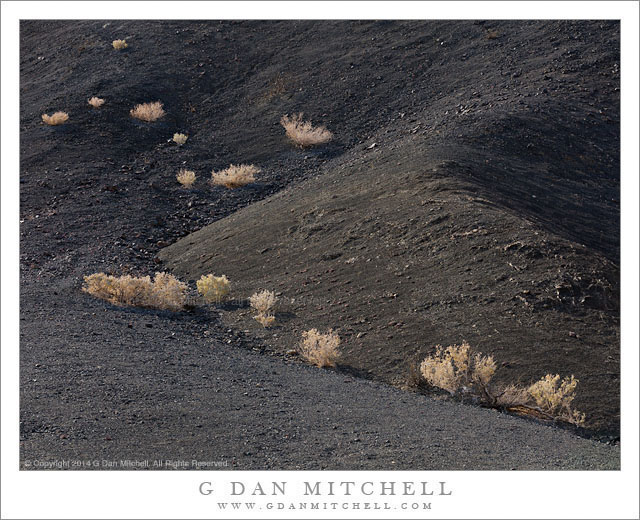
Desert Holly, Black Formation

Desert Holly, Black Formation

Desert Holly, Black Formation. Death Valley National Park, California. April 3, 2014. © Copyright 2014 G Dan Mitchell – all rights reserved.

Desert Holly plants grow on a black formation, Death Valley National Park

This area of Death Valley National Park, not far from the popular Zabriskie Point overlook, shares some of the same geology with that often crowded location. However, you don’t have to go too far from that parking lot to find locations where you can be almost alone, especially early in the morning. This area is one such spot—easily accessible but not marked in any sort of obvious way. Yet it is a great place to spend hours looking at geological forms, sparse plants, and spare effects of light and color.

The desert holly plants grow in some of the most arid locations, and often appear to be the only plants that are able to survive where it grows. You might find a plant or two in a rocky wash, growing out of a crack in a rock wall, or on this dark (volcanic?) material. One can only imagine how hot this black earth must get in the heat of the Death Valley summer! Besides often being the only visible living thing in some very stark areas, desert holly also can change its appearance depending upon how the leaves are doing and on where the light comes from. Light from behind the plant can make it take on an almost golden glow.

G Dan Mitchell is a California photographer and visual opportunist whose subjects include the Pacific coast, redwood forests, central California oak/grasslands, the Sierra Nevada, California deserts, urban landscapes, night photography, and more.
Blog | About | Flickr | Twitter | Facebook | Google+ | 500px.com | LinkedIn | Email

Text, photographs, and other media are © Copyright G Dan Mitchell (or others when indicated) and are not in the public domain and may not be used on websites, blogs, or in other media without advance permission from G Dan Mitchell.