
Tag Archives: high

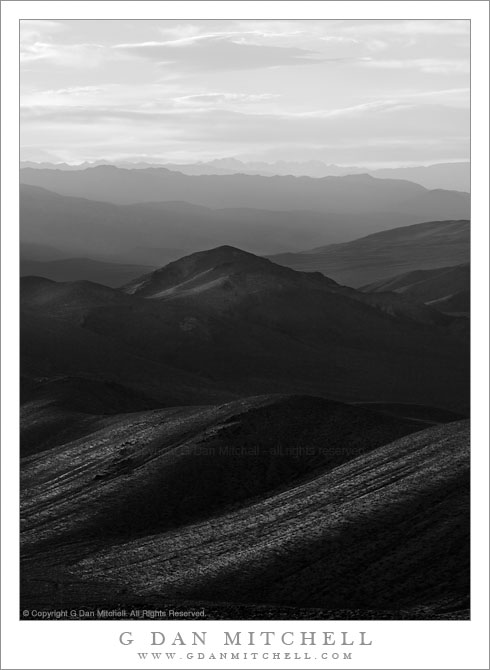
From the Panamints to the Sierra, Evening

From the Panamints to the Sierra, Evening

From the Panamints to the Sierra, Evening. Death Valley National Park, California. March 30, 2011. © Copyright G Dan Mitchell – all rights reserved.

The Sierra Nevada in evening light as seen from Aguereberry Point in Death Valley National Park’s Panamint Range.

I made this photograph from Aguereberry Point shortly before sunset. Aguereberry Point is a lonely prominence over 6000′ above Death Valley, high in the Panamint Mountain range, a place of astonishing panoramic views – and often some significant winds. As I drove the gravel road to the point late in the afternoon I saw three or four other vehicles heading the other direction, but when I arrived at the point a bit more than an hour before sunset no one else was there.

Having photographed here a few times previously, I am becoming more familiar with the challenges and the opportunities of shooting here. One of the challenges – as is the case in many spots in Death Valley – is that certain subjects seem to be “photographable” at very specific times and only for short intervals. One of the most interesting views from Aguereberry is southeast down into Trail Canyon and on to the lower slopes of Wildrose Peak beyond. This is wild, rugged, austere terrain. However, because it lies on the east side of this range the light changes quickly from a washed out blast of daytime sun to sudden deep shadows as the sun drops behind the higher ridges of the Panamints. (Trail Canyon is not seen in this photograph.)

Another challenge is that, impressive and overwhelming as the scale of this grand scene is, it can be difficult to pull interesting compositions out of it. I tend to work with longer lenses here, both to isolate smaller areas out of the huge landscape and to compress distance. In this photograph, the silhouetted crest of the highest part of the Sierra Nevada range is on the horizon, with the intervening ridges of the Panamint Range and others probably including the Inyo Mountains and the ridge just west of Panamint Valley.

And, since I tend towards those large and long lenses… wind is an issue! And on top of Aguereberry Point there is nothing to stop the often strong winds of Death Valley. On this evening the winds were howling, so I found a spot below some rocks where it was a bit less windy and then spent a lot time waiting for momentary lulls in the wind when I could make photographs.

G Dan Mitchell Photography | Flickr | Twitter | Facebook | Email
Text, photographs, and other media are © Copyright G Dan Mitchell (or others when indicated) and are not in the public domain and may not be used on websites, blogs, or in other media without advance permission from G Dan Mitchell.
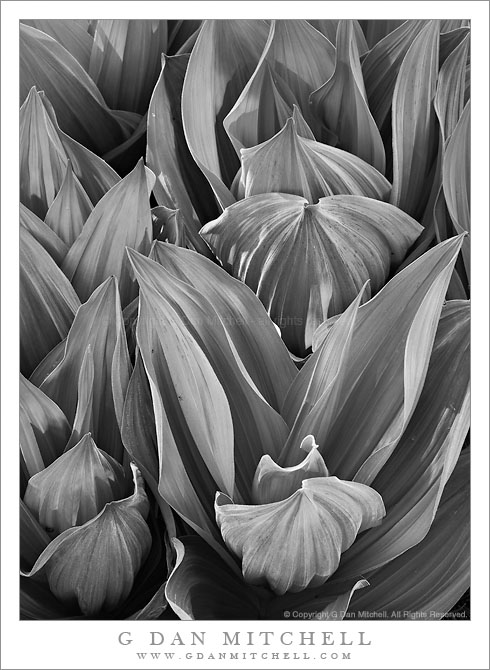
Corn Lilies – Sierra Nevada

Corn Lilies - Sierra Nevada

Corn Lilies – Sierra Nevada. Yosemite National Park, California. June 30, 2010. © Copyright G Dan Mitchell – all rights reserved.

High Sierra corn lilies grow profusely near a waterlogged meadow in the high country of Yosemite National Park.

I had spotted this little meadow area on my way to photograph earlier in the morning at Tenaya Lake, so on my return I decided to wander down into this wet, meadowy area where a small creek flows in the early summer season. As I walked up the stream I came upon large and lush stands of corn lily plants in a boggy area where the stream turned and twisted through a flat area.

I have long been a fan of these plants. I’m fascinated by them at every phase of their annual life cycle, from the time when they first poke up from ground newly free of snow, through this phase when they grow thick and wildly green, to the first hints of brown at the tips of the leaves (which always seem to come a bit too early), to the time in late August when they begin to turn brown and yellow and hint at the coming fall, to the dry stalks that fall over in late September and October.

It is somewhat hard to give up the beautiful green color when you photograph the plants at the peak of growth, as these were when I photographed them at the end of June. However, I like the way that black and white abstracts the curving and sweeping shapes of the plants. (And I always think of John Sexton’s wonderful corn lily photograph when I work with this subject!)

G Dan Mitchell Photography | Flickr | Twitter | Facebook | Email
Text, photographs, and other media are © Copyright G Dan Mitchell (or others when indicated) and are not in the public domain and may not be used on websites, blogs, or in other media without advance permission from G Dan Mitchell.
Rushing Water and Granite Slab, Sierra Nevada

Rushing Water and Granite Slab, Sierra Nevada

Rushing Water and Granite Slab, Sierra Nevada. Yosemite National Park, California. June 28, 2010. © Copyright G Dan Mitchell – all rights reserved.

A Sierra Nevada creek, swollen from spring runoff, flows across granite slabs – Yosemite National Park.

The image and sound of spring runoff water rushing over granite slabs are common in the high Sierra. Though the scene is almost a generic one, for me it also brings to mind many very specific places and experiences throughout the range. (Some of my backpacking friends might think of a spot along Tyndall Creek on the John Muir Trail where we have camped more than once.)

The exact location of this little bit of cascading and rushing water is probably not very important – you are never far from a little scene like this if you are near almost any little creek high in the Sierra! Here the water flows mostly across very smooth rock – so smooth that you can see right through the rushing water to the rocks in many places. In this precise spot there is a weakness in the rock and a small ledge has formed, and the result is a bit of white water.

I’ll share a few technical observations about this photograph, too. First, there isn’t a sharp thing in the image! While sharp focus can be important, I don’t think it is here. (Though if you look closely, the patterns of the blurred, fast-moving water are sharp in a fuzzy sort of way. ;-) The rocks beneath the water cannot be sharp because they are blurred by the water; the water cannot be sharp since I intentionally chose a shutter speed that allowed motion blur. Second, I have to admit that I did not originally have a black and white photograph in mind when I made this exposure. I worked on it for a while in color and though I liked the motion of the water I just wasn’t happy with the coloration of the scene. I finally realized that this image wasn’t about the “reality” of the rocks and water but about creating an impression of the rushing water – and that perhaps monochrome might work. Third, this is yet another “landscape” photograph made with a lens that the “common wisdom” (which often turns out to be not so wise) would say is not a landscape lens – a 70-200mm zoom.

G Dan Mitchell Photography | Flickr | Twitter | Facebook | Email
Text, photographs, and other media are © Copyright G Dan Mitchell (or others when indicated) and are not in the public domain and may not be used on websites, blogs, or in other media without advance permission from G Dan Mitchell.

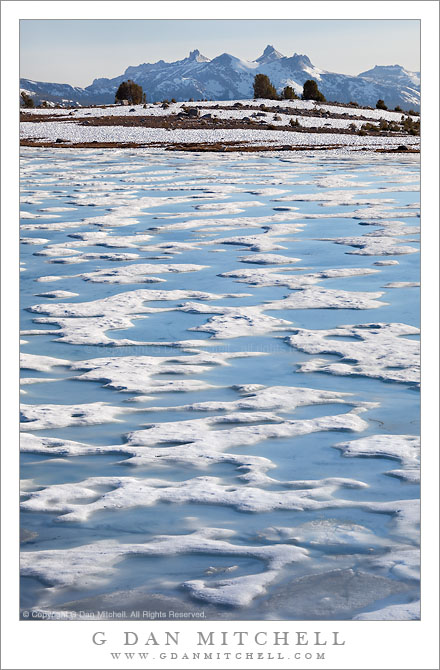
Melting Ice, Gaylor Lake and the Cathedral Range

Melting Ice, Gaylor Lake and the Cathedral Range

Melting Ice, Gaylor Lake and the Cathedral Range. Yosemite National Park, California. June 29, 2010. © Copyright G Dan Mitchell – all rights reserved.

The distant Cathedral Range rises above the melting ice of Gaylor Lake, Yosemite National Park.

Near the end of June last summer I hiked up here late in the day with my friends Mike and Karl. This was a somewhat unusual season in the Yosemite Sierra, in that there had been a lot of snow during the winter season and it had continued right on into spring. Consequently, the high passes opened up later than usual, and on a very late June day when things would typically be a bit more summer-ish, it looked more like late winter up here when we arrived.

I’ve visited this place quite a few times, but had never seen quite this scene before. More typically, the snow and ice are completely gone by the time I manage to get up there, and a typical visit usually entails arriving late on a warm afternoon and then hanging out in the sun while waiting for the evening light to come on. This time we were in snow before we crossed the ridge before the lake, and we had to think a bit about just how to head down toward the lake since the usual path was covered in snow. The lake itself was (obviously, judging from the photo!) still covered in ice, though melting was underway and the surface was a jigsaw puzzle of alternating blue pools and white ice.

We found a location near clumps of trees on rocky talus slopes above the lake to do our photography. In this photograph I shot down the length of the lake to mostly fill the frame with the melting ice. Beyond a small rocky rise at the end of the lake, the terrain drops off towards the meadows of the Tuolumne region, and beyond rise the peaks of the Cathedral range in early evening light.

G Dan Mitchell Photography | Flickr | Twitter | Facebook | Email
Text, photographs, and other media are © Copyright G Dan Mitchell (or others when indicated) and are not in the public domain and may not be used on websites, blogs, or in other media without advance permission from G Dan Mitchell.