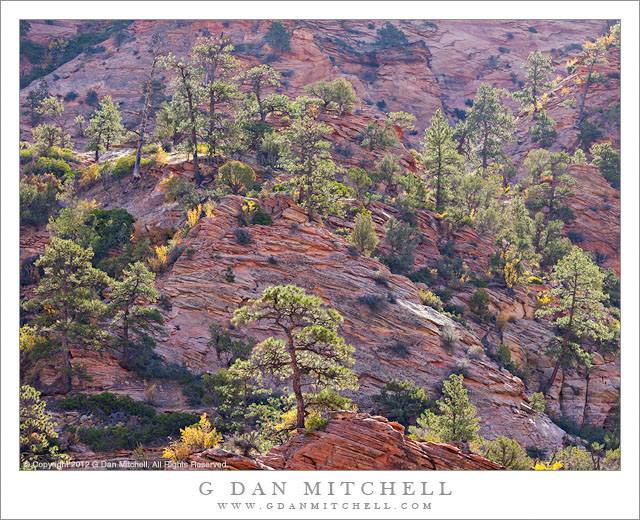
Backlit trees in a high country terrain of rugged red rock sandstone, Zion National Park
Since this has been a recurring theme in my photographs from Zion National Park in October, I think I’ll keep the commentary a bit short on this one. I made the photograph along the Mount Carmel Highway, which passes through high country along an east-west route though the park. We had a day here while on our way to our eventual destination to the east, so we decided to focus on this high country area, with its deep washes and slot canyons, autumn colors, and rounded forms of various types of layered sandstone.
In this area the sandstone was a sort of medium red – not as intense as some of the deeper strata nor as light as some of the nearly white rocks found elsewhere. This rock was finely layered in many places, and formed into a small world of ridges and domes covered with widely spaced trees. I photographed the scene in afternoon light, when the sun was shining from behind the trees and creating a sort of halo of light for each one. Because of the backlight, a bit of atmospheric haze is present and the underlying rocks take on a deeper tone. Every so often a friend of fellow photographer might refer to something they call “G Dan light,” and this is it – the light of backlit trees, photographed by shooting almost directly into the sun, with just a bit of haze.
G Dan Mitchell is a California photographer whose subjects include the Pacific coast, redwood forests, central California oak/grasslands, the Sierra Nevada, California deserts, urban landscapes, night photography, and more. Blog | About | Flickr | Twitter | Facebook | Google+ | 500px.com | LinkedIn | Email
Sunset light momentarily illuminates coastal bluffs near Davenport, California
This photograph or one very much equivalent to it might have been made in any of perhaps thousands of locations along the California coastline, given the right time of year, the right atmospheric conditions, and the right light. With just a bit of looking around, these views from promontory bluffs, looking down the coastline past a series of other rugged bluffs are characteristic of the area. This spot happens to be near the small coastal town of Davenport, California just north of Santa Cruz.
The photograph illustrates one thing about my orientation to photographing the coast line and also illustrates something about light. About the coastline… my favorite times of the year on the coast are not the typical peak tourist season times, but instead are during the late fall through early spring period. Not only is coastal fog much less likely – though still possible! – but the ocean is more interesting and variable under the influence of winter weather, the potential for interesting skies is greater, and the generally lower-angle light creates all sorts of interesting possibilities. The clouds in this photograph, which glow just a bit in the momentary sunset light, are from a weak weather front that passed over during this afternoon along the coast. That weather front leads to my second point about light, which I’ll get to by way of telling part of the story of this afternoon’s photography. When I arrived at this location near the middle of the day, the light seemed very, very unpromising. It wasn’t just the usual nature of midday light, but there was a sort of bland haze in the air, and a shield of approaching clouds was coming down from the north – and as the afternoon wore on it became clear that those thick clouds were going to end up in front of the sun in the late afternoon.
However, sometimes the easiest and most predictable light is the least interesting to shoot in, and the least predictable and sometimes least-promising light can occasionally produce momentary wonders if you watch and are ready for them – or just have enough dumb luck to arrive at the right instant! (On the other hand, you can also watch and wait and, in the end, get… nothing. It goes with the territory!) In this case, I thought about two things. First, I thought about how I could photograph this “boring” light. The way I look at it, I’m there because the place, the circumstances, and the time are interesting – in which case there must be some way to produce a photograph in those conditions that reflect that. But that’s not my point with this particular photograph. The point that this one so nicely illustrates has to do with that possibility of momentary light on a day that seems unpromising. I ran into a couple of other photographers on the bluff during the “blah light” period. I wasn’t making photographs at that point, instead mostly just looking around. We talked briefly about the currently uninspiring light, but I pointed out that I thought I could see an edge to the cloud shield far off-shore, and if I was right there just might be a brief moment of special light as the sun passed below that edge and before it reached the horizon. Sure enough, with just a few minutes left before sunset, the sun dropped below the clouds and an intense band of extremely warm light began to suffuse the coastline against the backdrop of gray higher clouds. It lasted for only a minute or two, but that light was worth the wait.
G Dan Mitchell is a California photographer and visual opportunist whose subjects include the Pacific coast, redwood forests, central California oak/grasslands, the Sierra Nevada, California deserts, urban landscapes, night photography, and more. Blog | About | Flickr | Twitter | Facebook | Google+ | 500px.com | LinkedIn | Email
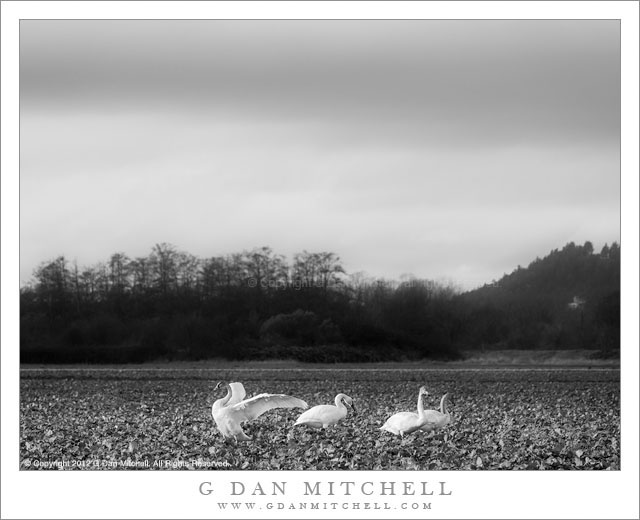
A small group of trumpeter swans on a misty day in a Skagit Valley field, Washington
Finding myself in a wonderful place to photograph birds, but without the (rather long!) lens I would usually rely on, I had to think differently about how to photograph the migratory birds of Skagit Valley, Washington earlier this week. I was in Washington for something else entirely, but had brought along a minimal kit “just in case…” but wasn’t really thinking that bird photography might be on the agenda until plans changed and I found myself with nearly a full day free. So despite having nothing longer than 200mm, I decided to drive up there from Seattle and see what I could find.
Among the locals, I hear that the area is especially renowned for eagles – which I saw and (barely) photographed a year ago. But I’m also, and perhaps predominantly, fascinated by the snow geese and the trumpeter swans. The geese remind me of the very similar Ross’s geese that I photograph in California, but the trumpeter swans are birds that I don’t really get to see at home. While the geese collect in huge flocks of many thousands of birds, creating an audio uproar that must be heard to be believed, the swans don’t seem to be such social creatures nor nearly as noisy. When I’ve seen them, they collect in small groups, sometimes very small or perhaps including a few dozen individuals. They seem to assemble quietly – apart from the occasional “trumpeting” – and don’t do anything like the swirling, flocking behavior of the geese. Instead, even so often a couple of them will lift off – taking a long, shallow trajectory like an overloaded airliner lifting off – and then fly at low levels across fields.
Having only my “short” 200mm telephoto, it proved nearly impossible to photograph them in the usual bird photography style – trying to come as close as possible to filling the frame with a bird or two. Instead, I started by thinking about how I could incorporate the birds into the landscape. Here, near the end of an empty road, I turned onto an even emptier road and slowly drove up to where I was reasonably close to this group. I remained in the car, using it as my “blind” so as not to disturb the birds, and I sat quietly making a few photographs as they fed in the field. I decided to go with an interpretation of the subject that did not attempt for anything like objective realism, instead trying to evoke the subjective aspects of these birds, caught in a momentary beam of sunlight against a misty and rainy sky and hills.
G Dan Mitchell is a California photographer and visual opportunist whose subjects include the Pacific coast, redwood forests, central California oak/grasslands, the Sierra Nevada, California deserts, urban landscapes, night photography, and more. Blog | About | Flickr | Twitter | Facebook | Google+ | 500px.com | LinkedIn | Email
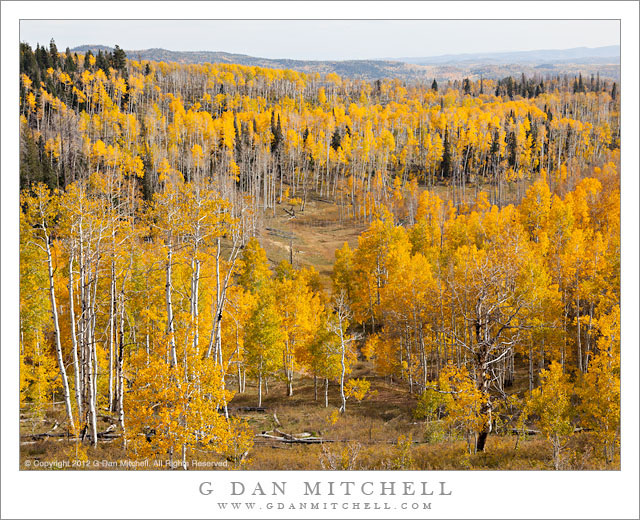
Autumn colors in extensive aspen forests extend into the distance near Cedar Breaks National Monument, Utah
This was a serendipitous photograph. We were driving down a main road from Cedar Grove towards the lowlands when I caught site of a decent looking gravel side road that looked like it might head in the direction of some interesting and extensive aspen forests that were in full fall color – so I quickly turned off and headed down this road. It passed through huge stands of aspen trees as it descended toward the south, and eventually I felt that I had gone as far as time allowed, so I turned around and started back up the road with the sun at my back.
At about this time, a high thin layer of clouds moved over. This is more or less ideal for daytime photography of subjects like the aspens since it softens the light just a bit and moderates the harsh shadows and extreme contrasts that are otherwise found during daytime hours. With this tree color and this light, it was mostly a matter of finding some scene that would fit together compositionally, and here I found a bit of open meadow between colorful trees, along with a distant view to further aspen covered hills almost as far as I could see.
G Dan Mitchell is a California photographer whose subjects include the Pacific coast, redwood forests, central California oak/grasslands, the Sierra Nevada, California deserts, urban landscapes, night photography, and more. Blog | About | Flickr | Twitter | Facebook | Google+ | 500px.com | LinkedIn | Email
Photographer and visual opportunist. Daily photos since 2005, plus articles, reviews, news, and ideas.
Manage Consent
To provide the best experiences, we use technologies like cookies to store and/or access device information. Consenting to these technologies will allow us to process data such as browsing behavior or unique IDs on this site. Not consenting or withdrawing consent, may adversely affect certain features and functions.
Functional
Always active
The technical storage or access is strictly necessary for the legitimate purpose of enabling the use of a specific service explicitly requested by the subscriber or user, or for the sole purpose of carrying out the transmission of a communication over an electronic communications network.
Preferences
The technical storage or access is necessary for the legitimate purpose of storing preferences that are not requested by the subscriber or user.
Statistics
The technical storage or access that is used exclusively for statistical purposes.The technical storage or access that is used exclusively for anonymous statistical purposes. Without a subpoena, voluntary compliance on the part of your Internet Service Provider, or additional records from a third party, information stored or retrieved for this purpose alone cannot usually be used to identify you.
Marketing
The technical storage or access is required to create user profiles to send advertising, or to track the user on a website or across several websites for similar marketing purposes.

 G Dan Mitchell is a California photographer whose subjects include the Pacific coast, redwood forests, central California oak/grasslands, the Sierra Nevada, California deserts, urban landscapes, night photography, and more.