Tag Archives: in

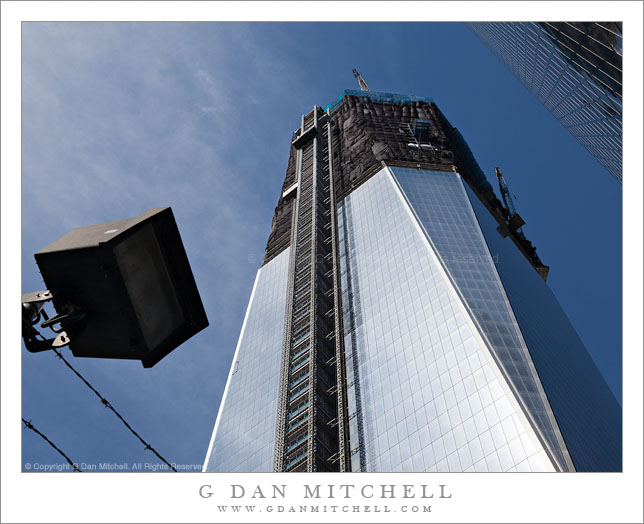
1 WTC, August 23, 2011

1 WTC, August 23, 2011

1 WTC, August 23, 2011. New York, New York. August 23, 2011. © Copyright 2011 G Dan Mitchell – all rights reserved.

The 1 World Trade Center (1 WTC) building under construction on August 23, 2011, New York City.

“When words become unclear, I shall focus with photographs. When images become inadequate, I shall be content with silence.” – Ansel Adams


G Dan Mitchell is a California photographer and visual opportunist. His book, “California’s Fall Color: A Photographer’s Guide to Autumn in the Sierra” (Heyday Books) is available directly from him.

G Dan Mitchell: Blog | Bluesky | Mastodon | Substack Notes | Flickr | Email


All media © Copyright G Dan Mitchell and others as indicated. Any use requires advance permission from G Dan Mitchell.

Very Basic Filter Advice for New DSLR Shooters

(This article has been slightly updated since it was originally posted.)

Earlier this morning I replied to a question about filters from a new DSLR owner who wondered which filters he “had to get” to use his new camera. I realized that this sort of question comes up from time to time, and I thought that the answer might be useful to others. So here it is!

With DSLRs there are typically four types of filters that most people might consider. You do not necessarily need filters – it is a question of shooting preference and some stylistic issues.

“Protective” filters

Some believe or have been told that they need so-called “protective UV filters” on their lenses. The thought is that these filters will protect the front element of your lens from possible damage, and there is an old school notion that reducing UV (ultraviolet) light will improve certain types of photographs. DSLRs are not sensitive to UV light  in the way that film was, and there are some compelling arguments against using filters for protection in normal shooting. My thoughts on this are posted elsewhere on this blog.

I must acknowledge that opinions vary on this issue, and that this discussion (oddly, but like those about certain other photography equipment issues) can become rather heated. I don’t use protective filters. Others do. You’ll have to weigh the arguments yourself on this one.

Circular Polarizing (“CP” or “CPL”) Filters

Contrary to what you may think, CPL filters are generally not simply placed on the lens and left there, but they may be added occasionally for certain shots and in certain conditions. You do not necessarily need them, but in some situations they are useful. There are several things that they can do:

  1. In some photographs they can increase the contrast between things like clouds and sky, possibly producing a more dramatic photograph. This does not always work – it depends on things like the angle of the sun and the nature of the sky. It also does not work well on very ultra-wide-angle lenses. You almost certainly would want to use this effect sparingly, since it easily become a cliche.
  2. The CPL can control or reduce reflections from things like the surface of water or windows. It can also be useful in some situations for reducing the reflections from shiny foliage. Some find the CPL useful for photographing waterfalls and cascades.
  3. The CPL can also function as a stand-in neutral density filter when you want to use a slightly longer exposure time or a larger aperture.

In the first two cases, you rotate the filter to control the effect. There is usually a small dot on the edge of the filter and you can maximize the filtering effect by rotating in 90 degrees away from direction of the sun.

Neutral Density (“ND”) filters

These filters simply darken the image by some number of stops, ranging from one stop to as much as 10 stops. ND filters allow you to use a longer exposure and/or a larger aperture in conditions that might otherwise not allow this. You might do the former to allow motion blur, for example with photographs of water or clouds. You might to the latter to limit depth of field in very bright conditions. (As noted above, a CPL can stand in for a mild ND filter in some cases.) Contrary to some claims you will read, they do not really alter the overall brightness or color balance of photographs at all. (The very dark 9- and 10-stop filters can produce an unwanted color shift.) Most photographers starting out will not need neutral density filters.

Graduated Neutral Density (GND) filters

These filters are darker on one half than the other, with the clear and darker sections separated by an area of relatively smooth gradation whose width may vary. The dark section may reduce the light by two or three exposures. An example of their use might be a scene with very bright sky and darker foreground – the filter is lined up so that the graduated section is on the horizon and the darkened section covering the sky. Although screw-in versions of these filters are available, their usefulness is very limited. More common are large rectangular versions that are attached by means of a holder in front of the lens and then positioned manually. This is a fussy bit of business, and if you are new to this it is quite unlikely that you want to “go there” at this point. (I have heard some argue that they should be called “gradated” rather than “graduated” neutral density filters. I may be dense, but I’m, uh, neutral on this question. ;-)

Filter Alternatives

Today we can emulate the effects of most filters in software. In most cases this gives us more options and greater control than attaching filters to the lens at the time of exposure, and it also means less gear to carry. The circular polarizing filters is an exception, in that you cannot really emulate its ability to control reflections using photography post-production software.

Bottom Line

In my opinion, if you just got your first DSLR and suddenly find yourself in the mood to start buying lots of accessories… hold off on getting filters for a while. Not everyone needs them, and at first you can probably do everything you need to do without adding this additional complication. Eventually, once you become more comfortable with your camera, the filter that is most likely to occasionally be useful to you is perhaps the circular polarizer since it is useful in several different ways and because its effect is generally not one you can duplicate in post-processing.

G Dan Mitchell is a California photographer and visual opportunist whose subjects include the Pacific coast, redwood forests, central California oak/grasslands, the Sierra Nevada, California deserts, urban landscapes, night photography, and more.
Blog | About | Flickr | Twitter | FacebookGoogle+ | 500px.com | LinkedIn | Email

Text, photographs, and other media are © Copyright G Dan Mitchell (or others when indicated) and are not in the public domain and may not be used on websites, blogs, or in other media without advance permission from G Dan Mitchell.

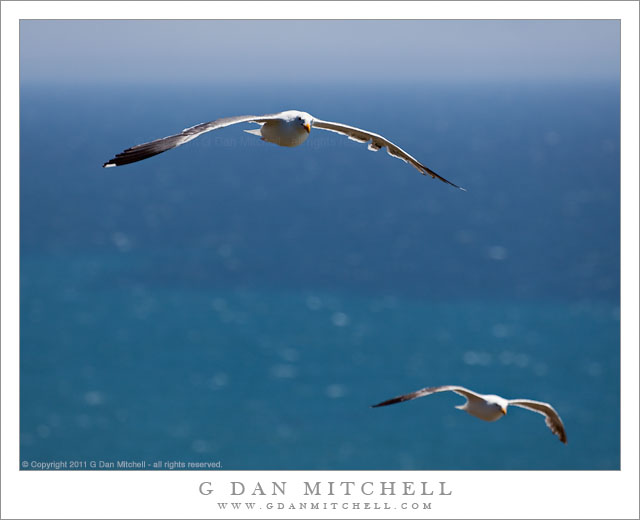
Two Gulls, Ocean and Horizon

Two Gulls, Ocean and Horizon

Two Gulls, Ocean and Horizon. California Coast North of Santa Cruz. July 12, 2010. © Copyright 2011 G Dan Mitchell – all rights reserved.

Two sea gulls glide along the top of coastal bluffs above the Pacific Ocean north of Santa Cruz, California.

Since I’ve related the basic story previously – more than once – I’ll keep it short this time. Since I live within an hour or less of the California coast, I head over that way frequently to photograph. Among my favorite subjects are the pelicans that travel up and down (but mostly, for some inexplicable reason up) the coast, riding the updrafts along the tops of coastal bluffs. I had some free time on this day, so I headed over with photographing the birds as one of my possible goals.

When I got to this familiar spot, there were no pelicans. (Eventually a few did fly past, but this was not a good day for pelicans.) Before moving on to other subjects I thought I’d at least stay here a while and practice the skills involved in photographing these birds in flight since even though there were no pelicans, there were plenty of other obliging birds. Most of the time it is difficult to get two gulls in the frame once they get close and start to fly past, but these two hung close enough together to be in the same frame, and their low trajectory placed them right in front of the deep blue water, with the fog-softened horizon near the top of the frame.

G Dan Mitchell Photography
About | Flickr | Twitter | FacebookGoogle+ | 500px.com | LinkedIn | Email

Text, photographs, and other media are © Copyright G Dan Mitchell (or others when indicated) and are not in the public domain and may not be used on websites, blogs, or in other media without advance permission from G Dan Mitchell.
(Basic EXIF data may be available by “mousing over” large images in posts. Leave a comment if you want to know more.)

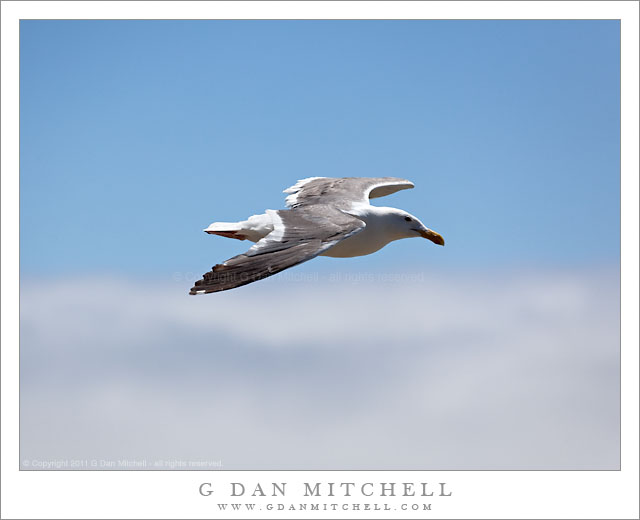
Gull, Sky, and Fog

Gull, Sky, and Fog
Gull, Sky, and Fog

Gull, Sky, and Fog. Pacific Coast Near Santa Cruz, California. July 12, 2011. © Copyright 2011 G Dan Mitchell – all rights reserved.

A solitary gull flies above California’s Pacific Ocean coastline with a fog bank and blue sky beyond.

With some free time earlier this week, and the excuse of driving my son to a summer-session class at UC-Santa Cruz, I headed north from Santa Cruz looking for things to photograph. Because there was a lot of fog, even in the middle of the day, fog was one of my general subject ideas. And I almost always make at least a quick stop at a couple of bluff-top locations that I know of where shore birds often glide by very close as they ride the updrafts from the ocean winds. It turned out that my first stop was precisely one of these locations. With nothing else specific in mind at this midday hour, I figured I would at least spend a bit of time honing my skills and tracking and photographing birds in flight.

Although sea gulls are not necessarily my favorite subjects, there sure were plenty of them to practice on! At the spot I picked, they first become visible perhaps 10-15 seconds away as they come around the edge of a bluff to the south. As they approach they tend to vary their altitudes, with some dropping low enough that they disappear behind the cliff and others going so high that only their shaded undersides are visible. But a few come very close at almost eye level.

I almost always learn something new when I photograph birds in flight and this session was no exception. While in retrospect it seems like one of those “Well, duh!” realizations, I figured out that really strong winds tend to upset the birds ability to remain level, and for this reason they are constantly adjusting to remain level. From moment to moment the wings move into interesting positions or they find themselves tilting wildly to get back on course. This is much more interesting than what they do in benign conditions, where they often seem to just… coast.

So, add one more thing to watch for as they fly past. This isn’t an easy thing, and I have the greatest admiration for those who are really great at photographing birds in flight – or “BIF,” as some call them. The first challenge is simply to keep the moving birds in the viewfinder when using a long focal length lens. (I advise practicing the process of simply following the birds without even firing the shutter at first.) But that’s not enough. You must also attempt to keep the bird(s) in a position within the frame that is aesthetically interesting and which will position the target under the active AF points on the camera. Easier said than done! Then there is the matter of trying also be aware of what the bird is doing – watching wing and head position and so forth. On top of that, you ideally also want to be aware of the what else is in the frame – sky, clouds, water, other birds – and factor that into the decision about when to press the shutter. There are exposure challenges, too, especially with birds like this gull that have white on their backs… and this portion of the bird is in direct sun.

Let’s just say that – for me at least – it takes a lot of exposures to get a few shots that I like.

G Dan Mitchell Photography
About | Flickr | Twitter | FacebookGoogle+ | 500px.com | LinkedIn | Email

Text, photographs, and other media are © Copyright G Dan Mitchell (or others when indicated) and are not in the public domain and may not be used on websites, blogs, or in other media without advance permission from G Dan Mitchell.
(Basic EXIF data may be available by “mousing over” large images in posts. Leave a comment if you want to know more.)