Since the question of how the Canon EF 17-40 f/4 L performs across the frame for landscape photography comes up periodically, I have posted an older test photo I made last year (2007) – updated here to include a comparison corner and center sharpness.
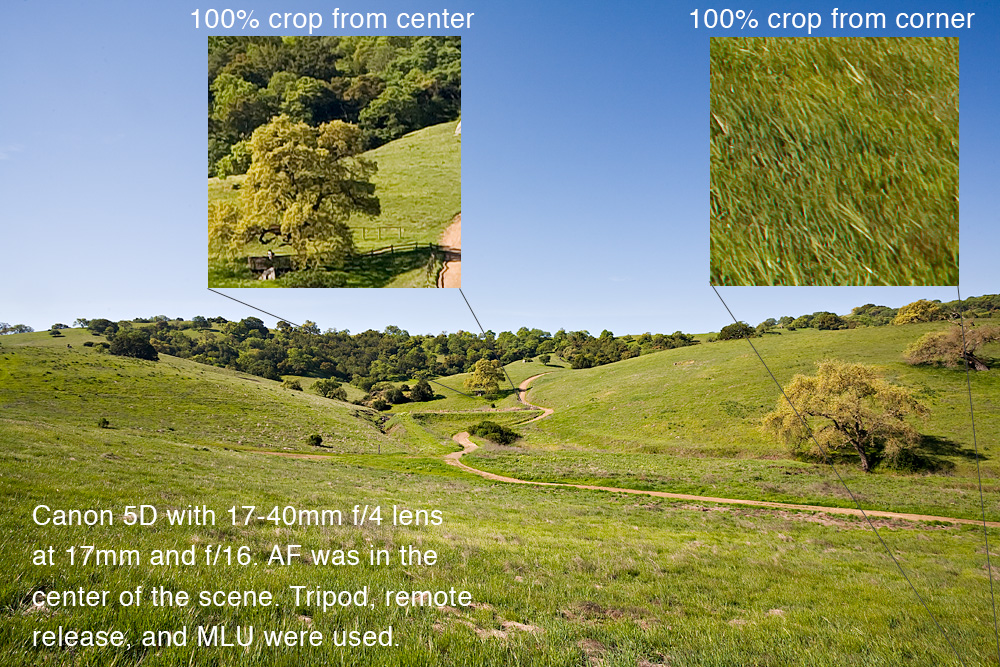
Technical data: Canon 5D. Canon EF 17-40mm f/4 L lens. Focal length: 17mm. Aperture: f/16. Shutter speed: 1/60 second. Shot on the tripod with MLU and remote release. If the full image were reproduced at this resolution the print would be about five feet wide. (Not that I’d do that – it is a really boring photograph! :-) In a more typical size print the corners would like very good, indeed.
A 100% crop would not be expected to be “razor sharp” – and we see typical results here. It is impressive to see how well the corner image quality holds up – despite the fact that grass is one of the most challenging subjects for a digital sensor and the fact that this part of the scene was much closer to the camera than the focus point in the center of the scene – i.e. the corner section showing the grass is only a few feet from the camera, and the camera is focused hundreds of feet away on the objects in the center of the frame. (On that subject, I’m convinced that a good number of the reports of “poor corner performance” in ultra wide lenses are actually due to the subjects in the corner being much closer to the camera position than the subjects in the center of the frame, especially when the “tests” are done by shooting actual landscape subjects.)
BOTTOM LINE: What does this tell us, how do we view this in the context of reports of soft corners on the EF 17-40mm f/4 lens, and what does this mean for anyone trying to choose a wide (or ultra-wide in the case of full-frame cameras) Canon zoom lens?
While this lens is soft in the corners when shot wide open, the lens is not particularly soft in the corners when stopped down. If your primary use for such a lens is, for example, shooting very low light handheld wide angle photographs the 17-40 is perhaps not your best choice. (The EF 16-35mm f/2.8 on full frame or the EFS 17-55mm f/2.8 IS on a cropped sensor body could be more appropriate zooms.) On the other hand, if you are primarily interested in subjects that are usually shot at smaller apertures (urban/wild landscapes, architecture, etc.) then the 17-40 can be an outstanding lens – though this is more true on a full frame body than on a crop body, given that you are unlikely to use the smaller apertures on a crop sensor body given the diffraction blur issues there. So, to state it very succinctly…
… the Canon EF 17-40mm f/4 lens is an excellent lens for shooting deep DOF small-aperture photography on a full-frame camera. (It is OK but not necessarily ideal for use with cropped sensor bodies, where I would prefer the EFS 17-55mm f/2.8 IS.)
G Dan Mitchell is a California photographer whose subjects include the Pacific coast, redwood forests, central California oak/grasslands, the Sierra Nevada, California deserts, urban landscapes, night photography, and more.
Blog | About | Flickr | Twitter | Facebook | Google+ | 500px.com | LinkedIn | Email
Text, photographs, and other media are © Copyright G Dan Mitchell (or others when indicated) and are not in the public domain and may not be used on websites, blogs, or in other media without advance permission from G Dan Mitchell.