Tag Archives: light

Glacier Point and Ground Fog in Ahwahnee Meadow, Autumn

Glacier Point and Ground Fog in Ahwahnee Meadow, Autumn

Glacier Point and Ground Fog in Ahwahnee Meadow, Autumn. Yosemite Valley, California. October 31, 2010. © Copyright G Dan Mitchell – all rights reserved.

Thin morning ground fog floats above the dry autumn grasses of Ahwahnee Meadow below the granite cliffs of Glacier Point, Yosemite Valley.

During the cooler and wetter months of the year, ground fog often forms in the meadows of Yosemite Valley. Ahwahnee Meadow is one of the places I like to photograph these conditions, and since this was the morning after a damp and rainy day, I arrived here very early in anticipation of conditions that might produce the fog. It was very cold when I arrived, certainly below freezing by at least a few degrees. At first the fog was much denser and a bit deeper. I have photographs from this earlier pre-dawn period when a herd of deer passed through the meadow. Eventually, as the sun rose high enough that the light beams began to clear the mountains to the east of the Valley, the first light began to strike the upper slopes and walls of Glacier Point. As this happened and the air began to move and the temperature stopped dropping, the fog began to thin. This photograph was made shortly before the fog actually dissipated completely, and thin streamers of mist are broken up by clearer areas.

I have to admit that I do not know what the foreground plant is. (Hint: I won’t mind even a tiny bit if someone wants to write and tell me! :-) Cottony tufts are found at the top of long stems, growing out of odd shaped pods. I shot this with a very wide angle lens so that I could include some of this foreground foliage and the fill width of Glacier Point.

On a technical note, this image incorporates a blend of two exposures. Portions of the sky at the left side of the frame were very bright, while much of the rest of the scene was in shade and a lot darker. Almost the entire frame is from the 1/15 second exposure, but I have manually blended in a bit of the 1/40 second exposure in the area of cloudy sky at upper left in order to retain a bit of detail there. Also, though it should be obvious, this was shot with an ultra-wide angle lens – a 17mm focal length on a full frame DSLR. If you are at all familiar with this location in the Valley you will recognize that this is a bit of an unusual view.

This photograph is not in the public domain and may not be used on websites, blogs, or in other media without advance permission from G Dan Mitchell.

G Dan Mitchell Photography | Twitter | Friendfeed | Facebook | Facebook Fan Page | Email

10 Critical Tips for Landscape Photographers

1. Use a camera. The most important and basic tool of the landscape photographer is the camera. Using a camera greatly simplifies the process of capturing photographic images, and without one you’ll likely feel a bit lost. You may have noticed that pretty much all great landscape photographers use a camera – some use more than one! – so take a cue from the pros and make sure you have a camera, too!

2. Get a lens. Having a lens makes your camera much more useful. While a camera is critical to your work as a landscape photographer, without a lens the usefulness of the camera is greatly diminished. For this reason, virtually all successful landscape photographers end up, sooner or later, getting a lens to use with their camera. You’ll definitely want one, too – just like the pros! (Some cameras come with a lens built in – what a useful idea!)

3. Remove your lens cap. How many photographers can tell stories of forgetting to remove the lens cap before making a photograph, only to discover that the results were not what they had hoped for? But you don’t have to learn the hard way! Practice removing your lens cap at home – that way, when you are in the field you will have developed “photographer’s instincts” that will ensure that you remove the lens cap. (The good news is that with digital cameras you don’t have to worry about whether you loaded the film – but don’t forget your memory card!)

4. Photograph interesting things. Although it isn’t universally true, you will probably get more interesting photographs if you photograph interesting things. There are many things in the world, and not all of them are interesting. Look for the interesting things and photograph them. Look around – it is an interesting thing to do! Interesting, yes?

5. Pick the right brand. There are many brands of photographic equipment out there – cameras, lenses, filters, bags, you name it. Picking the wrong brand may hamper your photography; pick the right brand and you may not hamper your photography so much. So be sure to pick the right brand. If you aren’t sure which brand is best, talk to photographers – any one of them can tell you which is best… and why!

6. Light is important. Without light it would be pretty much impossible to make photographs, at least the typical landscape photographs. So if you plan to make typical photographs, look for scenes that are illuminated by… light! Light is your friend. Seek out light and when you see it make photographs. Think about it… how many of the photographers you admire work without light? So, do what the pros do – use light!

7. Pick the right subject. Pick the wrong subject and your photograph won’t be what you wanted it to be, so be sure to photograph the right subject. Seek it out and when you see the right subject make a photograph. Perhaps make several. There are so many subjects in the world that finding the right one can be a challenge, so be sure to apply yourself carefully to this task.

8. Colors are important. Unless you are making black and white photographs – in which case the only important colors are black and white. You’ll want to pay careful attention to color. The most important advice is to focus on color in your color photographs – just like the pros!

9. Focus on what is most important. Some people think that mastering technical issues is the most important thing. Others think that having the right equipment is critical. Some claim that the artistic quality of the photograph is important. (Don’t forget – color is important, too!) Before you make great photographs you’ll have to decide which is the most important in your work. Don’t waste your time being a generalist and trying to do everything – pick one and focus on it!  Successful photographers develop a speciality and stick to it.  And don’t forget the rule of thirds!

10. Find good locations. There are many popular spots to make photographs, and you can make photographs just like the pros if you seek out these locations and shoot there, too. You’ll have to be attentive, since these spots are easy to miss if you are talking on your cell phone as you drive past them. Some telltale hints include parking lots full of cars and lines of people with tripods. Stop and make a photograph – there is always room for one more tripod! You can probably make one that looks just like those that the other photographers are making! (Hint: You can also visit online photography sites ahead of time – both to find the locations and to save yourself from spending too much time searching for compositions when you actually get there. Your time is precious!)

Good luck!

(I probably should have saved this for April 1, but I couldn’t wait… :-)

For those whose first experience with my blog is this tongue-in-cheek post, I write serious stuff, too, and a related recent post might interest you: Photographic Myths and Platitudes – ‘Landscape Photography Lenses’ (Part I)

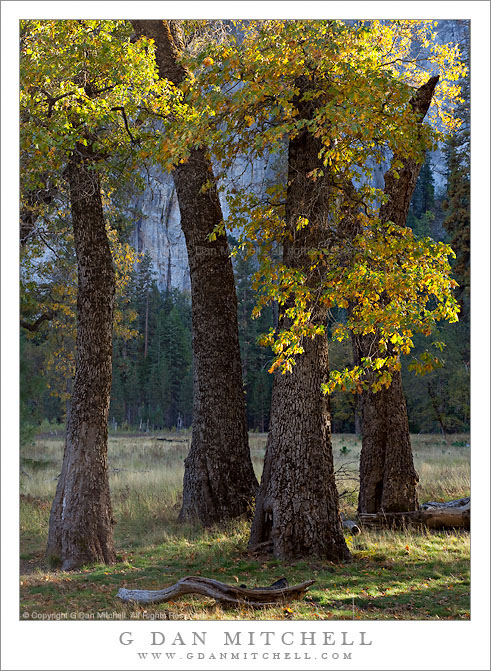
Trees in Morning Light, Ahwahnee Meadow, Autumn

Trees in Morning Light, Ahwahnee Meadow, Autumn

Trees in Morning Light, Ahwahnee Meadow, Autumn

Trees in Morning Light, Ahwahnee Meadow, Autumn. Yosemite Valley, California. October 31, 2010. © Copyright G Dan Mitchell – all rights reserved.

Morning light on trees in and around Ahwahnee Meadow, Yosemite Valley.

This little grove of trees might be one of the best known groves in Yosemite Valley. It sits apart from other trees out in Ahwahnee Meadow, and it can be an appealing site at various times of the year – in spring when the new leaves are bright green, in winter when the meadow and the trees may be snow-covered, and in fall. I made this photograph at the very end of October when the leaves had begun to change to fall colors and the meadow grasses had gone dormant. I had arrived here very early – before sun rise – and shot for a good hour or more in ground fog conditions. As the morning wore on the layer of fog thinned and finally disappeared completely just before I made this photograph. At about the same time, higher clouds around the rim of the Valley that had blocked the earlier light began to thin and the stronger light hit the meadow and the trees.

This photograph is not in the public domain and may not be used on websites, blogs, or in other media without advance permission from G Dan Mitchell.

G Dan Mitchell Photography | Twitter | Friendfeed | Facebook | Facebook Fan Page | Email

Oak Trees, Evening, El Capitan Meadow

Oak Trees, Evening, El Capitan Meadow

Oak Trees, Evening, El Capitan Meadow. Yosemite Valley, California. October 31, 2010. © Copyright G Dan Mitchell – all rights reserved.

A grove of oak trees in El Capitan Meadow illuminated by late afternoon light.

What Yosemite photographer hasn’t photographed these oaks, especially the four in the foreground? I know I can’t resist, and I’ve photographed them in every season and in conditions ranging from warm afternoons to winter mornings with snow on the ground. Here I photographed them during the last few minutes of direct light, just before the sun dropped behind ridges to the west, and after the light had already left the meadow, the forest and the Valley walls beyond.

This photograph is not in the public domain and may not be used on websites, blogs, or in other media without advance permission from G Dan Mitchell.

G Dan Mitchell Photography | Twitter | Friendfeed | Facebook | Facebook Fan Page | Email