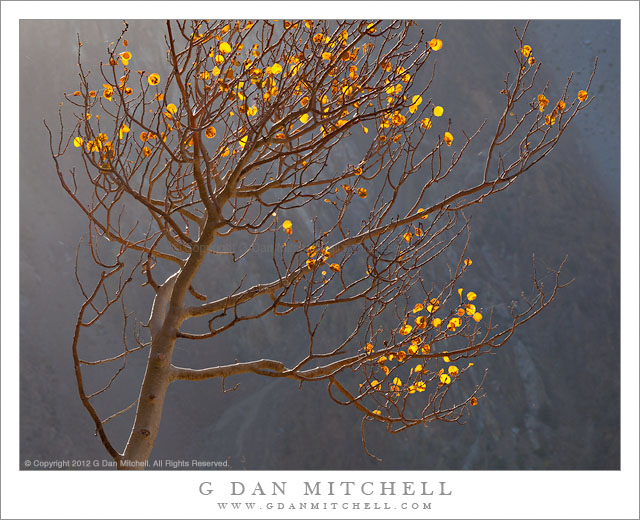
An aspen tree with morning backlight, photographed high above Bishop Creek Canyon *
Today’s Morning Musings post is a brief summary of some things I’m hearing about the development of the eastern Sierra fall aspen color. With the exception of some things I saw a week and a half ago in the Yosemite backcountry, what follows is entirely second-hand information, gleaned from descriptions and photographs I’ve seen posted here and there on the web. (That means that you will likely want to do whatever other checks you normally rely on if you want more detailed and specific information.)
I usually target the first week of October for my first serious aspen photography in the eastern Sierra, but in recent posts I have mentioned the widespread feeling that the color just might come early this year. I also wrote about seeing some strong signs of autumn color in northern Yosemite during the first two weeks of September, earlier than I would usually expect to see such things.
After reading some years of the annual excitement of “the aspens are changing early this year!” following the discovery of an odd tree here or there with some yellow leaves, I’m usually pretty cautious about reports of early color. However, I’m starting to hear and see a significant number of reports and photographs suggesting that things really are getting underway early this time. Continue reading Aspen Color Update (Morning Musings 9/20/14)→
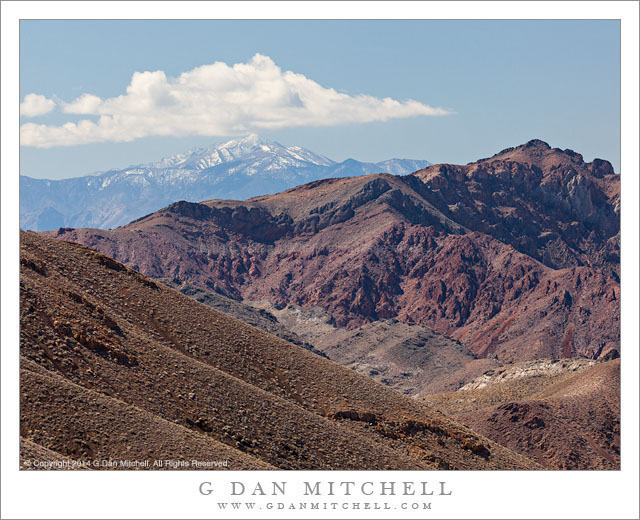
Telescope Peak, the highest point in Death Valley National Park, in the distance beyond the rugged terrain of upper Titanothere Canyon in the Amargosa Range
This one has been sitting in my queue for months now, and it is finally time to send it out with the other photographs! I made the photograph back in early April, while spending a few days in Death Valley exploring a lot of higher elevation area in the mountains on either side of the Valley itself. At one point during this visit, we ended up spending nearly an entire day high up in the Panamint range, at times doing something very unusual — photographing Death Valley wildflowers during a snowstorm!
The distant snow-covered peak in the photograph is Telescope Peak, at over 11,000′ of elevation the highest point in the Panamint range and in Death Valley National Park. While we often think of Death Valley’s reputation for heat, this peak is often covered with snow during the colder times of the year. The location from which I made this photograph is high in the mountains on the other, east side of the Valley, a very arid and rugged region that presents a different appearance than the much lower areas of the Valley itself. Here there is a landscape of dry and rugged mountains and valleys, often receding one behind the other into the distance. I stopped at this spot, where I have photographed before, and was captivated by the conduction of three peak shapes — the nearly peak at upper right, the distant summit of Telegraph Peak, and the peak-like form of the clouds above.
G Dan Mitchell is a California photographer and visual opportunist whose subjects include the Pacific coast, redwood forests, central California oak/grasslands, the Sierra Nevada, California deserts, urban landscapes, night photography, and more. Blog | About | Flickr | Twitter | Facebook | Google+ | 500px.com | LinkedIn | Email
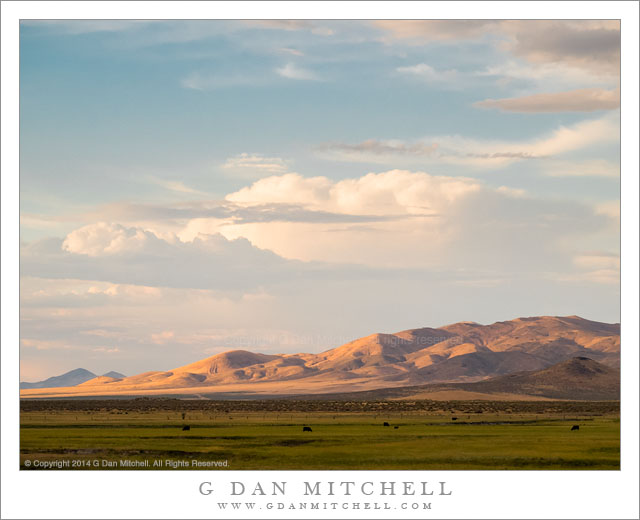
Evening monsoon thunderstorms dissipate above the basin and range terrain of Nevada
This simple photograph necessarily leads to a long story. It starts many, many years ago when I was a child. My family moved to California from Minnesota when I was four years old, and every few years we took a long trip back to the Midwest to visit my mother’s family in Sioux Falls, South Dakota. (Although I have not been there for some years now, I still have fond feelings for the place.) Sometimes we drove, with my parents figuring out routes that would take us through national parks and monuments — Yellowstone, Rocky Mountain, etc — along the way. Several times we took the train, which in those days was the famous California Zephyr. We would get on the train in Fremont, California and travel all the way to Omaha, Nebraska, arriving very early in the morning and then getting to South Dakota by (usually) rental car or (occasionally) a plane. To a young kid, the California Zephyr was an amazing thing — somehow we got “Pullman” sleeper cars, ate in the dining car, and — if my memory is correct — passed hours in the vista dome car watching the terrain roll by.
Jump forward to the new millennium. Patty’s brother and sister-in-law, and two of our sons and their girlfriends live in Brooklyn, so we find excuses to go to New York City every year or so. This time we went not only to visit family, but also so that Patty could attend the International Double Reed Society conference at NYU. We’ve flown plenty of times, so this time we decided to give the train a try. (We did fly back home at the end of the trip — a good choice in my view.) So on this last day of July we went up to Emeryville, where the Zephyr’s trip starts these days, and embarked on our adventure, nostalgic for me and brand new for Patty. There is much more to say about train travel than I have space for here, but I’ll share just a bit about the first day. The route begins along the shores of the San Francisco Bay and then up the delta to Sacramento, the historic end point of the continental railroad. From there the train crosses the Sierra above Truckee Lake, an absolutely beautiful route that often reveals perspectives on this part of the Sierra that are quite different from what we know from driving Interstate 80. As we crossed the crest, the clouds thickened and we rolled through a hail storm as we descended to Truckee. Not long after that we stopped briefly in Reno, Nevada, and then continued on to the northeast across Nevada. After we passed through Winnemucca (from which I departed some years ago on a grand bike trip across the Black Rock Desert and into Northern California) the train continued on through the Humboldt Basin as evening came on and beautiful light fell on the rangeland and the monsoon clouds overhead as the day came to an end.
G Dan Mitchell is a California photographer and visual opportunist whose subjects include the Pacific coast, redwood forests, central California oak/grasslands, the Sierra Nevada, California deserts, urban landscapes, night photography, and more. Blog | About | Flickr | Twitter | Facebook | Google+ | 500px.com | LinkedIn | Email
Hazy sunset light on a small cove and successive ridges along the Pacific Coast Highway
The California Big Sur coast along the Pacific Coast Highway is a place of extraordinary beauty, but also light and conditions that change on a scale ranging from daily to seasonally. Summer often brings a lot of fog — enough fog to sometimes perplex and disappoint visitors who have seen photographs of beautiful summer vistas and imagine that they are the norm. They aren’t. Summer is the season of almost daily fog here. Fall and winter are more likely to provide those vistas, especially between the passage of great Pacific storms that sweep the atmosphere clear of fog and which may bring dramatic clouds. The “off-season” is also the time of the most impressive seascape, as those same winter storms can bring very high surf.
The foggy time of summer does have its attractions, especially when you become aware of the daily cycles. It is often foggy early in the morning, but the fog usually clears back to and beyond the coast later in the day. Photographing in the fog is special, though it can require you to look at the landscape in quite different ways. But as the fog clears you can follow the edges of the fog and light and discover all sorts of interesting and dynamic conditions. Once the fog does clear, the atmosphere often remains somewhat hazy. I know that some people think they want perfectly clear air, but I’ll take a bit of atmospheric haze over perfect clarity almost any day! This was a day of such haze, and very late in the day it began to glow in golden hour light and obscure the farthest parts of the seemingly unending series of Big Sur ridges dropping to the sea.
G Dan Mitchell is a California photographer and visual opportunist whose subjects include the Pacific coast, redwood forests, central California oak/grasslands, the Sierra Nevada, California deserts, urban landscapes, night photography, and more. Blog | About | Flickr | Twitter | Facebook | Google+ | 500px.com | LinkedIn | Email
Photographer and visual opportunist. Daily photos since 2005, plus articles, reviews, news, and ideas.
Manage Consent
To provide the best experiences, we use technologies like cookies to store and/or access device information. Consenting to these technologies will allow us to process data such as browsing behavior or unique IDs on this site. Not consenting or withdrawing consent, may adversely affect certain features and functions.
Functional
Always active
The technical storage or access is strictly necessary for the legitimate purpose of enabling the use of a specific service explicitly requested by the subscriber or user, or for the sole purpose of carrying out the transmission of a communication over an electronic communications network.
Preferences
The technical storage or access is necessary for the legitimate purpose of storing preferences that are not requested by the subscriber or user.
Statistics
The technical storage or access that is used exclusively for statistical purposes.The technical storage or access that is used exclusively for anonymous statistical purposes. Without a subpoena, voluntary compliance on the part of your Internet Service Provider, or additional records from a third party, information stored or retrieved for this purpose alone cannot usually be used to identify you.
Marketing
The technical storage or access is required to create user profiles to send advertising, or to track the user on a website or across several websites for similar marketing purposes.