
Tag Archives: obscure

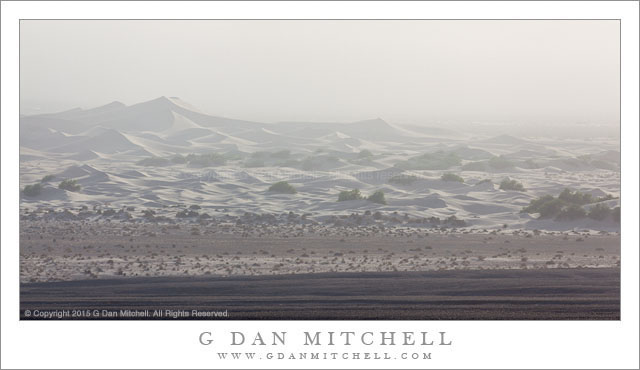
Dust Storm, Dunes

Dust Storm, Dunes
An afternoon desert dust storm obscures sand dunes

Dust Storm, Dunes. Death Valley National Park, California. April 1, 2015. © Copyright 2015 G Dan Mitchell – all rights reserved.

An afternoon desert dust storm obscures sand dunes

Where there are dunes, there will be sand storms and dust storms. The dunes are largely the result of geography that interrupts prevailing winds and causes them to drop their load. When unusually high winds blow through these areas and through dry playas, they inevitably pick up the loose sand and dust and it becomes airborne once again. The immediate effects on a visitor to such places at these times are several. There is dust and sand everywhere — you simply cannot escape it. The night before the wind and sand came through my camp. Fortunately I use a very strong mountaineering when I visit Death Valley since I’ve seen these winds and what they can do. So I used every stake I had, attached stabilizing lines to the tie-out points on the fly, and zipped everything up tightly. I heard the wind and the sand, but my tent was snug and secure. Others were not so lucky (or so prepared?) and all night I heard people outside in the campground trying to tie down flapping tents, recover blowing gear, pound in more tent stakes… or giving up and crawling into their cars. As tight as my tent is, in the morning there was a thin coat of dust everywhere inside.

The next day I headed up into the mountains where I figured it might be less windy. I spent a lot of the time in a deep canyon, and I did escape the wind. In fact, I was pretty much cut off from the outside world — and, therefore, a bit surprised to emerge from the bottom of the canyon into Death Valley to find that the dust was still blowing like crazy. The air was so thick that mountains on the far side of the valley were almost completely obscured, and as I drove south down the valley there were strong cross-winds and blowing sand. I stopped at this slightly elevated spot off to the side of some dunes, put on a long lens (in the relatively dust-free confines of my vehicle) and photographed the dunes, aiming the camera straight into the blowing dust. Yes, this is what a sand storm looks like. (And, yes, I’ve seen worse. Much worse.)


G Dan Mitchell is a California photographer and visual opportunist whose subjects include the Pacific coast, redwood forests, central California oak/grasslands, the Sierra Nevada, California deserts, urban landscapes, night photography, and more.
Blog | About | Flickr | Twitter | FacebookGoogle+ | 500px.com | LinkedIn | Email

Text, photographs, and other media are © Copyright G Dan Mitchell (or others when indicated) and are not in the public domain and may not be used on websites, blogs, or in other media without advance permission from G Dan Mitchell.
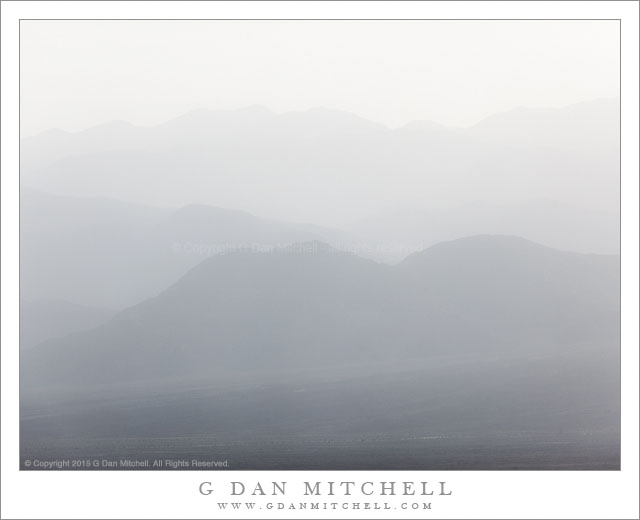
Mountain Silhouette, Dust Storm

Mountain Silhouette, Dust Storm

Mountain Silhouette, Dust Storm. Death Valley National Park. April 1, 2015. © Copyright 2015 G Dan Mitchell – all rights reserved.

A dust storm obscures desert mountains

Those who have been in a desert dust storm (not fun) or sand storm (worse!) will already know about this, but I wanted to share a photograph that shows a bit of how the desert environment is transformed by these conditions. The weather conditions on the first part of this visit to Death Valley had already been strange — the previous morning I had traveled to a high ridge top overlook before dawn, only to discover the atmosphere filled with such haze to a depth of perhaps 7000′, despite the fact that there did not seem to be a source of the dusty air nearby. On the day I made this photograph I took a long drive over a different ridge and then down into and through a long and deep canyon. The trip through the canyon as beautiful, but it is so narrow that my world was confined to what the interior of that canyon — I had little awareness of what might be going on outside.

Eventually I reached the end of this canyon after passing through a narrow slot area, and I emerged at the top of the canyon’s gigantic alluvial fan, hundreds of feet about the valley floor. I was surprised to find that the other side of the canyon was almost completely obscured by the backlit, dust-filled atmosphere. The far hills were visible, but only barely, and almost all details were gone. Such views carry an odd mixture of awe at the immensity of the glowing atmosphere and a kind of resignation to the uncomfortable and difficult aspects of working in such an atmosphere. As a photographer I try to focus on the visual power of the scene (while protecting my gear!) and I make photographs. As I made this one I felt that it was going to be a bit of a stretch since the contrast was so low and the details washed out so much — but this is, in fact, what one sees on an afternoon like this one.


G Dan Mitchell is a California photographer and visual opportunist whose subjects include the Pacific coast, redwood forests, central California oak/grasslands, the Sierra Nevada, California deserts, urban landscapes, night photography, and more.
Blog | About | Flickr | Twitter | FacebookGoogle+ | 500px.com | LinkedIn | Email

Text, photographs, and other media are © Copyright G Dan Mitchell (or others when indicated) and are not in the public domain and may not be used on websites, blogs, or in other media without advance permission from G Dan Mitchell.
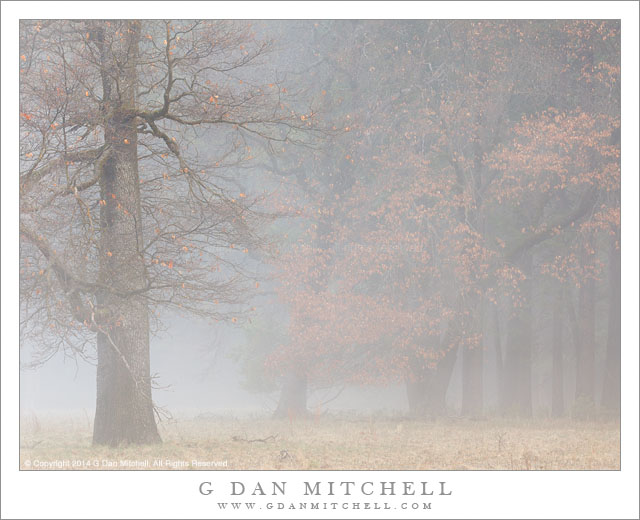
Oak Trees, Winter Fog

Oak Trees, Winter Fog

Oak Trees, Winter Fog. Yosemite Valley, California. March 2, 2014. © Copyright 2014 G Dan Mitchell – all rights reserved.

Winter fog drifts through a meadow to obscure oak trees, Yosemite Valley

The oak trees of Yosemite Valley always have a strong presence in my thoughts of the place. While coniferous trees are undoubtedly far more common, the individual oaks seem to have more character, and this character is strongly influenced by the changing seasons, weather, and light in their typical environments in and around the Valley’s meadows. In the spring they produce a brilliant green color, especially when lit from behind. In the fall their colors, while not as vivid as those of maples, bring a warm golden/brown color. In winter, as the leaves fall away, the structure of the trunks and branches becomes more visible.

In late winter I was in the Valley for a few days in conjunction with the opening of the Yosemite Renaissance exhibit. Often in the winter the Valley’s meadows will fill with ground fog, especially in the mornings, producing all sorts of photographable beauty. This fog is almost alive, often changing suddenly as barely felt breeze moves it to and fro and cause it to thicken and thin. When we arrived to photograph this meadow the fog was very shallow, but it silently thickened and before we knew it the trees were almost obscured, allowing me time for a “barely there” photograph of oak trees with a few leaves still remaining from the previous season — and just as quickly the fog dissipated.

G Dan Mitchell is a California photographer and visual opportunist whose subjects include the Pacific coast, redwood forests, central California oak/grasslands, the Sierra Nevada, California deserts, urban landscapes, night photography, and more. Blog | About | Flickr | Twitter | FacebookGoogle+ | 500px.com | LinkedIn | Email Text, photographs, and other media are © Copyright G Dan Mitchell (or others when indicated) and are not in the public domain and may not be used on websites, blogs, or in other media without advance permission from G Dan Mitchell.

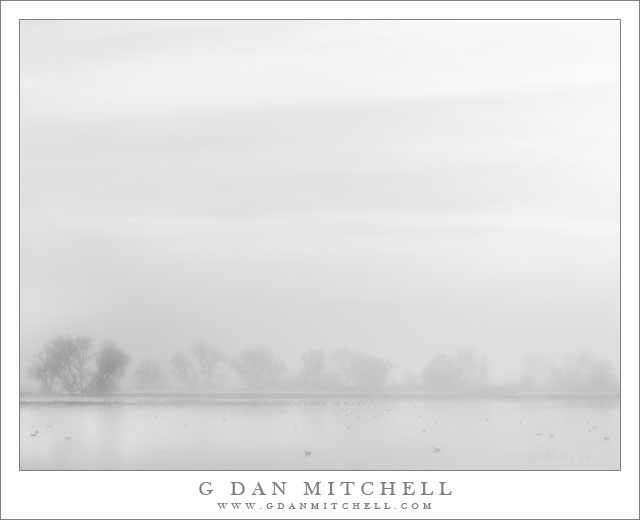
Fog, Trees, and Pond

Fog, Trees, and Pond

Fog, Trees, and Pond. San Joaquin Valley, California. February 14, 2014. © Copyright 2014 G Dan Mitchell – all rights reserved.

Tule fog nearly obscures a San Joaquin Valley pond and surrounding trees

This particular fog condition developed quickly as we were out in the San Joaquin Valley early on a winter morning photographing birds. The winter tule fog in the Valley is often quite thin — so thin, in fact, that you can sometimes seen the stars and moon above on a night when you can barely make out object 100 feet in front of you. This was that sort of fog, but a gentle breeze was also moving it around and changing the conditions from moment to moment. I recall coming to this spot, where the marshland water extends for some distance, and noticing that the trees were alternating between the state of “barely visible” and “not visible at all,” and the fog was brightly lit from the morning sun and sky.

This sort of subject is a bit challenging to photograph and to work with in post. The contrast is obviously very low, and details are hard to see, making focus a bit tricky. And the low contrast almost certainly requires a bit of work in post to get the right combination of diffuse, luminous atmosphere and enough detail to produce an image that makes sense. Here, since the sky was actually quite bright, I wanted to push the sky close to white but still retain the subtle shapes of the high clouds. And beyond all of that, I wanted the photograph to evoke the feelings of stillness and mystery that arise on such a morning.

G Dan Mitchell is a California photographer and visual opportunist whose subjects include the Pacific coast, redwood forests, central California oak/grasslands, the Sierra Nevada, California deserts, urban landscapes, night photography, and more.
Blog | About | Flickr | Twitter | FacebookGoogle+ | 500px.com | LinkedIn | Email

Text, photographs, and other media are © Copyright G Dan Mitchell (or others when indicated) and are not in the public domain and may not be used on websites, blogs, or in other media without advance permission from G Dan Mitchell.