Tag Archives: san joaquin

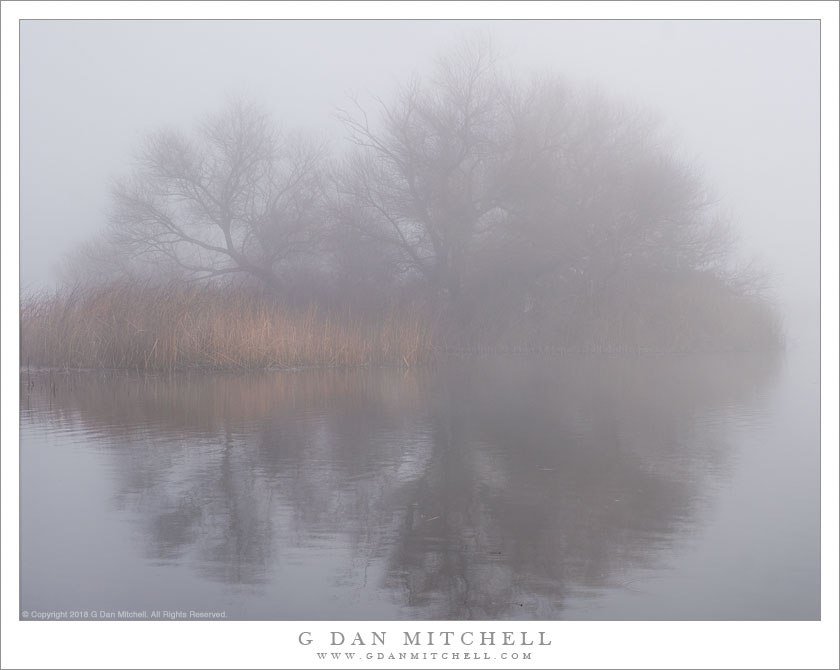
Island With Trees, Thinning Fog

Island With Trees, Thinning Fog
Sunlight begins to illuminate a small wetland island as San Joaquin Valley tule fog thins

Island With Trees, Thinning Fog. © Copyright 2018 G Dan Mitchell – all rights reserved.

Sunlight begins to illuminate a small wetland island as San Joaquin Valley tule fog thins

We all know that (apparently false) story about the number of words that Inuit people have for the myriad types of snow. I suspect that it would be possible to have a similarly diverse vocabulary of descriptions for fog, dependent upon its thickness, temperature, quality and color of light, tendency to move, effect on sound, time of day, season, persistence, and much more. Photographing in California is something of a laboratory in the nature of fog, in that we have so many types. Living in the San Francisco Bay Area I am very familiar with the type of fog created by the marine influence — often cold and gray and damp, and frequently a feature of the late-spring and summer months. Photographing Central Valley birds (and driving across the great valley while traveling to and from the Sierra Nevada) has given me ample opportunities to know the tule fog, mostly a winter phenomenon caused by cool and damp conditions over land.

On winter days when I photograph in the valley I experience transitions though many different types of fog and fog-light. I often start before dawn, when the fog and darkness can close the world down to what I can (barely) see in my headlights, or by the glow of commercial signs and streetlights as I pass through towns. Before sunrise the fog can glow in colors ranging from sky blue to the gaudy reds, oranges, yellows, and purples of first light on clouds above the fog. Eventually that color dissipates and the fog can simply become gray. Then, as it things (often from the top down), and light begins to filter down to the ground level, the colors of grasses and trees and water being to appear faintly.


G Dan Mitchell is a California photographer and visual opportunist. His book, “California’s Fall Color: A Photographer’s Guide to Autumn in the Sierra” is available from Heyday Books and Amazon.
Blog | About | Flickr | Twitter | FacebookGoogle+ | LinkedIn | Email


All media © Copyright G Dan Mitchell and others as indicated. Any use requires advance permission from G Dan Mitchell.
Fog, Tree, And Pond

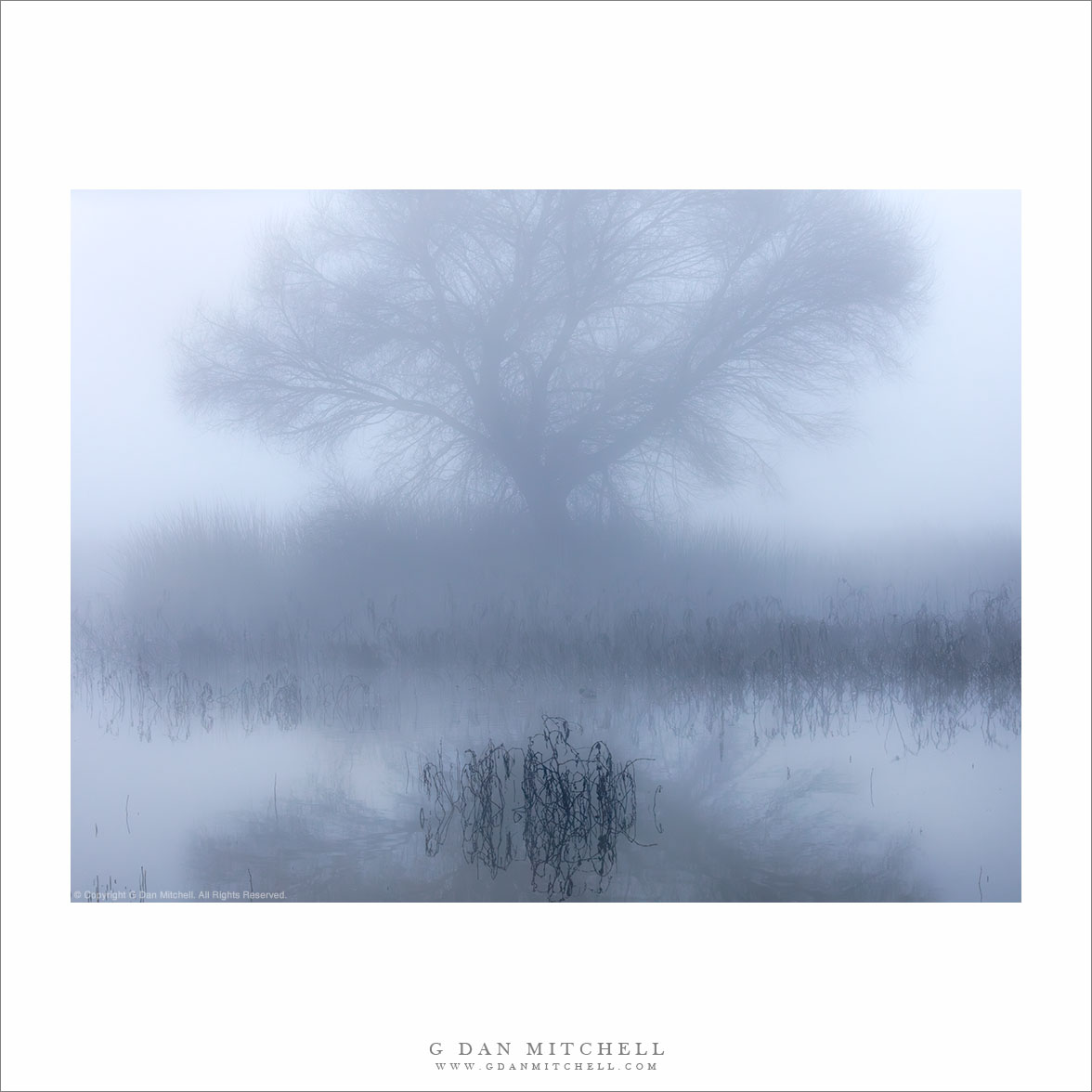
Fog, Tree, And Pond
“Fog, Tree, And Pond” — A tree reflected in a wetland pond in dawn tule fog, San Joaquin Valley

I love fog, and I especially love the thick and mysterious tule fog of California’s Central Valley — comprised of the northern Sacramento Valley and the southern San Joaquin Valley, and draining to the Pacific Ocean via San Francisco Bay. This fog is mostly a winter thing, when the moisture rises from the ground, farmland, and ponds as the temperature drops at night. It often reaches its peak in the early morning, just after dawn. (It also creates some very challenging driving conditions — so bad that lots of people simply try to avoid them.)

If you stop and get out of your car, the world of tule fog is quiet and mysterious and still. Your universe closes down to a radius of perhaps a couple hundred feet or less, and you can sense as much about your surroundings by sound as you can by vision — you might hear but not see a flock of crane passing overhead. Surprising to some who are new to these conditions, while the tule fog is incredibly dense, it is often astonishingly shallow. On occasion I have seen conditions so bad that it was almost impossible to drive… but I could look up and see clouds in the sky overhead. The tops of trees and utility poles might poke out of the top of the fog layer. This, of course, can produce some very special light, since this thick fog may also be intensely illuminated by that overhead sky and sun, to the point that at times it can almost hurt to look into the brightness. Those were not the conditions when I made this photograph, but the astonishing blue color (which I actually had to tone down a bit in post) is the result of the glowing fog picking up the color of the blue morning sky.


Leave a comment or question using the form. (If you are reading this on the home page, click the article title to see the full article and the comment form.

G Dan Mitchell is a California photographer and visual opportunist. His book, “California’s Fall Color: A Photographer’s Guide to Autumn in the Sierra” (Heyday Books) is available directly from him. Blog | Bluesky | Mastodon | Substack Notes | Flickr | Email

All media © Copyright G Dan Mitchell and others.

The Cranes Return

The Cranes Return
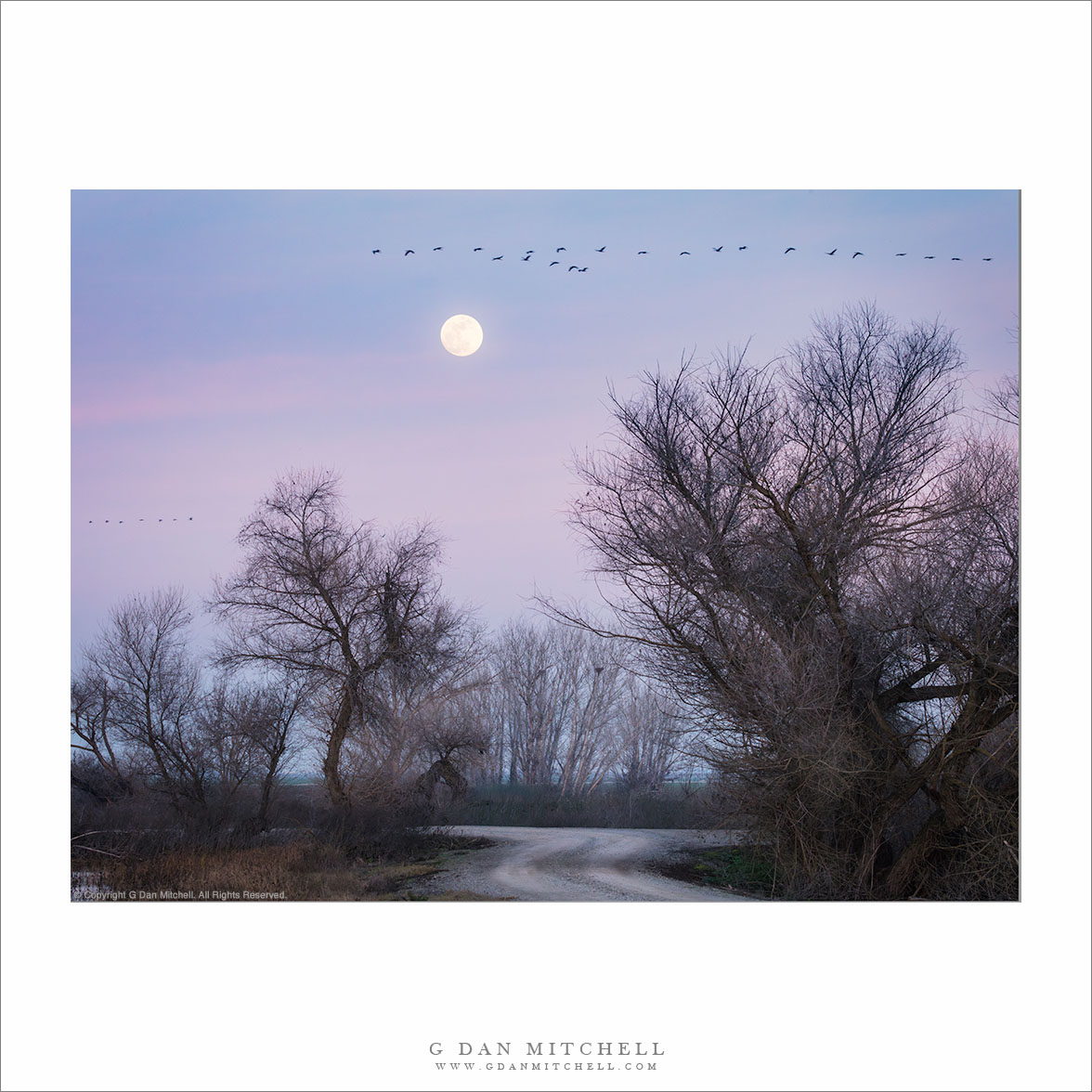
“The Cranes Return” — Sandhill cranes fly over full moon in twilight and return San Joaquin Valley wetlands

I understand that the “Super Blue Blood Moon” or something similar occurred early this morning. I missed it. (Well, not quite. I did look out my window before sunrise, and I saw a bit of the eclipse over my neighbor’s house.) However, almost exactly 12 hours earlier I was in a position to look at and photograph that very same moon as it rose over the Sierra Nevada and climbed into the sky above California. It was a beautiful, quiet, peaceful moment at the end of a long day photographing birds.

I chose this particular day to visit the wetlands for a couple of reasons. First, I knew there would be ground fog in the morning and that fog often leaves behind a soft and hazy atmosphere. Second, I knew that the moon would rise from behind the Sierra about a half hour before actual sunset, putting it at an interesting elevation above the horizon at sunset and during the blue hour, that period when the moon seems bright but the ambient light is still sufficient to illuminate the landscape. I began watching for the rising moon at the appointed time, but it did not immediately appear, because it still had to clear the Sierra and because the atmosphere above the valley was so thick with haze. Perhaps twenty minutes later it began to emerge from the haze, and I quickly moved to a spot I had previously considered, where some trees break up the otherwise flat landscape here where a gravel road winds among them. I hoped that the cranes might appear — they often do during the moments shortly after sunset — and hoped even more that they might pass through the scene. Sometimes one does get lucky, and a long string of the birds flew just above the moon as the sky turned pink and deeper blue.


Leave a comment or question using the form. (Click the title to see the full article and to comment if you are viewing it on the home page.)

G Dan Mitchell is a California photographer and visual opportunist. His book, “California’s Fall Color: A Photographer’s Guide to Autumn in the Sierra” (Heyday Books) is available directly from him. Blog | Bluesky | Mastodon | Substack Notes | Flickr | Email


All media © Copyright G Dan Mitchell and others.

Wetlands Evening

Wetlands Evening
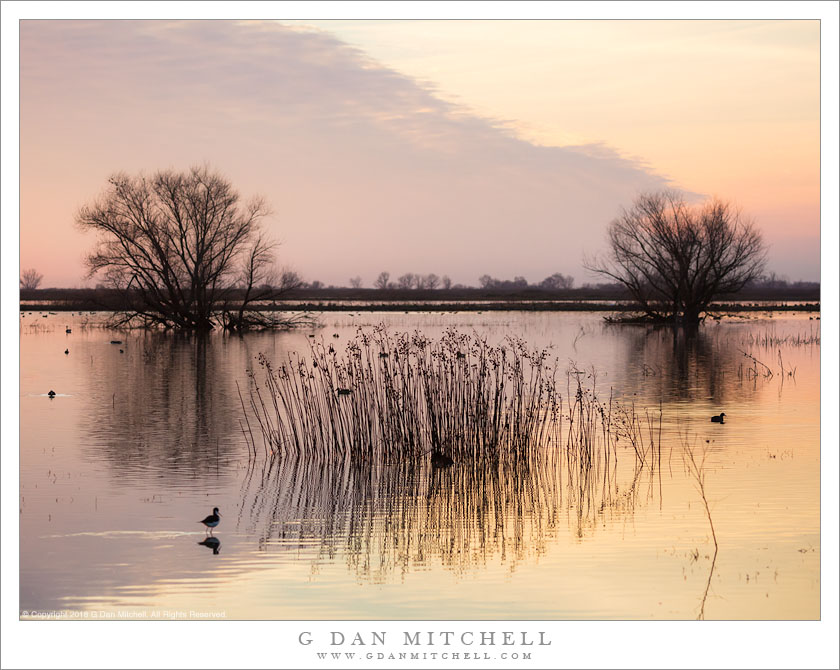
Trees, plants, and a few birds under a bank of clouds above San Joaquin Valley wetlands

Wetlands Evening. © Copyright 2018 G Dan Mitchell – all rights reserved.

Trees, plants, and a few birds under a bank of clouds above wetlands

The process of bird-photography, at least as I know it, is perhaps not quite what people who don’t photograph this subject might imagine. The actual practice and experience varies from photographer to photographer and, no doubt, from place to place. However, I’d be willing to bet that many people would be surprised at how much not-photographing goes on! There are amazing moments when we come upon a special scene, when a huge flock of geese lifts off, when we get close to a raptor, when the light and sky do something astonishing. Then there are all the other moments, and they form the majority of the experience. The birds are somewhere else. They are just a bit too far away. The light goes flat. It rains. And so on.

The fact of the matter is that in order to photograph those periodic extraordinary moments, you have to spend a lot of time just being there. If really special stuff happens, say 1% of the time, you’ll increase your odds of experiencing it if your base is 100 hours rather and one. Of course, that also means that you’ll increase the number of slow hours when not much happens. Be ready. Bring a book. Take a nap. Wander a bit. And sometimes take a look at other subjects, like the still and quiet grasses growing in a shallow pond beneath winter skies, even though there aren’t a whole lot of birds there.


G Dan Mitchell is a California photographer and visual opportunist. His book, “California’s Fall Color: A Photographer’s Guide to Autumn in the Sierra” is available from Heyday Books and Amazon.
Blog | About | Flickr | Twitter | FacebookGoogle+ | LinkedIn | Email


All media © Copyright G Dan Mitchell and others as indicated. Any use requires advance permission from G Dan Mitchell.