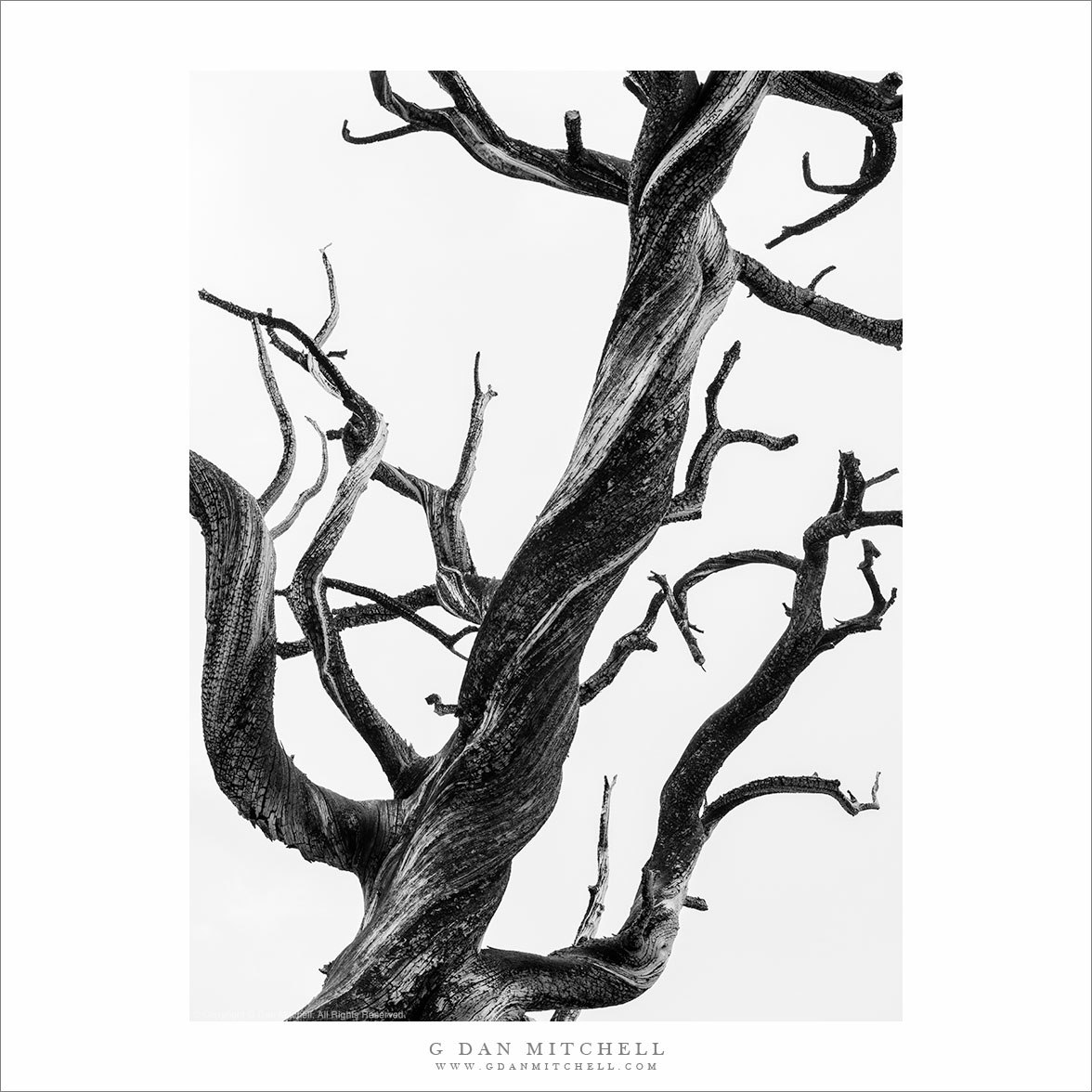
“Snag, Sky” — An old, twisted snag against a gray and cloudy Sierra Nevada sky
Old dead snags can be some of the most compelling sights in the High Sierra. They are everywhere —on the glaciated granite slabs, high atop ridges, within the first, lying in meadows. They are the other end of the life cycle begin by small trees at the edges of meadows. Sometimes to me they seem almost closer in spirit to rocks than to other living things, and some that die in dry rocky places continue to stand for a long time before finally decaying and fading away. Because they are stripped of small branches and needles, the reveal the complex and twisting shapes of the inner tree.
I came across this snag high in an area of granite slabs above a lake where we were camped. I visited it several times, intrigued by its shape and challenged to figure out a way to photograph it that did not include the surrounding living trees. Finally I found an angle that I could photograph with a long lens, tightly cropping a section of its form against the gray of a cloudy sky. In the end I decided on a monochrome rendition, feeling that it better captures the abstract from of the trunk and branches.
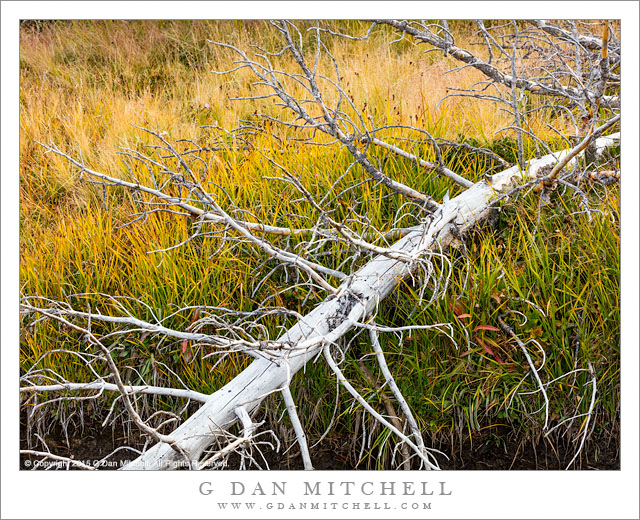
An old fallen tree and lakeshore autumn grasses at a Sierra Nevada lake.
During a week at this backcountry lake and the surrounding area I had plenty of time to wander about, work in varied conditions, and see beyond the obvious first impressions. After a few long stays in such places I have come to be familiar with a certain cycle. I arrive with a mixture of “how will I ever manage to find enough here for a week of work?” and “once I slow down I know there will be plenty to see.” After a day of settling in it begins to feel like there will be plenty to photograph, but that there is no real urgency to the work. I tend to wander, looking at whatever happens to catch my attention and not really working much from a plan. At some point near the middle of the stay there comes a time when I do a count of subjects remaining to photograph and number of mornings/evenings remaining… and I realize that I have to formulate a plan! And then, invariably, on the final day or two I realize that even with a week to work there will be subjects that I won’t get to.
I photographed this scene close to the midway point on the trip — when there still seemed to be plenty of time and just before I felt the need to begin planning more carefully. This is a wonderful time on such a trip, when there are opportunities to engage in “aimless” wandering — though there is very much an aim to that aimlessness! This subject is one that I could easily overlook early on during a trip or during the end-of-trip attention to specific remaining subjects. The skeletal gray of the fallen tree contrasts wonderfully with the rich coloration of the early fall meadow around the edges of this sub-alpine lake.
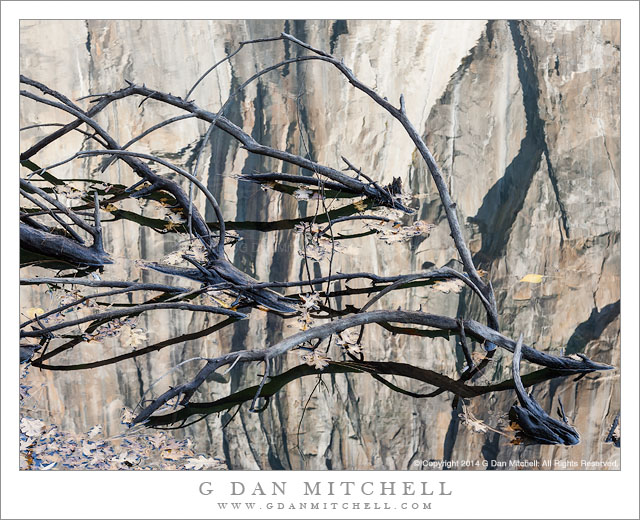
Branches in the still water of the Merced River with floating autumn leaves and the reflection of El Capitan, Yosemite Valley.
This photograph is almost a bit of an optical trick. I’ll let you look for a second and figure it out…
… Does it make sense now? The foreground is composed of some intertwining dead branches just above the surface of a very still section of the quiet, late autumn Merced River in Yosemite Valley. The leaves floating on and just beneath the surface of the water give it away. Because there are so many branches, their dark reflections seem, to me at least, to almost merge with the shapes of the actual branches, creating a complex pattern. And, reflected in the surface of the water and appearing as a backdrop to these elements, is the sunlit face of El Capitan.
I would love to tell a great story about making this photograph… but I don’t remember making it! I discovered it only recently while reviewing all of my old raw files, and all I can say for sure is that I made it on one of my annual late October trips to The Valley to photograph the fall colors. For those who follow the technical stuff, I made this photograph with some pretty low-level gear back at a time when I was experimenting with my first DSLR. The camera was the very humble (but better than some think, at least for this sort of thing!) Canon Digital Rebel XT, an early 8 MP body. Even more humble was the lens, the not so swell EFS 17-85mm Canon lens.
(Note: This was originally posted on September 21, 2011. I’m moving this photograph back up on the home page today as this is a new revision of the original photograph — the date of the revision is December 26, 2014)
G Dan Mitchell is a California photographer and visual opportunist whose subjects include the Pacific coast, redwood forests, central California oak/grasslands, the Sierra Nevada, California deserts, urban landscapes, night photography, and more. Blog | About | Flickr | Twitter | Facebook | Google+ | 500px.com | LinkedIn | Email
This is another multi-photograph post — in this one I share four photographs from the Grand Staircase-Escalante National Monument that feature trees in various back-country landscapes ranging from the canyons and rock formations to one otherwise perhaps un-notable stop near a campsite where I stayed.
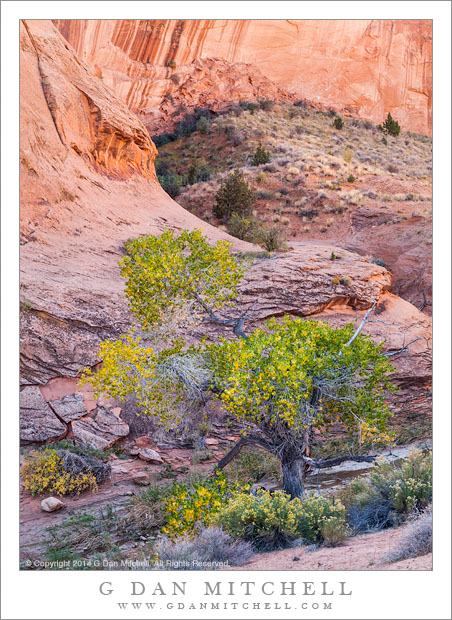
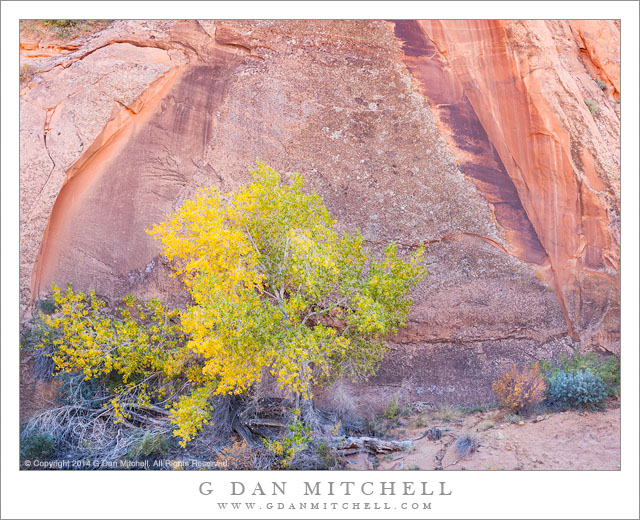
Colorful autumn foliage on a cottonwood tree next to a creek at the bottom of a deep sandstone canyon
This stout cottonwood tree grows in the wash at the bottom of this deep canyon, at the base of huge sandstone walls that tower above and wrap around curves in the canyon’s path. I had stopped here to photograph a different tree — it is among those shared in this group — and after finishing with that tree I looked over here to see this one standing against the worn and curving rock shapes at the base of the canyon walls.
Fractured and sandstone canyon walls arch above a cottonwood tree with fall foliage
This is one of two photographs of this tree that I like. (The other is a in portrait orientation, and may give a better sense of the trees size and the relative scale of the huge sandstone canyon wall.) The tree grows in the bottom of the wash and right up against the canyon walls, with several arch shapes in the sandstone creating a sort of frame for it.
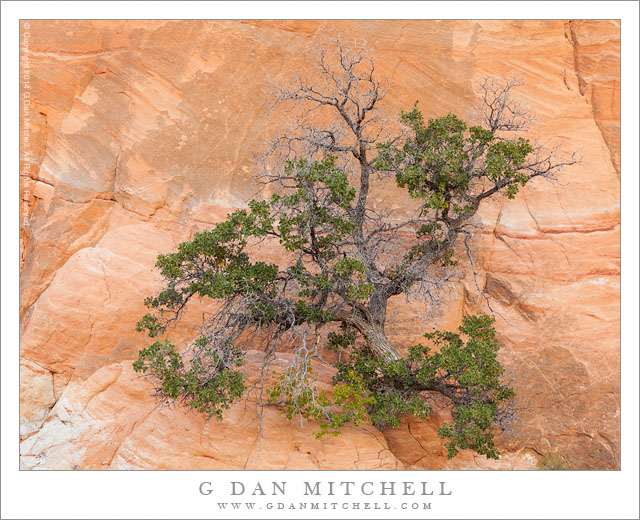
A solitary oak tree grows from a crack in Utah sandstone
This photograph comes with a bit of a personal story. In the morning we (a group of six photographers) had departed our camp on foot to hike down a nearby wash and drop into a deeper canyon. Although the morning began well, with a pleasant walk down the wash, followed by some exploration as we tried to find a good way to drop into the deeper canyon, I suddenly developed a knee problem — I decided to remain behind as the group went on. I walked back to camp, making photographs along the way, and then drove to some other places along our gravel road looking for other subjects. In the late afternoon I returned to camp, though no one else had yet returned. So I decided to do a bit of exploring near camp, and I ended up at the base of a sandstone face as the sun dipped behind mountains to the west — and I photographed this tree in the low light before heading back to camp.
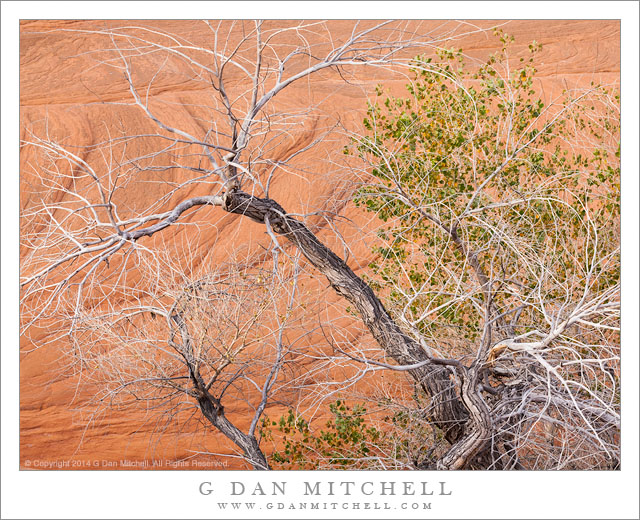
On our first night together as a group in a back-country area of Utah we set up camp and then headed out to photograph something as the evening approached. We drove, ending up at a spot where large sandstone formations are backed by an even larger area of smooth sandstone surfaces, interrupted by potholes and other features. At one point we were in one of those locations where the number of obvious photographic subjects was limited — basically, there was a beautiful pothole with a true and there was this old snag. With six photographers, interesting questions arise. Do we all shoot the same subject? If one person shoots it first, is it OK for the next to photograph from the same angle? How could we each take this common subject and do something different with it? I initially resolved to not shoot this snag, but a bit later I came back and gave in to temptation! ;-)
G Dan Mitchell is a California photographer and visual opportunist whose subjects include the Pacific coast, redwood forests, central California oak/grasslands, the Sierra Nevada, California deserts, urban landscapes, night photography, and more. Blog | About | Flickr | Twitter | Facebook | Google+ | 500px.com | LinkedIn | Email
Photographer and visual opportunist. Daily photos since 2005, plus articles, reviews, news, and ideas.
Manage Consent
To provide the best experiences, we use technologies like cookies to store and/or access device information. Consenting to these technologies will allow us to process data such as browsing behavior or unique IDs on this site. Not consenting or withdrawing consent, may adversely affect certain features and functions.
Functional
Always active
The technical storage or access is strictly necessary for the legitimate purpose of enabling the use of a specific service explicitly requested by the subscriber or user, or for the sole purpose of carrying out the transmission of a communication over an electronic communications network.
Preferences
The technical storage or access is necessary for the legitimate purpose of storing preferences that are not requested by the subscriber or user.
Statistics
The technical storage or access that is used exclusively for statistical purposes.The technical storage or access that is used exclusively for anonymous statistical purposes. Without a subpoena, voluntary compliance on the part of your Internet Service Provider, or additional records from a third party, information stored or retrieved for this purpose alone cannot usually be used to identify you.
Marketing
The technical storage or access is required to create user profiles to send advertising, or to track the user on a website or across several websites for similar marketing purposes.