
Tag Archives: southern

Badlands, Morning Light

Badlands, Morning Light
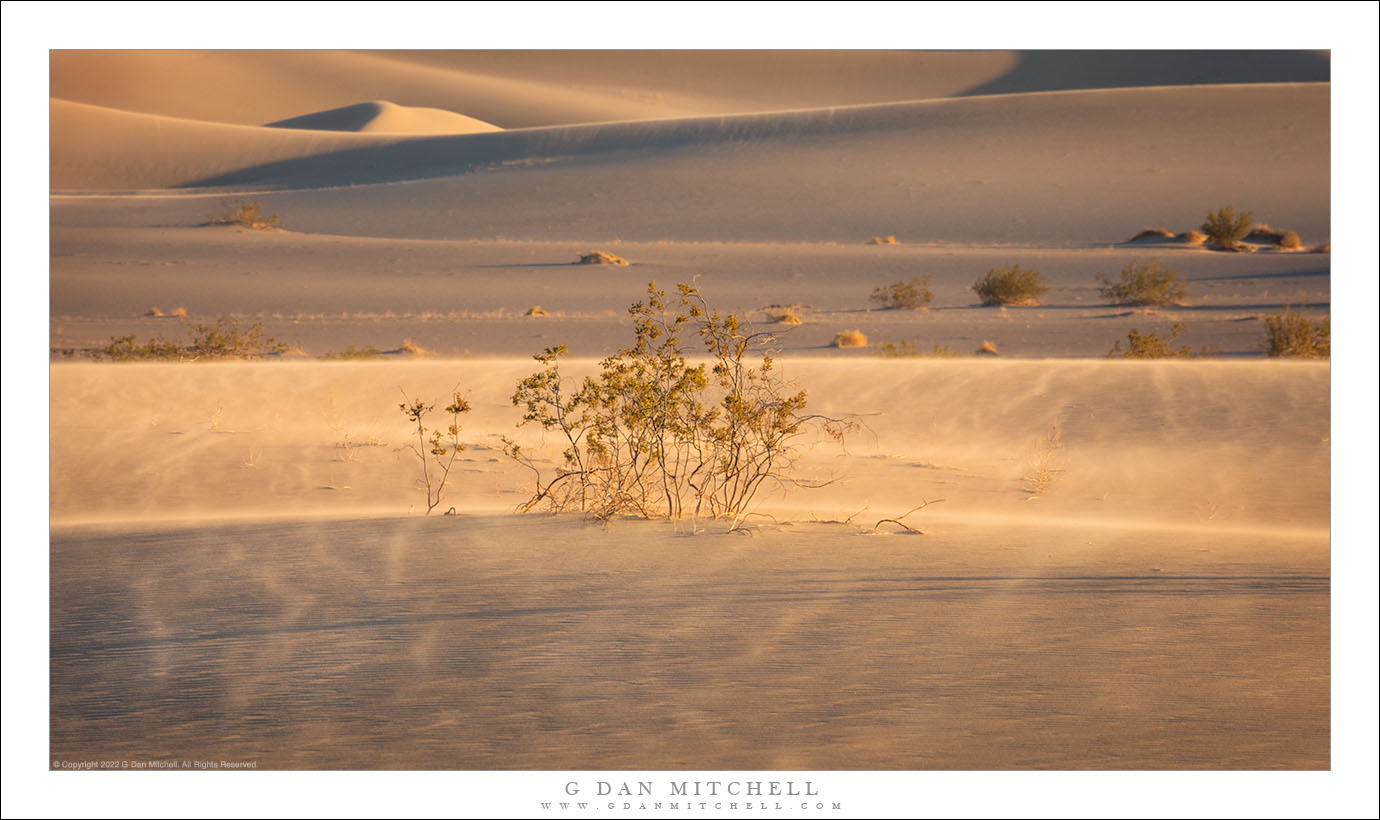
Soft morning sunlight on colorful badlands terrain, Death Valley National Park.

Badlands, Morning Light. © Copyright 2022 G Dan Mitchell.

Soft morning sunlight on colorful badlands terrain, Death Valley National Park.

This area of Death Valley attracts me on almost every visit to this desert landscape. Unlike many of the places I like to visit in the park, it isn’t in the “back of beyond,” and I often photograph here on a morning when I don’t want to travel too far, for example on the final morning of a visit. Like many badlands locations, this area provides an astonishing wealth of potential photographic subjects, and their appearance changes with the light.

In keeping with the usual practice, we visited early one morning on this trip, arriving in the area before sunrise so that we would be ready for the arrival of the first light. This morning sun can be intense, but a bit of high cloudiness softened the light a bit, and this made the colors a bit more visible.


G Dan Mitchell is a California photographer and visual opportunist. His book, “California’s Fall Color: A Photographer’s Guide to Autumn in the Sierra” is available from Heyday Books, Amazon, and directly from G Dan Mitchell.

Blog | About | Flickr | FacebookEmail

Links to Articles, Sales and Licensing, my Sierra Nevada Fall Color book, Contact Information.

Scroll down to leave a comment or question. (Click this post’s title first if you are viewing on the home page.)


All media © Copyright G Dan Mitchell and others as indicated. Any use requires advance permission from G Dan Mitchell.
Dune Study, Evening

Dune Study, Evening
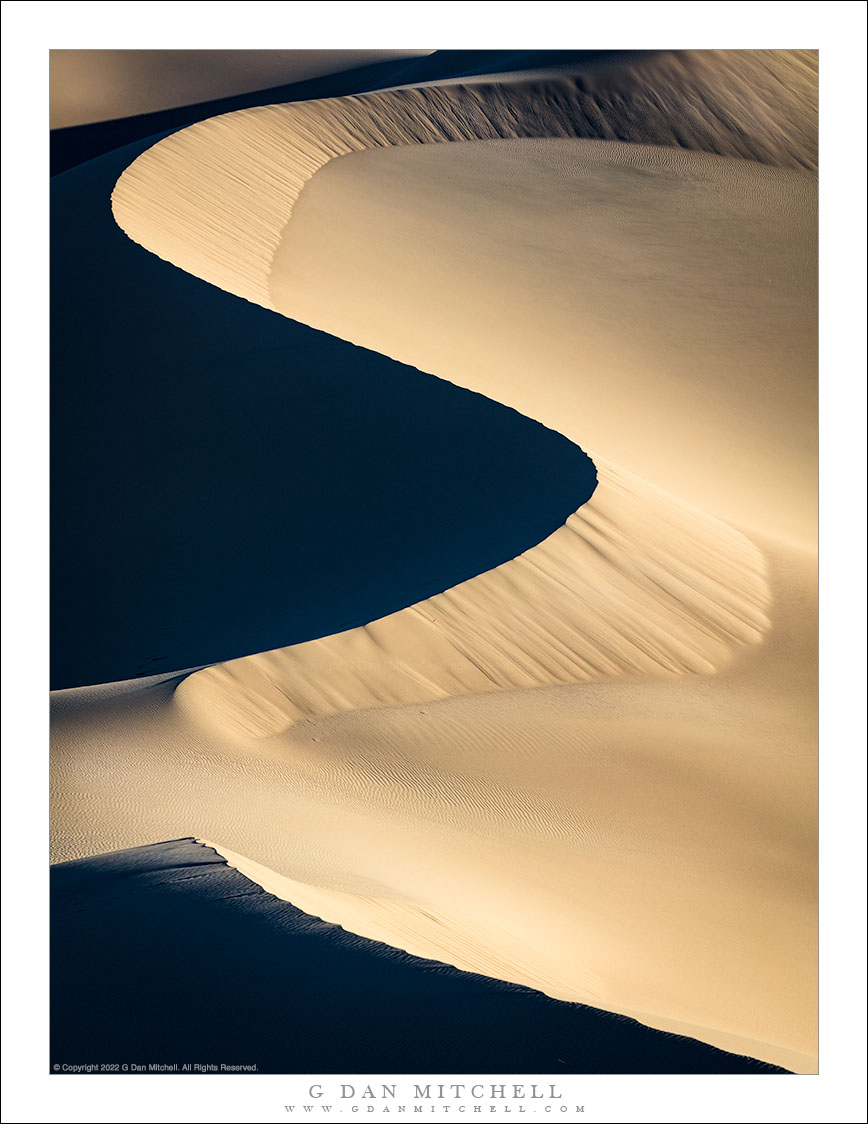
An interpretation of soft dune forms and colors in evening light, Death Valley National Park.

Dune Study, Evening. © Copyright 2022 G Dan Mitchell.

An interpretation of soft dune forms and colors in evening light, Death Valley National Park.

When photographing sand dunes I spend a lot of time looking for just the right combination of shading, texture, line, curve, and color. But in the end, it mostly comes down to the light — the light that colors the sand, creates the shading, and illuminates those lines and curves. It seems like every photograph in the sand dunes is an ephemeral, one-time thing, and the particular combinations of conditions can never be precisely replicated. Unlike subjects where the primary elements of the scene don’t change much, each visit to the dunes takes me to different places and photographs.

On a late-March trip to Death Valley National Park, I revisited a location that I had photographed with great success a couple of months ago. This time Patty accompanied me, and I wanted her to experience the light that I had worked with on the earlier visit. That did not happen. Two months ago the evening sky was clear, and warm-colored sunset light illuminated the western-facing dunes. This time the sky was filled with clouds and the light was soft and the colors far less intense, producing an entirely different and subtle experience.


G Dan Mitchell is a California photographer and visual opportunist. His book, “California’s Fall Color: A Photographer’s Guide to Autumn in the Sierra” is available from Heyday Books, Amazon, and directly from G Dan Mitchell.

Blog | About | Flickr | FacebookEmail

Links to Articles, Sales and Licensing, my Sierra Nevada Fall Color book, Contact Information.

Scroll down to leave a comment or question. (Click this post’s title first if you are viewing on the home page.)


All media © Copyright G Dan Mitchell and others as indicated. Any use requires advance permission from G Dan Mitchell.
Sand Dunes, Light and Shadow

Sand Dunes, Light and Shadow
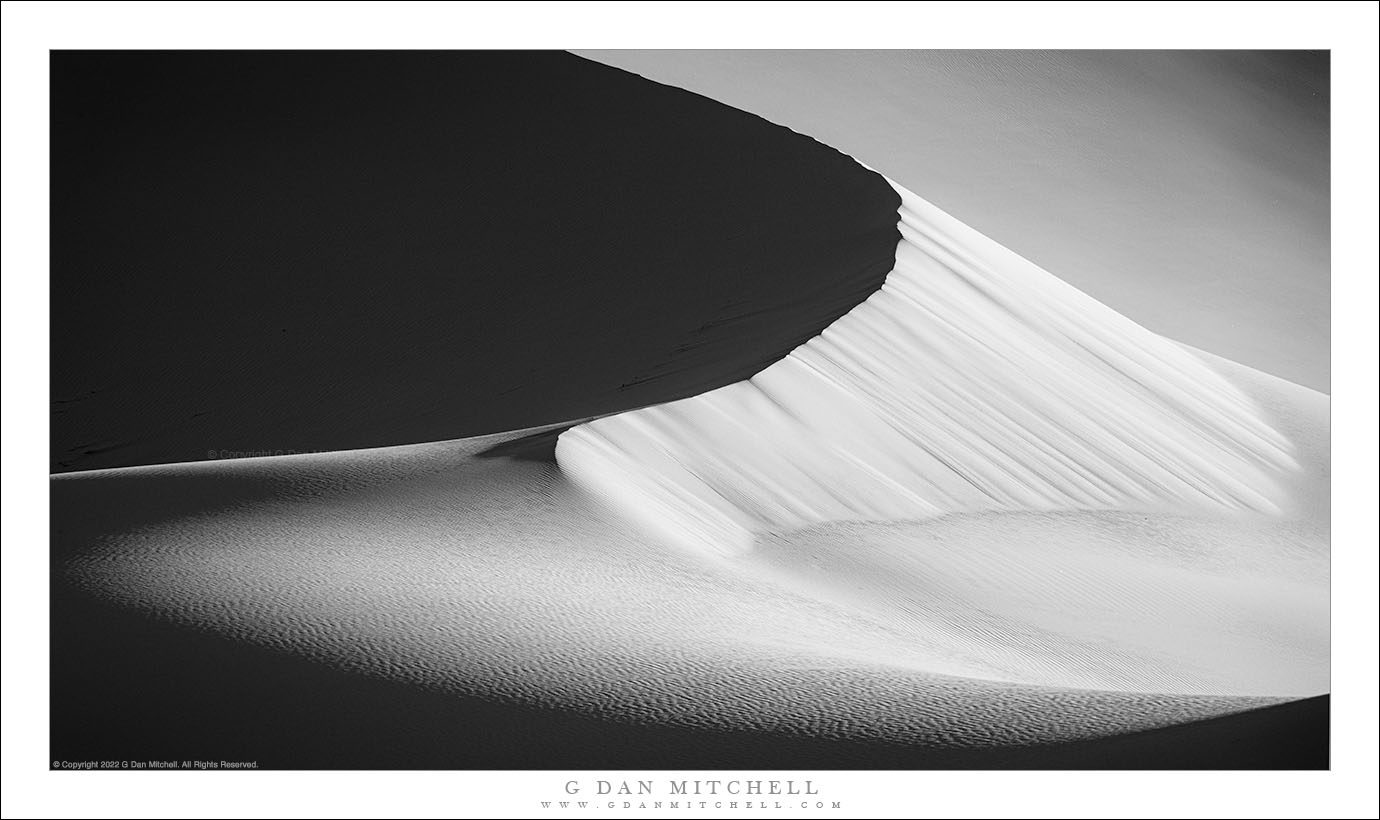
A curving sand dune boundary between light and shadow, Death Valley National Park.

Sand Dunes, Light and Shadow. © Copyright 2022 G Dan Mitchell – all rights reserved.

A curving sand dune boundary between light and shadow, Death Valley National Park.

This particular curving dune section became the subject for a series of photographs I made on this morning. It is a remarkable form, traveling higher and lower on the dune that what you can see in this photograph — a sort of “s-curve plus.” I have previously shared a couple of other photographs of it that were interpreted in color, photographs that show a larger portion of the dune. This one focuses on a small area near its base.

The light here was fascinating. The dunes are backed by a taller ridge, so the morning light does not arrive here until some time after dawn. At sunrise the light on these dunes is fully shadowed, and it has the blue tones of reflected sky. But as the sun rises it eventually sends its light across that ridge behind the dunes, and streamers of light being to slant across the dunes features, creating quickly evolving patterns of light and shadow.


G Dan Mitchell is a California photographer and visual opportunist. His book, “California’s Fall Color: A Photographer’s Guide to Autumn in the Sierra” is available from Heyday Books, Amazon, and directly from G Dan Mitchell.

Blog | About | Flickr | FacebookEmail

Links to Articles, Sales and Licensing, my Sierra Nevada Fall Color book, Contact Information.

Scroll down to leave a comment or question. (Click this post’s title first if you are viewing on the home page.)


All media © Copyright G Dan Mitchell and others as indicated. Any use requires advance permission from G Dan Mitchell.
Interrupted Dune #2

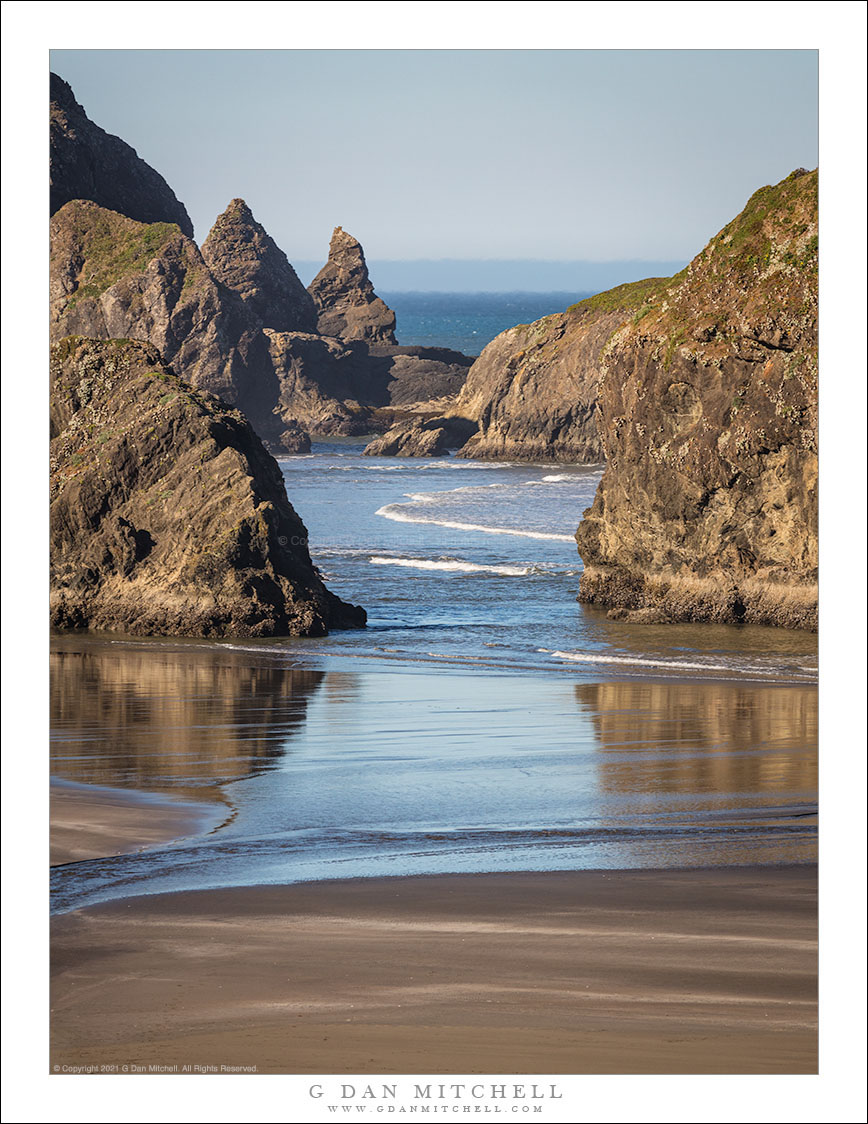
Sand dune patterns, Death Valley National Park
“Interrupted Dune #2” — Interrupted curve of sand at a Death Valley dune.

If you follow my posts and think that this looks familiar… you are right! It is a vertical (or “portrait”) format version of a subject that I shared earlier in a companion “landscape” orientation version. When a subject can work either way (albeit with different effects) it is my practice to capture both vertical and horizontal versions. I suppose one reason is that it relieves me of the worry that I might have picked the “wrong” option. It also puts off a final choice until later. In addition, it provides me with two visual options for the image, something that is occasionally useful. (For example, book and magazine covers tend to use vertical formats.)

Superficially this version looks a lot like the other one, though the taller and narrower format may give greater weight to the curve running between the bottom and top of the image and less weight to the darker portions of the scene. However, if you were to look at them side-by-side you would notice that the textures in the sand are subtly different, and that that colors have also shifted a bit. This photograph, like quite a few that I make in situations like this, was made in rapidly changing light conditions, and in the brief interval between the two photographs the scene changed visibly.


G Dan Mitchell is a California photographer and visual opportunist. His book, “California’s Fall Color: A Photographer’s Guide to Autumn in the Sierra” from Heyday Books, is available directly from G Dan Mitchell.

Blog | Bluesky | Mastodon | Substack Notes | Flickr | Email
Articles | Sales | Sierra Nevada Fall Color | Contact Info

All media © Copyright G Dan Mitchell and others as indicated. Any use requires advance permission from G Dan Mitchell.