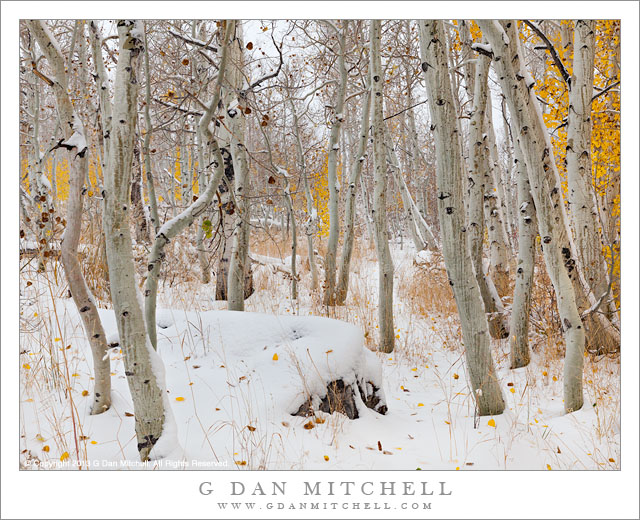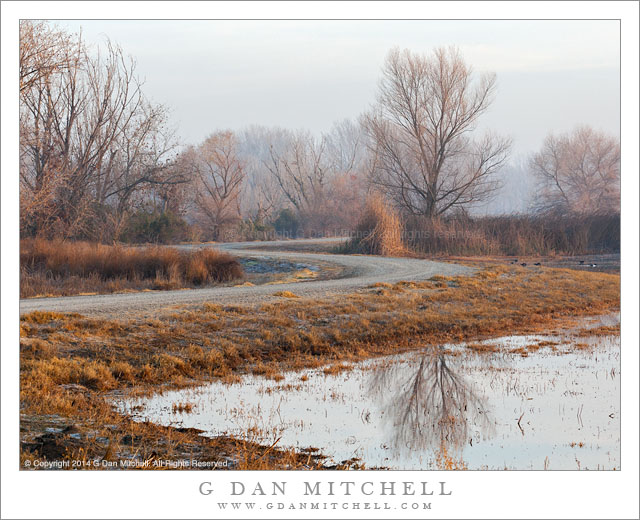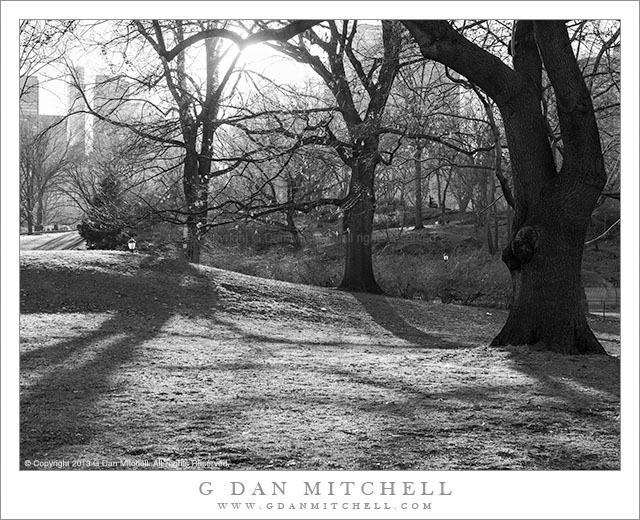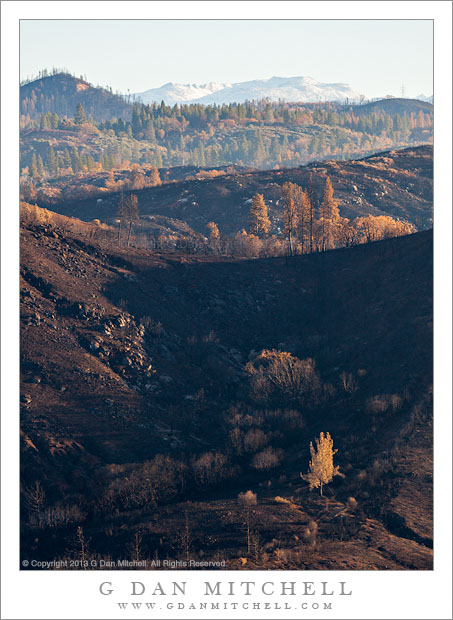
On this early October drive across the Sierra, eventually heading for the town of Bishop, we crossed Carson Pass from west to east. The object of the drive was to photograph fall subjects on the east side of the range, but there was nothing to keep us from starting early – and we began searching out colorful autumn aspens and other subjects even before reaching the pass. Light snow started west of the pass, and when we stopped at the turn-out at the pass a decent amount of snow was falling, the wind was blowing, and it definitely felt like winter. Back in the car we started down the east side of the pass.
The snow continued as we took a short detour on a gravel side-road, then returned to the main highway to head east on highway 88 through Hope Valley. I first visited Hope Valley many years ago when I had just begun cross-country skiing, and today I often pass through on my aspen-hunting trips. The aspens were turning colors on this day, and if you look very closely you can see a very large grove of them in the distance through the snow. We briefly stopped at the turn-off to Luther Pass, where I made this photograph looking back up the creek that flows through the valley. Snow was falling and there was a thin layer of snow sticking to everything. As if to prove that photographers aren’t the only people nuts enough to stand around in the cold wind and snow, there was actually a fisherman along the creek just out of the frame to the right!
G Dan Mitchell is a California photographer and visual opportunist whose subjects include the Pacific coast, redwood forests, central California oak/grasslands, the Sierra Nevada, California deserts, urban landscapes, night photography, and more. Blog | About | Flickr | Twitter | Facebook | Google+ | 500px.com | LinkedIn | Email
Hazy morning light filters across the burned hillsides in the area of the Rim Fire, California
In photographic terms this is perhaps not the most spectacular photograph, and the location is not quite a scenic icon – though it is a place that many stop and take a look on their way to Yosemite, the “Rim of the World” overlook along highway 120 between Groveland and the northern park entrance. However, this view is loaded with implications and connected to many stories.
Late this past summer, the state of California was tremendously dry after a second drought season. It wasn’t a question of whether there would be big wildfires, but more of where, when, and how many. Perhaps the biggest one of all started very near the Rim of the World overlook, and in the hot and dry conditions it quickly – some might say explosively – spread to the north, east, and south. While many think of it as “the Yosemite fire” – and it did burn a lot of terrain inside the park – it really was more of a “Yosemite area” fire. Because of the conditions – the long-term conditions of drought and the immediate conditions of heat and wind – the fire apparently did very serious damage to the forests in the are.
Shortly after the fire was contained, I thought that I might drive through the park on Tioga Pass Road to get to and from the eastern Sierra in early October. In fact, the roads had opened up again by that time, but snow closed Tioga Pass on my trip to the west and we ended up coming back over Sonora Pass. So the post-fire conditions of this area, which is very familiar to me after years of visits, were still an unknown when I drove to The Valley on October 30 for a few days of autumn photography. Passing into the first fringes of the burned areas along highway 120 things didn’t look all that different than they do after any wildfire – some areas badly burned, some singed, and others that mostly escaped the fire. I decided to stop at the Rim of the World overlook, which was pretty much the only place where stopping was allowed, and get out and take a look. I was floored by the scale of the fire. It had come from behind my position, burned down and across the deep canyon of the Tuolumne River, up the canyon walls on the far side, and then across a vast series of receding ridges. Some smoke and haze still seemed to be coming from the area, and early morning light glanced across the ridges, with their dead trees. In the far distance there is a low peak with a bit of early season snow.
I have seen quite a few fires in the park over the past few decades. One not far from here destroyed a large area of forest a few decades ago – and on this trip, ironically, I was noting that new evergreen trees are finally taking hold there. Later several very bad fires blew up from near Foresta, doing terrible damage to the section of Crane Flat Road descending towards The Valley. There have been others. In most of these cases – though I wondered in the case of the most recent Foresta fire, too – it seemed that I could watch the forest recover and return to something resembling what I remember. However, given the intensity and scale of this fire, I wonder if I’ll have that opportunity where the Rim Fire burned?
To end on a cheerier note, a couple of other observations. Even near badly burned areas, I did see sections where this fire only burned some of the vegetation and a few that seemed to have been completely spared. And when I got to a spot inside the park along highway 120 where I often stop to photography dogwood trees in the spring and fall, a spot that seemed like it might have been within the burn zone on the maps, I found my little spot completely intact, with the dogwoods turning to fall colors.
G Dan Mitchell is a California photographer and visual opportunist whose subjects include the Pacific coast, redwood forests, central California oak/grasslands, the Sierra Nevada, California deserts, urban landscapes, night photography, and more. Blog | About | Flickr | Twitter | Facebook | Google+ | 500px.com | LinkedIn | Email
Peak autumn color in a small stand of aspens high in a desert mountain range east of the Sierra Nevada
It is no secret that I love aspen trees, especially in the fall, and that I’m a big fan of the aspens along the eastern slopes of the Sierra Nevada. I photograph them every year, and I have come to know quite a bit about where to find them and how to photograph them in a variety of conditions ranging from sun to clouds and rain to snow. The aspens in this photo are also in California… but just not in the Sierra.
For a while I’ve had the idea to photograph aspens that are east of the range, since I have seen them from time to time while out there, but usually at the “wrong” time of year. This year I had a chance to make such trees the target of some travel, and we went looking for them east of the Sierra between roughly Long Valley and Bridgeport or thereabouts. The specific location of these trees is not all that important, though I’ll say that we came across this stand in some mountains east of the Sierra – as we rounded a bend and dropped into a valley in mostly sagebrush and juniper country, the stunning color of this grove along a small stream bed provided a vivid contrast with the surrounding terrain. We stopped and wandered around the edges of the grove, mostly making photographs of the trees themselves rather than their larger setting. Sierra fall aspen photographers are (sometimes painfully) aware of the ways that aspen leaves can deteriorate in the autumn, including brown or black spotted leaves or trees that go straight to drab dead leaves without passing through a colorful stage. However, the leaves on these trees were among the most perfect I have seen, with barely a blemish and with intense colors covering the spectrum from barely green though golden and on towards orange and red.
G Dan Mitchell is a California photographer and visual opportunist whose subjects include the Pacific coast, redwood forests, central California oak/grasslands, the Sierra Nevada, California deserts, urban landscapes, night photography, and more. Blog | About | Flickr | Twitter | Facebook | Google+ | 500px.com | LinkedIn | Email
Morning fog drifts through a stand of cottonwood trees with golden autumn leaves, Yosemite Valley
Like essentially everyone who has photographed much in Yosemite Valley, I know this little stand of cottonwood trees very well. It is an obvious attractive photographic subject since its densely grouped trees stand apart from other trees in the middle of a meadow, its “perfect cottonwood-ness” is broken by the presence of a couple of other trees almost hidden within the stand, there are a variety of potential backgrounds for the small grove, at the right times it can be beautifully lit, and the meadow often forms beautiful ground fog early in the morning during certain seasons and conditions. Since the fall color of the trees seemed near its peak, I made a plan to be out there at one of the potentially ideal times on Halloween morning.
On the prior day I had decided on the spot from which I would photograph, with the idea being to make a fairly tightly cropped photograph of the trees with a bit of canyon wall in the background. With this plan in mind, I woke up in the darkness and arrived here well before sunrise and went directly to the spot I had picked out. I was very happy to find ground fog drifting over the meadow and frost on its dried grasses. I started photographing almost right away, before there was any direct light here or anywhere else in the Valley, and I planned to shoot right through sunrise and the point when the first direct light strikes the meadow and this group of trees. Before long, the first bit of sunlight came to the upper edge of the trees, and the light changed quickly as the beam of light from up near Half Dome moved down across the trees and began to cast alternating light and shadow across the meadow. This image from the series of photographs seems like the best combination of fog (which began to dissipate as the sun arrived), sunlight on trees and meadow, and background still in shade.
G Dan Mitchell is a California photographer and visual opportunist whose subjects include the Pacific coast, redwood forests, central California oak/grasslands, the Sierra Nevada, California deserts, urban landscapes, night photography, and more. Blog | About | Flickr | Twitter | Facebook | Google+ | 500px.com | LinkedIn | Email
Photographer and visual opportunist. Daily photos since 2005, plus articles, reviews, news, and ideas.
Manage Consent
To provide the best experiences, we use technologies like cookies to store and/or access device information. Consenting to these technologies will allow us to process data such as browsing behavior or unique IDs on this site. Not consenting or withdrawing consent, may adversely affect certain features and functions.
Functional
Always active
The technical storage or access is strictly necessary for the legitimate purpose of enabling the use of a specific service explicitly requested by the subscriber or user, or for the sole purpose of carrying out the transmission of a communication over an electronic communications network.
Preferences
The technical storage or access is necessary for the legitimate purpose of storing preferences that are not requested by the subscriber or user.
Statistics
The technical storage or access that is used exclusively for statistical purposes.The technical storage or access that is used exclusively for anonymous statistical purposes. Without a subpoena, voluntary compliance on the part of your Internet Service Provider, or additional records from a third party, information stored or retrieved for this purpose alone cannot usually be used to identify you.
Marketing
The technical storage or access is required to create user profiles to send advertising, or to track the user on a website or across several websites for similar marketing purposes.