Tag Archives: use

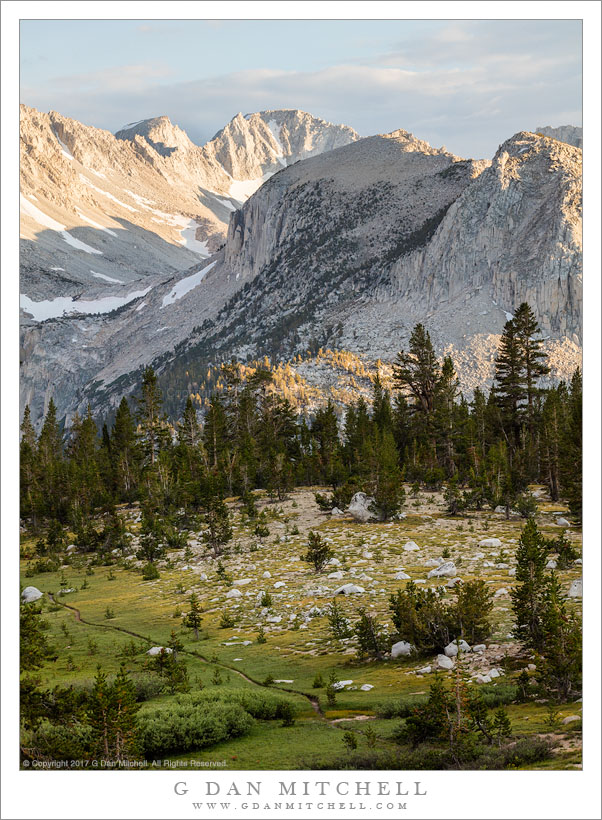
High Country Meadow and Trail

High Country Meadow and Trail
A use trail cuts across a subalpine meadow high in the John Muir Wilderness

High Country Meadow and Trail. John Muir Wilderness, California. August 28, 2017. © Copyright 2017 G Dan Mitchell – all rights reserved.

A use trail cuts across a subalpine meadow high in the John Muir Wilderness

Earlier this afternoon we left our camp down at a lower lake and headed off into higher country. I followed a use trail up to a moraine ridge, then passed over a section of beautiful meadow with stunning views of surrounding peaks and closer views of late-season wildflowers. From here I simply followed the watershed up the valley a ways until a decent stream crossing presented itself, and from there I wandered across glaciated slabs to the top of a low ridge separating our valley from another containing several lakes.

It was late in the day, so the time available for lingering on the ridge was limited. I soon spotted Patty traversing a lower section of the slabs and I headed down to join her. We continued down to the creek where we had a moment of good light on a small lake before the sun dropped behind a high ridge and left us in shadow. As we continued down the drainage toward that meadow where we started the views to the south opened up and the evening light was still on the ridges. We stopped before descending to the meadow, and from here a narrow trail was visible as it traversed one side of the meadow just below a rocky section filled with old glacial erratics, with a dramatic backdrop of high peaks on the far side of the valley.


G Dan Mitchell is a California photographer and visual opportunist. His book, “California’s Fall Color: A Photographer’s Guide to Autumn in the Sierra” is available from Heyday Books and Amazon.
Blog | About | Flickr | Twitter | FacebookGoogle+ | LinkedIn | Email


All media © Copyright G Dan Mitchell and others as indicated. Any use requires advance permission from G Dan Mitchell.
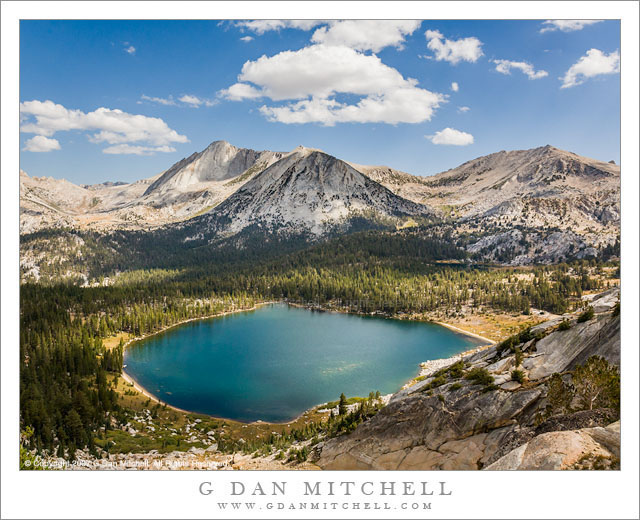
Young Lake, Mount Conness

Young Lake, Mount Conness
Cloud shadows race across the landscape on a summer day near the Sierra crest below Mount Conness

Young Lake, Mount Conness. Yosemite National Park. September 11, 2007. © Copyright 2015 G Dan Mitchell – all rights reserved.

Cloud shadows race across the landscape on a summer day near the Sierra crest below Mount Conness

This is an older photograph, made eight years ago back in 2007 on a late-season solo backpack trip into the Yosemite back-country. A week or so after the Labor Day holiday, the crowds almost disappear from the park’s high country, and everything seems to sort of slow down as the summer comes to and end and the inevitable signs of impending autumn remind us that summer is over and winter is not that far away. I think that this can be the most beautiful time of year in the Sierra, especially on a day with beautiful, warm autumn-like light, golden brown meadows, blue sky, comfortable temperatures, solitude, and perhaps a few passing clouds.

There is a story about how I found myself in this high spot overlooking this lake and the mountains beyond. That morning I had been poking around near by bivy sack camp when I saw someone napping in the lakeside meadow. It turned out to be a backcountry ranger. I made some wise-guy remark (intended entirely in jest, and he took it that way) about the challenges of the ranger’s life, and we got to talking. For him, this late season period was a time to slow down a bit and enjoy his own solitude. As we talked he pointed up towards a rocky saddle above the lake and pointed out what, in retrospect, should have been obvious to me — there was a well-used cross-country route through the saddle. So I decide to depart the lake via this alternative route, and when I reached the top of the climb and looked back I saw this spectacular Sierra panorama.


G Dan Mitchell is a California photographer and visual opportunist. His book, “California’s Fall Color: A Photographer’s Guide to Autumn in the Sierra” is available from Heyday Books and Amazon.
Blog | About | Flickr | Twitter | FacebookGoogle+ | 500px.com | LinkedIn | Email


All media © Copyright G Dan Mitchell and others as indicated. Any use requires advance permission from G Dan Mitchell.

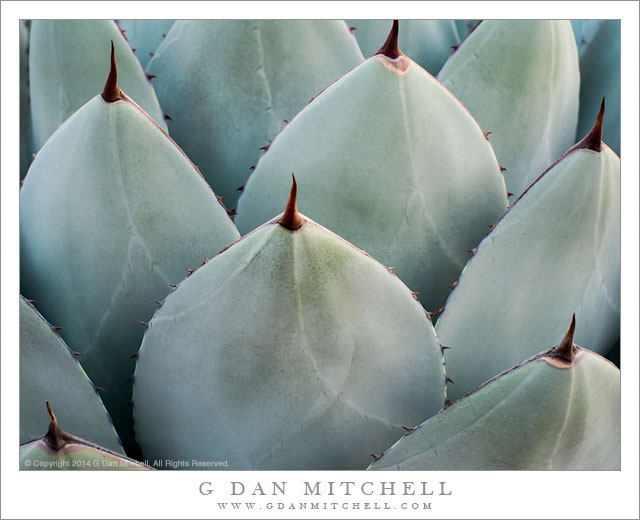
Agave Plants

Agave Plants
Agave Plants

Agave Plants. Huntington Botanical Gardens, San Marino, California. November 28, 2014. © Copyright 2014 G Dan Mitchell – all rights reserved.

Agave plants, the Huntington botanical gardens

We spent the Thanksgiving Holiday in Southern California — and once we finished the Big Eating Day Celebration, we did other things. Well, OK, we ate more, too. Among those other things was a trip to the Huntington Library, etc. in San Marino, a place that we had not been to before. (The “etc.” above acknowledges the ridiculously long name of the place, a name the mentions galleries, library, and gardens. I wonder if people in the area perhaps just call it “The Huntington?”)

There was lots to see there. We started by focusing on art, both old and new — including an exhibit of photographs — and then moved on to lunch, followed by visits to a bunch of gardens: Chinese, Japanese, tropical, and desert. I wasn’t there primary for photography, but since I had a camera with me I did make a few photographs, including this close up of the beautiful leaves of this plant, whose form is almost always intriguing.


G Dan Mitchell is a California photographer and visual opportunist whose subjects include the Pacific coast, redwood forests, central California oak/grasslands, the Sierra Nevada, California deserts, urban landscapes, night photography, and more.
Blog | About | Flickr | Twitter | FacebookGoogle+ | 500px.com | LinkedIn | Email

Text, photographs, and other media are © Copyright G Dan Mitchell (or others when indicated) and are not in the public domain and may not be used on websites, blogs, or in other media without advance permission from G Dan Mitchell.
About Tripods (Morning Musings 11/4/14)

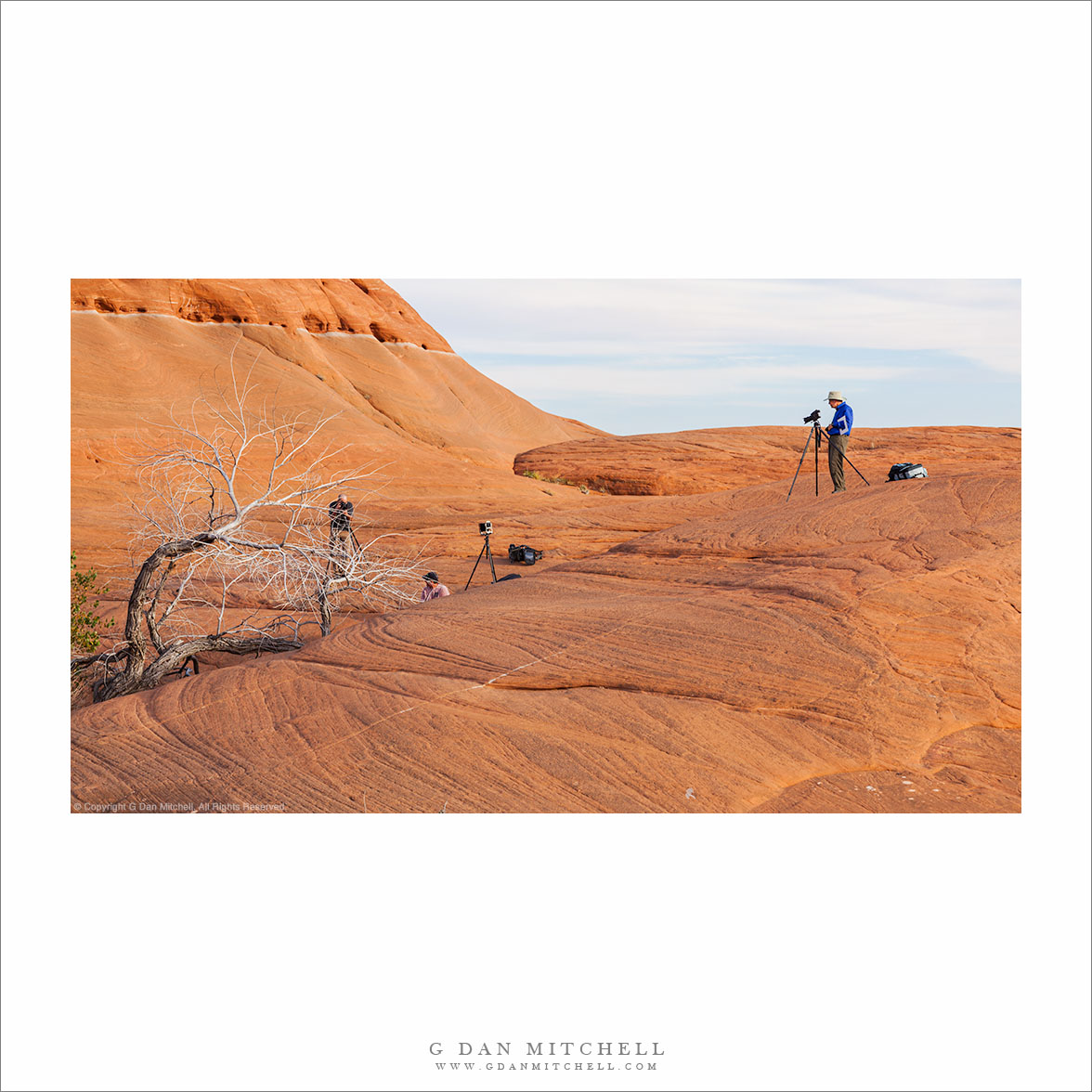
Working the Red Rock Landscape
“Working the Red Rock Landscape” — Photographers at work in Utah’s red rock country

Morning Musings are back! Today I have a few general thoughts about tripods — not aimed at those who are already confirmed tripod users, but rather at those who find it hard to bother using them.

To start, let’s admit that one does not always need a tripod. For certain types of photography in which quick response is required and being too obviously a photographer can interfere with photographs, it is usually better to not use one. There are exceptions to every rule, but you are unlikely to use a tripod for most street photography, for personal and family photography at home and on vacations, for certain kinds of portrait work, casual travel photography, and so on.

Let’s also agree that using a tripod is a burden, especially at first when you haven’t accepted the extra trouble and when you haven’t developed instincts that make tripod use a lot more automatic. I’ll readily admit to being less than thrilled on about the 50th time that I must remove my tripod from the car or pack, extend and lock the legs, level the thing, attach the camera, and only then make a photograph… after which I have to reverse the process: remove the camera, collapse the tripod legs, stow the thing once again. The slightly put-upon feeling diminishes as you get used to it, but it never goes away entirely. (The good news here is that the process of setting up and using the tripod does eventually become much quicker and much more automatic.)

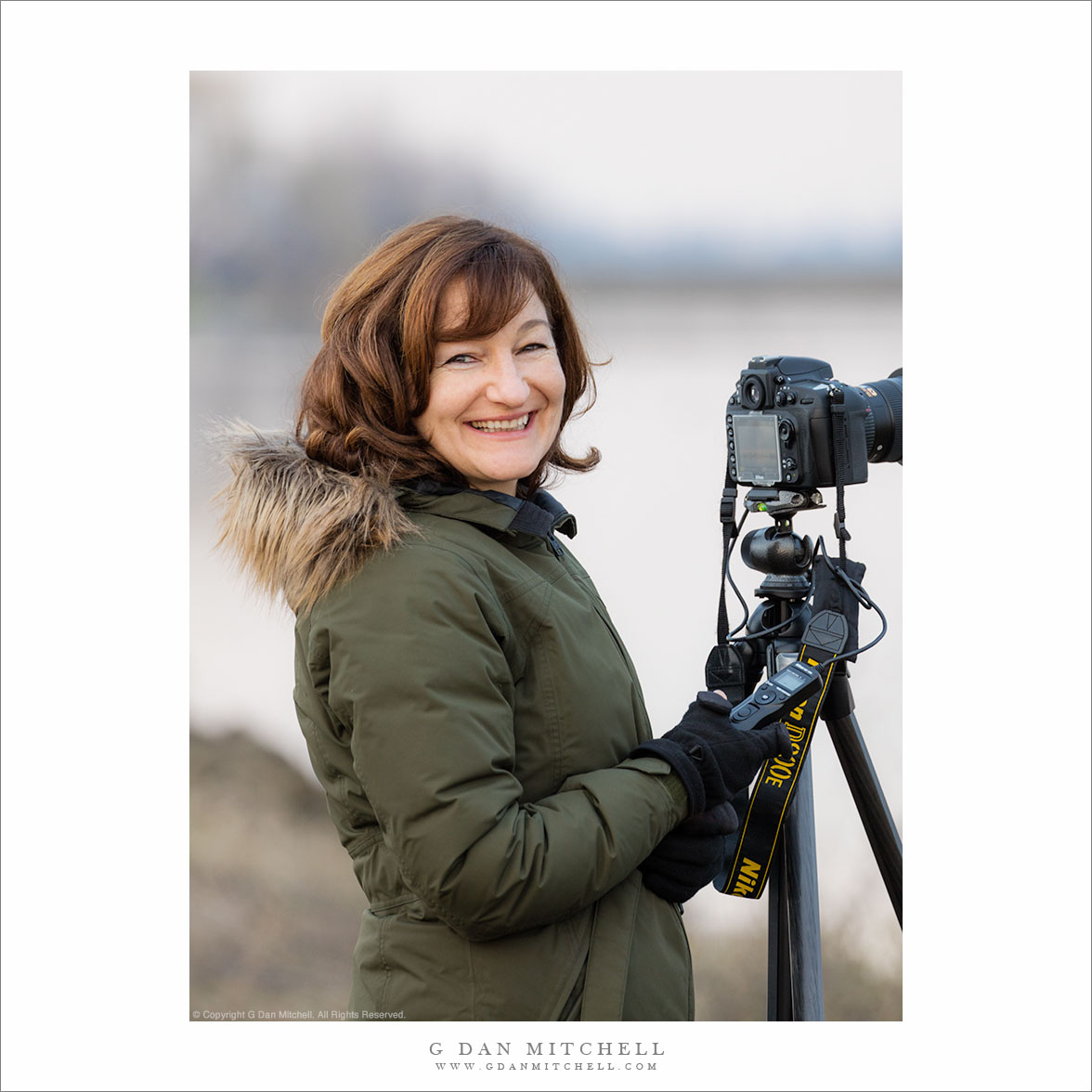
Photographer Franka M. Gabler
“Photographer Franka M. Gabler” — Franka M. Gabler in the field photographing in the San Joaquin Valley

So, why use it then? There are more reasons than you might imagine.

Stability is an obvious advantage of the tripod. While you can, with care and practice, often hold a camera quite steadily and produce very sharp images when shooting handheld, you simply cannot eliminate all of the blur that comes when you hold the camera in your hands. And if you do happen to have very steady hands, you still will make mistakes that produce blur — working a bit too fast you may introduce a bit of camera vibration in some shots and you will reduce the number of successful results. A good tripod used correctly can virtually eliminate camera motion and vibration. This is especially important when doing types of photography that intrinsically require longer shutter speeds. This obviously includes night photography. Low light, low ISO, long lenses, and small apertures often require landscape photographers to use rather long shutter speeds.

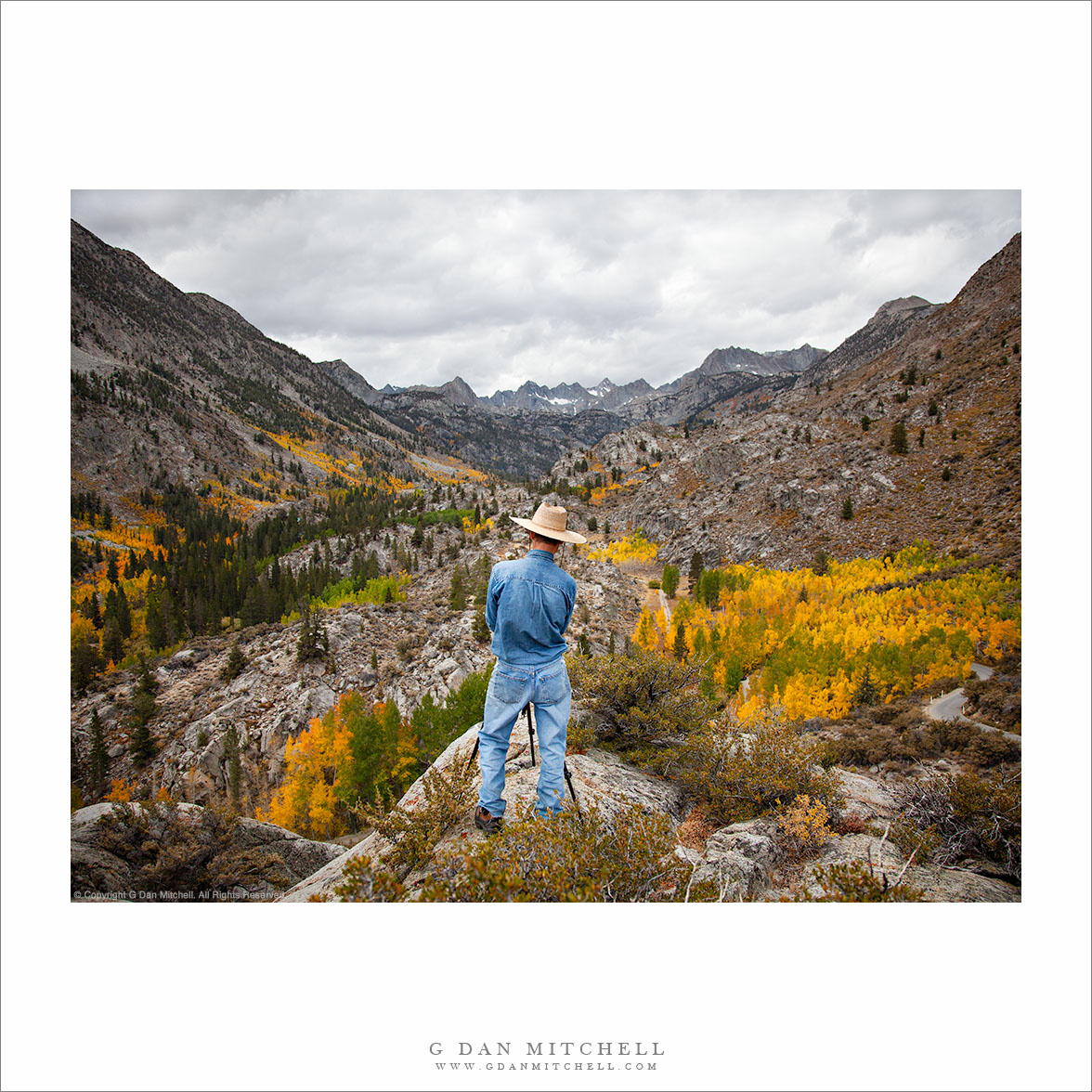
Photographer, Sabrina Basin
“Photographer, Sabrina Basin” — A photographer working the autumn colors from a ridgetop in Sabrina Basin, Sierra Nevada, as an early fall storm comes in.

High resolution cameras can capture images that may be reproduced at much larger sizes, and at those sizes the effects of minor camera stability issues become more visible. If you want to take advantage of such cameras’ potential for higher image resolution, the stability that comes with tripod use can be critical.

Continue reading About Tripods (Morning Musings 11/4/14)